
It Was Never About the Cat
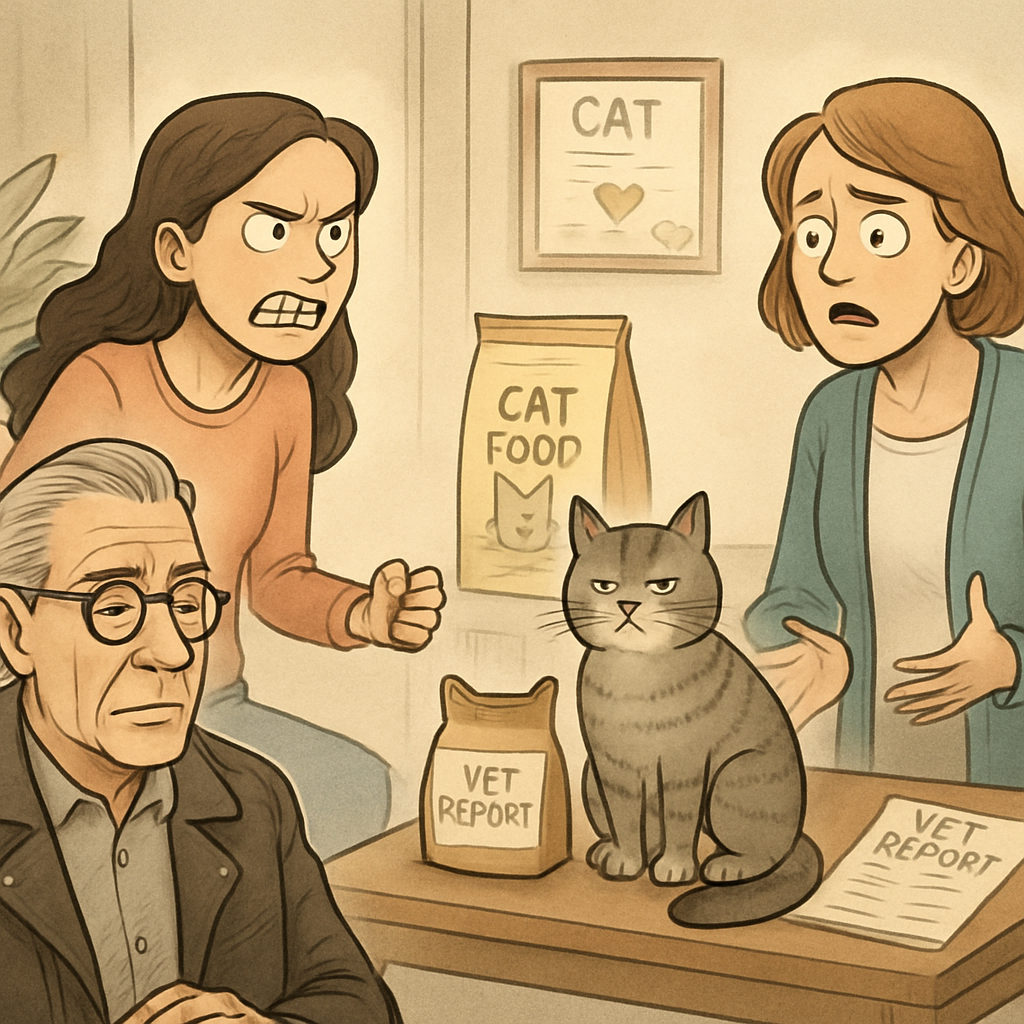
Brielle came in on a Tuesday, shoulders tight, jaw clenched like they were bracing for impact. The complaint? A family war over their cat’s diet. The vet said the cat needed to lose weight. Brielle was enforcing it. The family was losing their minds.
I’ve heard a thousand variations of this story. Not always about cats. Sometimes it’s money. Sometimes it’s how the kids are raised. Sometimes it’s whose turn it is to take out the trash. But the pattern is always the same: one person trying to implement a decision, getting resisted by everyone else, and feeling like they’re the villain.
What I learned that day—what I’ve watched happen hundreds of times since—is that these conflicts almost never land where they start. The cat isn’t the problem. The cat is just the territory where multiple internal systems are struggling to maintain coherence.
The Invisible Framework Behind What’s Actually Happening
Her family wasn’t fighting about the cat. They were fighting because multiple internal organizing systems (different characters within each person’s emotional container) were all activated at once, each trying to protect something essential.
When Brielle started limiting the cat’s food, something shifted in the household’s relational container (the shared organizational system that holds all of you together). The mother’s internal system registered a threat. Not because the cat actually was suffering, but because a particular character within her—let’s call it The Caretaker—experienced what felt like a violation of its core organizing principle: I matter through nurturing others.
What’s actually happening here is an Emotional Byte collision where multiple stored emotional patterns suddenly activate at once. An Emotional Byte is a unit of emotional information your nervous system holds: it contains physical sensations, emotional charge, need states, and the mini-stories the brain constructs to make sense of those sensations. When the mother watched Brielle restrict the cat’s food, it didn’t just activate a thought. It activated an entire cluster of emotional bytes tied to autonomy, nurturing, and mattering in the family system.
Here’s the uncomfortable truth: people don’t project emotional significance onto animals because they’re irrational. They do it because the animal becomes a canvas for their internal cast of characters. The animal can’t talk back. It can’t disagree. It can’t challenge the narrative. So when your family members insist the cat is “depressed” or “suffering,” they’re not necessarily fabricating. They’re operating from an Emotional Frame (an invisible interpretive lens shaped by their own history in this household and the gravitational fields of early relationships) that actively searches for evidence confirming that narrative. That frame tells them something like: “When someone takes control away from me, it means I don’t matter. When I don’t matter, I must be failing at my core purpose.” So they perceive the cat’s distress everywhere, because their pattern-recognition system is primed to find it. The brain is doing what brains do: creating a coherent story from available data.
The real issue? the family container was not safe enough container to articulate what their different internal characters actually needed. So they fought about the cat instead.
The Myth That’s Killing Your Peace: “If I Just Explain It Better, They’ll Understand”
This is the lie that keeps people stuck. Brielle thought if they could just articulate the vet’s advice clearly enough, everyone would get it. More words. Better logic. Stronger arguments.
Doesn’t work that way.
When someone’s internal system is already locked into a particular organizing pattern—when a particular character has already decided you’re wrong or harsh or making a mistake—more information doesn’t penetrate. It bounces off. What you’re actually dealing with is what I call an Emotional Script, an automatic survival strategy that a character in their container has learned works to maintain coherence and protect something essential. The Family Container Script might sound like: “When someone threatens my autonomy, I fight back harder to prove I still matter.” Once that character’s script activates, logic becomes irrelevant because the nervous system has already committed to a particular protective response.
You’re not dealing with a logic problem. You’re dealing with a protection problem. And you can’t argue someone out of a position their internal system didn’t reason itself into—their internal protector defended itself into it.
The relational research is clear on this: most of these conflicts don’t fail because of poor explanation. They fail because different characters within different people never learned how to actively listen to each other’s underlying need structures. Not hear. Not tolerate. Actively Listen: in the context of emotions this means trying to understand what underlying purpose or need each character is trying to protect. It’s not what they’re saying, it’s the meaning behind what they are saying and it’s not just waiting for your turn to talk so you can get your point across.
Your family isn’t stupid. Their internal systems are scared. And scared characters dig in. Scared characters don’t care about logic. They care about safety, about relevance, about threat reduction.
The Real Problem: Boundaries Without Negotiation
Here’s what nobody talks about in families like this: when you try to enforce a decision (even a good one, even a necessary one), but you do it where there has been no explicit negotiation about how decisions get made in your shared relational container, there is ambiguity about the container’s actual rules. And ambiguity gets filled with fear and resentment.
Brielle had clarity. The vet had given clear guidance. But Brielle hadn’t actually negotiated with the family about who gets to make decisions regarding the cat. So from the family’s perspective, Brielle just… reorganized the container unilaterally. And now mom can’t enact her internal Caregiver character, and dad can’t access his Organiser, and nobody feels like they have voice in something they all participate in.
What Brielle inadvertently activated was a needs hierarchy violation at the relational container level. In the family’s organizational system, certain relational needs are fundamental to how the container holds together: the need for autonomy (your voice matters in decisions that affect you), responsiveness (someone’s actually considering your perspective), and consistency (the rules of how we operate together don’t just change without us). When Brielle bypassed these needs entirely, the family didn’t experience good coherent decision-making, they experienced unilateral reorganization of their shared system.
This is where it gets real: Boundaries without communication aren’t boundaries. They’re just you reorganizing a shared container according to your internal requirements and calling it being responsible.
The Tactical Principle You Need is this: You don’t get to make decisions about shared resources in a shared container without establishing explicit agreement about how decisions will be made. Not after the fact. Not through argument. Before. This requires a deliberate conversation designed to write new Emotional Bytes into the family system’s organizational memory. Instead of the usual pattern (you decide, you enforce, they resist), you’re creating a different sequence: you propose, you listen to what each person’s internal characters are protecting, you negotiate the decision-making structure you’ll operate under, and then you move forward with authority because everyone has participated in defining it. This new sequence writes different emotional information into everyone’s nervous system about how your shared container actually works.
What the Experts Don’t Say (But Should)
The research on household conflict resolution talks a lot about “active listening” and “safe communication protocols.” That’s true. But here’s what it doesn’t acknowledge loudly enough: most families aren’t actually trying to resolve conflicts. They’re trying to ensure their internal characters get to maintain dominance in the relational container.
There’s a difference.
Brielle’s family didn’t need better communication to solve this problem. They needed to become the kind of relational system where different people’s internal characters could coexist without one party’s character needing to defeat another’s. That’s a deeper shift. That requires developing meta-container awareness. This is the ability to understand the organizational systems creating the emotions, not just the emotions themselves.
When you start examining why your mother’s internal Caregiver is so emotionally invested in the cat eating extra food, you’re not talking about the cat anymore. You’re examining what her Caregiver character is protecting. Maybe in the gravitational field of her own early relationships, feeding someone was the primary way her internal nurturing character got to matter, got to be needed, got to prove its value. So when food is restricted, it doesn’t register as medical care to her internal system. It registers as prohibition of her essential organizing principle: I matter through giving. That framework is invisible to her—it just feels like “the cat is suffering”—but it’s been coded into her relational patterns since childhood. The vocabulary available to her emotional system doesn’t include “I’m anxious about my role changing in this household.” So it appears as “they’re making the cat sad.”
And when you start examining why Brielle’s internal Protector needed to enforce the vet’s advice without negotiation first, you’re looking at Brielle’s own emotional bytes around mattering, competence, and being heard. Maybe Brielle has a history of articulating needs in this family’s container only to have them overridden or dismissed. So when the vet gave guidance, Brielle’s internal Protector didn’t frame it as “let’s figure this out together.” It framed it as “finally, something where I get to be the one who decides.” That’s not malice. That’s a reaction to the nervous system’s memory of having its voice eclipsed.
Both Brielle and the mother are operating from legitimate operating strategies worked out by their internal characters. The cat’s never been the issue.
The Guilt-Defensiveness Trap
Brielle’s carrying internal conflict because one internal character (The People-Pleaser, perhaps, or The Accommodator) is saying maybe you’re being too rigid, maybe you should soften up for the sake of keeping the peace. Simultaneously, Brielle’s Protector is being activated because Brielle is being criticized for enforcing what she thinks is right.
This is the position that paralyzes people. You’re caught between competing internal characters—one saying “sacrifice for the relationship,” another saying “stand firm on what’s right”—and neither position gives you stable ground to stand on because you haven’t made space for both.
Here’s what’s actually happening: Brielle’s guilt is trying to solve a relational problem by suggesting that maybe you should sacrifice the cat’s health to restore the container’s equilibrium. But guilt is information wrapped in an emotional charge, not a verdict. When you learn to practice Emotional Granularity (making finer distinctions between what you’re actually feeling and which internal character is generating it), you realize that guilt doesn’t mean “you’re wrong.” It’s saying “you’re navigating competing needs and it feels destabilizing.” That’s data, not damnation.
The defensiveness? That’s real too. You are being criticized. Your family’s internal characters are treating your decision like it’s cruel when it’s actually medically sound. And that stings because part of your internal system is questioning itself—your internal Critic is activated—which means you’re not operating from complete internal alignment.
The truth is that you can’t solve a family system problem by winning an argument. But you also can’t solve it by abandoning the decision. What you need is clarity about what you’re responsible for—and what you’re not. You’re responsible for the cat’s medical care. You’re not responsible for managing whether everyone’s internal characters feel okay about the change. What you can do is invite them into how the change happens.
The Uncomfortable Thing Nobody Wants to Face
Sometimes, the people we love most are the exact people whose internal characters make it hardest to do what we feel is necessary.
Because they know how to activate your internal characters. They know what guilt lands hardest on your internal critic. They know what words make your Critic flare up and question yourself. Not because they’re malicious—usually. But because they’re fighting for their own internal characters’ safety in a situation where those characters feel like they’ve lost something.
The part Brielle wasn’t fully examining? The relief—and even satisfaction—that came with finally orchestrating agreement about something no-one had ever talked about, but a structure that had just come about through the natural ebb and flow of Emotional Bytes, Frames and Scripts. The conflict was what happened when an internal character finally gets to exercise its essential function in a space where it might have been chronically repressed.
But it also meant Brielle’s wasn’t entirely blameless in the conflict escalation. And facing it not as moral failing but as information about your own internal organizing patterns—that’s where real understanding starts. This is what I call Positive Disintegration: the psychological tension of recognizing that you’re both right and are both part of the relational problem. That tension is uncomfortable, but it’s also where growth lives. The moment you can hold “I made a sound decision” and “I also could have honored the relational container’s needs differently”—that’s when you’re no longer trapped in a binary I’m right, They’re wrong situation.
What Success Actually Looks Like (Spoiler: It’s Not Everyone’s Internal Characters Being Happy)
Here’s what I’ve seen work in actual households: the person making the decision gets clear about what’s non-negotiable (the cat’s health) and what’s flexible (how the decision gets communicated, how input gets invited, how the family’s internal characters get honored). They establish explicitly what their role is (“I’m responsible for the cat’s medical needs”). They invite input on how it happens (“What would make this feel less like I’m controlling everything?”). And they accept that some family members’ internal characters will still resist—and that’s okay. That’s not failure. That’s just the reality of change in a relational system.
What they don’t do is pretend everyone’s internal characters will be delighted about it.
That might look like: “Mom, I know how much it means to your Caregiver to show love. What if we created specific times where you give treats? You still get to nurture. The parameters just changed. And you still have a voice in how we do this.”
That’s not compromise, that’s honoring the underlying need structure—the purpose each internal character is trying to serve—while maintaining boundaries.
Success in a shared relational container isn’t harmony. It’s clarity. It’s knowing who’s responsible for what, why those responsibilities exist, and being able to hold your role without needing everyone else’s internal characters to validate it. It’s recognizing that the cat was never the real conversation—it was always about honouring emotional needs in this system, whether there’s enough safety to articulate that directly, and whether the container’s rules allow for participation or just compliance.
—Jas Mendola: knowing that the battles that wreck families aren’t ever really about the thing you’re fighting about, and the moment you understand what each person’s internal characters are actually defending—what need, what purpose, what essential function is at stake—you stop taking it personally and start understanding the system.
- How People Manage Relationship Problems: An Exploratory Study …
- Managing Emotions in Relationships: Setting Healthy Boundaries
- Navigating Conflict in Relationships: Evidence-Based Strategies …
- Co-Regulating for Couples: Techniques for Stress Relief
- Solving Constant Conflicts in Relationships | Psychology Today
- How to Improve Your Relationships With Emotional Regulation …
- [PDF] Psychological distress, attachment, and conflict resolution in …
- What To Do When Emotion Dysregulation Affects Your Relationship
- Research shows conflict resolution is tied to long-term health
- Insecure Attachment & Emotional Dysregulation in Relationships
- Managing conflict, the healthy way
- The Co-Regulation Effect – Relationship Restoration
- Future Directions in the Study of Close Relationships: Conflict is Bad …
- How Emotion Regulation Can Transform Your Conflict Cycle
- “Psychology Works” Fact Sheet: Relationship Distress