
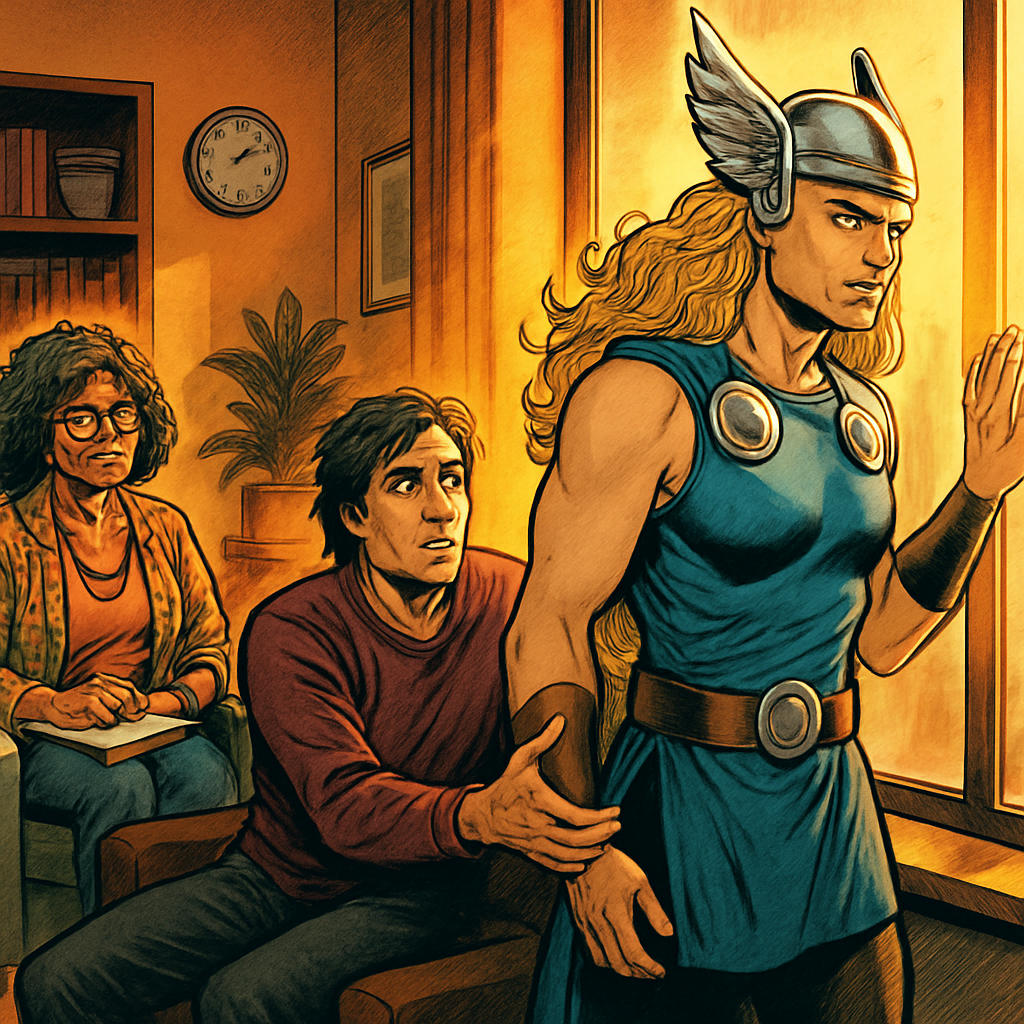
The Dance of Distance and Desire 💔
I met Brynhild on a Tuesday afternoon in a Manchester café—not my office, but somewhere they felt safer. They ordered a flat white and immediately began explaining their relationship with the precision of someone defusing a bomb. Their partner was anxious, they explained. Always seeking reassurance. Meanwhile, Brynhild had learned early on that the world was safer at a distance, that closeness meant losing yourself.
The question they carried was deceptively simple: How do I be more intimate without drowning? How do I set boundaries without building walls? It was framed as a technical problem. But it wasn’t. It was the oldest dance there is.
The Invisible Architecture Nobody Mentions 🏗️
What struck me most wasn’t the attachment labels—though they’re useful shorthand—but that Brynhild was carrying two completely different emotional operating systems about intimacy, and neither one fit together.
One said: closeness means you disappear.
Another said: I should be able to give more.
These beliefs came with physical sensations—tightness in the chest, a pull backward, a sense of suffocation. And they triggered automatic scripts: withdraw, create space, retreat into independence. But underneath was genuine confusion: Could they ever be the partner their anxious partner needed without sacrificing themselves entirely?
Here’s what people don’t realize about avoidant attachment: it’s not coldness. It’s protection.
Somewhere in Brynhild’s history, there had been too much need from too many people—or need that felt suffocating. The emotional frame they’d built was sophisticated and functional: independence equals safety, closeness equals danger. When their anxious partner reached out for reassurance, Brynhild’s nervous system didn’t read it as “I need you.” It read it as “you’re being consumed,” and the body responded with withdrawal and distance.
Their partner’s anxious attachment operated from the opposite frame entirely: closeness equals safety, distance equals abandonment. Same emotional stakes, opposite solution. So when Brynhild pulled back, their partner pursued—not to suffocate, but to survive. Each confirmed the other’s deepest fear. This wasn’t a character flaw in either of them. It was two different emotional systems running invisible scripts, each one perfectly logical from inside its own frame.
The damage they’d accumulated made perfect sense once you saw the underlying structure. Brynhild had withheld emotional availability not out of cruelty but out of genuine terror of being engulfed. Their partner had pursued reassurance not out of neediness but out of genuine terror of being abandoned. Both were trying to survive. Neither was trying to hurt the other. But hurt had accumulated anyway, like sediment.
When “Communicating Better” Isn’t Actually the Problem 🗣️
One of the first things Brynhild asked was how to communicate boundaries more effectively. Everyone asks this. And I understand why—communication feels like something you can control, something you can get right.
But the real issue wasn’t communication skills.
The real issue was that Brynhild’s beliefs about boundaries were tangled with guilt. Setting a boundary felt like rejection. Expressing a need felt like selfishness. The inner voice had organized meaning around these experiences in ways that made honest expression feel dangerous.
From what I’ve seen, when people struggle with boundaries, they’re usually not struggling with technique. They’re struggling with what the boundary means about them. For Brynhild, it meant: I’m not a good partner. I’m cold. I’m withholding. These narratives shaped every interaction.
We worked with the granular texture of what Brynhild actually experienced in moments of intimacy. Not the overwhelming blur of “too much closeness,” but the specific, manageable observations:
When they reach for my hand during conflict, I notice my chest tightens. My breathing changes. There’s a sensation like I’m being pulled under water.
Breaking the experience into these finer distinctions changed everything. It wasn’t “I don’t want intimacy.” It was “my nervous system is in protest mode right now, and here’s what that feels like.” That’s vastly different information to work with.
The Question Nobody Asks: Whose Job Is This? 👥
Brynhild kept asking who was responsible for growth in the relationship. Both of us, I said—but not equally at every moment, and not in the same way.
We’re told partners should be 50/50 contributors, equal in every way. But that’s not how human nervous systems work. At different moments, one partner has more capacity. Sometimes Brynhild had capacity to stretch toward vulnerability; sometimes their nervous system was too activated and they genuinely couldn’t. Their partner sometimes had capacity to self-soothe; sometimes anxiety overwhelmed that capacity.
The trick wasn’t finding some perfect balance. It was developing what I call relational flexibility—the ability to notice who has what capacity in this moment, and to work with that reality rather than against it.
I watched Brynhild’s shoulders relax when they understood this. They’d been carrying the belief that good partners didn’t have limits, that avoidance was a character flaw to overcome rather than a nervous system response to manage. The relief of permission—permission to have limits, permission to be human—was visible on their face.
Here’s what I’ve noticed: people don’t resist growth. They resist shame. Once Brynhild could distinguish between “I need space” (legitimate nervous system need) and “I’m a bad partner” (toxic narrative), they could actually move. Not perfectly. Not constantly. But genuinely.
The Work of Staying, When Leaving Feels Safer 🏡
Here’s the thing about avoidant attachment: it’s a successful strategy for not getting hurt. Brynhild had been using it for decades. It worked. It kept them safe, independent, in control. But it also kept them alone, even in partnership. And somewhere underneath the protection was the question: is this what I actually want?
Commitment, for someone with avoidant patterns, isn’t about grand romantic declarations. It’s about choosing to stay in the discomfort of closeness rather than reaching for the familiar escape route. It’s about tolerating the anxiety that comes with vulnerability. It’s about building new emotional associations—between closeness and safety rather than closeness and suffocation.
This requires intentional experiences. Brynhild couldn’t think their way into a more secure attachment style; they had to feel their way there through repeated moments of being close without being consumed. Small moments where their partner’s need for connection didn’t actually destroy them. Moments where expressing their own needs didn’t result in abandonment. Each moment created new data, updated the old predictive model, created finer distinctions in the emotional landscape.
But—and this matters—their partner had to show up differently too. An anxious partner’s job wasn’t to stop being anxious; that’s not how nervous systems work. Their job was to begin managing their own anxiety rather than outsourcing it to Brynhild. To develop what we might call an internal holding capacity—the ability to sit with discomfort without immediately needing external reassurance. That’s harder work than it sounds.
What Actually Changes Things ✨
The couples who make it aren’t necessarily the ones with the most compatible attachment styles. I’ve seen secure-secure pairings fall apart because people became complacent. I’ve seen anxious-avoidant pairings transform into something genuinely intimate because both people chose the discomfort of growth over the comfort of their familiar patterns.
The difference wasn’t compatibility. It was willingness. Willingness to see your partner’s protective strategies not as rejection but as survival mechanisms. Willingness to update your understanding of who they are beneath the script.
Brynhild and their partner didn’t solve this problem. That’s not how relationship work actually goes. Problems don’t get solved; they get integrated. You learn to live with the tension between needing closeness and needing space. You learn to read your partner’s pursuit not as suffocation but as an expression of fear. You learn that your withdrawal isn’t actually protecting them—it’s confirming their worst nightmare. And you choose, repeatedly, to stay present anyway.
The real work wasn’t teaching communication techniques or explaining attachment theory. It was helping Brynhild see that their avoidance wasn’t a character flaw—it was a strategy that had made sense. And now, they got to choose a different strategy. Not perfect. Not constant. Just conscious.
The Truth We Don’t Talk About Enough 💫
We don’t need our partners to be different. We need them to understand why we do what we do, and then love us anyway. And then we need to do the same for them.
That’s not codependency. That’s marriage.
- Avoidant Attachment, Withdrawal-Aggression Conflict …
- Anxious-Avoidant Cycle: How to Fix It
- The Attachment Dynamic: Dyadic Patterns of Anxiety and …
- Anxious or Avoidant? What Attachment Styles Mean …
- Exploring the Association between Attachment Style …
- Understanding Avoidant Attachment Style
- Why Anxious and Avoidant Attachment Attract Each Other