
The Mystery That Became a Prison 🔍
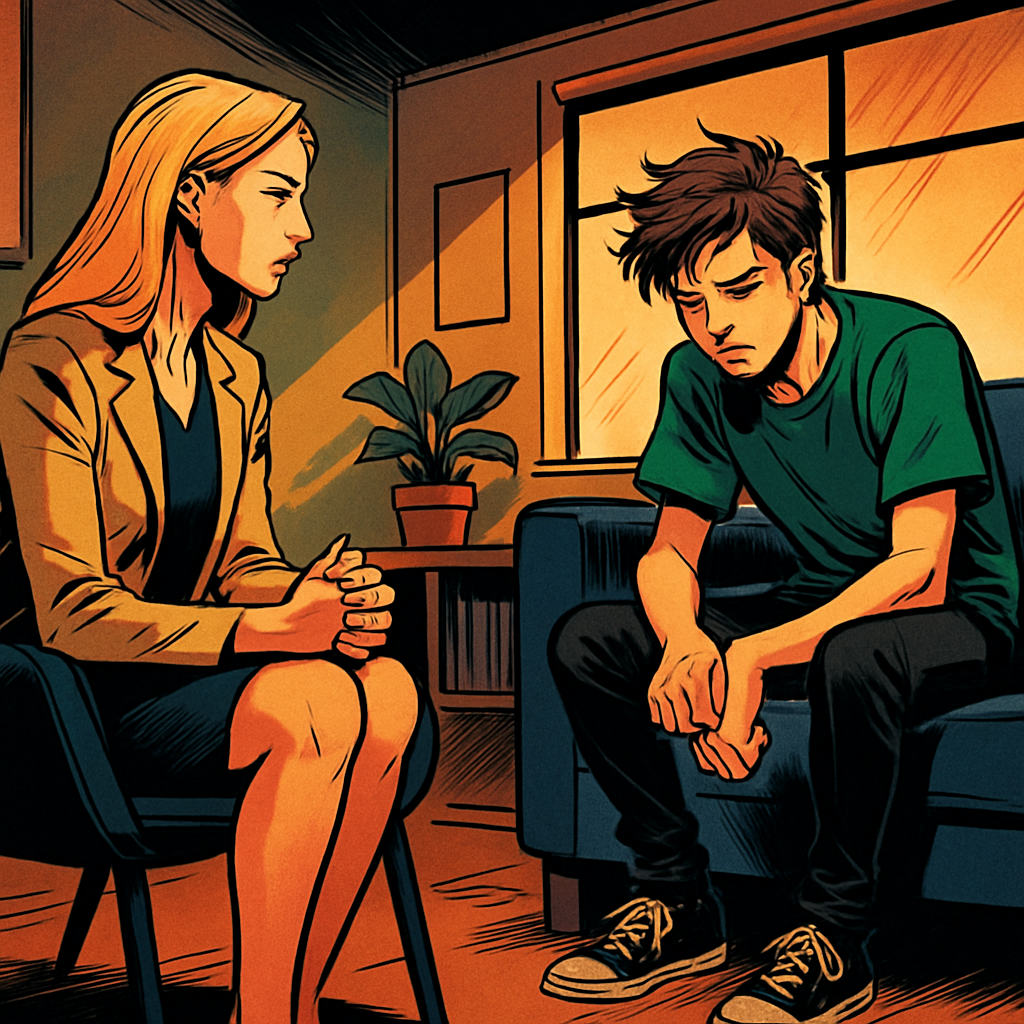
It was a Tuesday afternoon in late October when Sage sat across from me in my Chelsea office, their coffee gone cold, their leg bouncing with restless energy. They’d come because of the objects—a keychain here, a Post-it note there—each appearing on their doorstep like cryptic messages from an unseen correspondent. Not threatening, exactly. But deliberate. The uncertainty itself had become the real intruder, camping out in their apartment like an unwanted guest.
What struck me wasn’t the mystery of the objects, but how quickly Sage’s mind had transformed a strange incident into a narrative of violation. One unexplained gift becomes a pattern. A pattern becomes evidence. Evidence becomes threat. Suddenly, someone perfectly capable of navigating their profession found themselves unable to leave their apartment without scanning hallways for cameras, checking locks three times before bed, refreshing their Ring doorbell footage like an addiction.
This is what I’ve come to understand about successful, isolated people: we’re desperately efficient at building narratives around ambiguity. We’re trained to solve problems, see patterns, anticipate what’s next. We’re excellent at threat detection. And when our environment refuses to make sense, our minds don’t shrug and move on. They work overtime. They create meaning where none exists, because a story—no matter how terrifying—is still less destabilizing than genuine uncertainty.
The Comfort of Catastrophe 😰
Here’s what nobody tells you about anxiety: it can feel almost intimate. When you’re hypervigilant, scanning for threats, creating elaborate worst-case scenarios—at least you’re not lost anymore. At least you have a problem to solve. For people like Sage, who’d spent decades solving problems, this was almost seductive.
But something deeper was happening. When our emotional systems perceive a boundary violation—someone entering our private space, even symbolically—we’re experiencing a disruption in what I call our emotional frame: the invisible lens through which we interpret the world. That frame contains our sense of safety, our assessment of trust, our beliefs about what we deserve.
When something cracks that frame, it creates what I think of as an emotional byte—a unit of stored information combining physical sensation, emotional charge, and the mini-stories our minds spin around it.
Sage’s body was sending clear signals: Pay attention. Stay vigilant. Trust no one. And Sage’s efficient mind decided to prove the body right by finding evidence everywhere—in the silence that followed, in neighbors who seemed too quiet, in friends who didn’t respond fast enough to texts.
The hypervigilance created its own data. It generated the confirmation it was looking for.
When Your Nervous System Becomes Your Saboteur ⚡
By our second session, Sage had begun recognizing the pattern: staying up late doom-scrolling through security forums, researching stalking psychology, constructing elaborate theories about who might be leaving objects and why. Each theory felt true in the moment, felt like progress toward understanding, felt like regaining control.
What they didn’t recognize was that they were locked in an emotional script—an automatic behavioral response that had started as protection but had become performance. Their nervous system had decided the world was unsafe, and now it was auditioning evidence for that conclusion.
I asked Sage something deceptively simple: “What if the worst thing about this situation isn’t what’s happening, but what you’ve decided it means about you?”
The silence that followed was the good kind—the kind where something shifts.
Because here’s the brutal truth we rarely admit: boundary violations don’t just threaten our safety. They threaten our identity. They suggest we’re not as in control as we thought, that our carefully maintained life can be disrupted by something outside our purview, that we’re permeable and vulnerable. For someone who’s built their entire sense of self around competence and control, that’s almost worse than the original violation.
The Architecture of “What If” 🏗️
One of the most disorienting aspects of Sage’s experience was the impossibility of resolution. Unlike a typical crisis—a breakup you can mourn, a job loss you can recover from—the mystery offered no clear endpoint. Just an open loop in an otherwise tightly managed life.
This is where rumination becomes a kind of dark comfort. If you’re constantly analyzing, constantly churning through possibilities, you’re at least doing something. You’re not passive. You’re not helpless. You’re engaged in the elaborate architecture of “what if,” building towers of possibility so you won’t have to acknowledge the terrifying truth: some things are unknowable.
What I worked with Sage to understand was that their need for certainty—a legitimate psychological need—had shifted into something else: a compulsion actually eroding their sense of control. They’d traded one kind of powerlessness for another.
The emotional clarity work began here. We didn’t try to eliminate the anxiety or “fix” the hypervigilance. Instead, we made finer distinctions:
- The racing thoughts from the physical sensations
- The catastrophic stories from the actual evidence
- The fear of what might happen from the reality of what had happened
Fear and actual danger are not the same thing, but our nervous systems often merge them into one urgent signal. When you can feel the difference, you can start making different choices.
Building a Life That Doesn’t Require Proof ✨
By our sixth session, Sage had stopped checking the doorbell footage obsessively. Not because the uncertainty had resolved—it hadn’t—but because they’d begun to build a functional relationship with it. They still didn’t know who’d left the objects or why. But they’d stopped needing that answer to define their safety.
This is the subtle alchemy that happens when someone moves from threat detection to threat assessment. When you can say: “This is strange, and I don’t understand it, and I’m uncomfortable, and I’m going to be okay anyway.”
We also did quiet work around what Sage called “reasonable caution”—establishing boundaries that honored their legitimate need for security without feeding the rumination machine. Basic things: better locks, actual conversation with neighbors, telling a trusted friend what was happening. Not to solve the mystery, but to distribute the emotional weight and remember that isolation amplifies anxiety.
The most powerful shift came when Sage began noticing something about themselves. The hypervigilance had served a purpose once—it had kept them alive in an environment where safety required constant surveillance. Their nervous system wasn’t broken. It was running an old, outdated program.
This is where meta-emotional intelligence enters quietly. It’s not about managing emotions better or thinking positively. It’s about understanding the systems that create your emotions in the first place. Your anxiety isn’t a flaw. It’s information. It’s your nervous system trying to protect you based on everything it’s learned about the world. Once you see that, you can start to have a conversation with it instead of just running from it.
Sage’s emotional frame didn’t change overnight. But it became more flexible, less reactive, more curious about alternative explanations. Less convinced that ambiguity automatically means danger.
Some mysteries are just mysteries. And maybe that’s okay.
Signs You Might Be Caught in This Pattern 🚩
- You constantly search for evidence confirming your worst fears while dismissing contrary evidence
- Your mind generates elaborate narratives to explain ambiguous situations, and these feel increasingly true the more you rehearse them
- You engage in compulsive behaviors (checking, researching, analyzing) providing temporary relief followed by increased anxiety
- You’ve begun isolating from people who might offer alternative perspectives, because their skepticism feels threatening
- You can’t distinguish between what you know happened and what you’re afraid might happen
- You feel simultaneously helpless and hyperresponsible—as if you should control an uncontrollable situation
- You’ve stopped making decisions based on what you want, and started making them based on threat avoidance
The Path Forward 🌱
If any of these resonate, the work isn’t about eliminating anxiety. It’s about understanding what your nervous system is trying to protect, and whether that protection is still serving you. It’s about building a relationship with uncertainty that doesn’t require you to become someone constantly braced for impact.
It’s about remembering that you can be cautious and calm. That you can take reasonable precautions without surrendering to hypervigilance. That some things—many things—will remain unknowable.
And perhaps the real freedom isn’t in solving all the mysteries. It’s in learning to live alongside them.
— Lola Adams
- [PDF] Stalking Victims
- The Impact of Stalking and Its Predictors: Characterizing the Needs …
- [PDF] Stalkers : what are they thinking? – ThinkIR
- [PDF] Children and Stalking – Civic Research Institute
- [PDF] Stalking of the Mental Health Professional: Reducing Risk and …
- What Is the Psychological Toll of Stalking?
- Stalking. What is the psychology behind the stalker?