
The Consent Conundrum 🤔
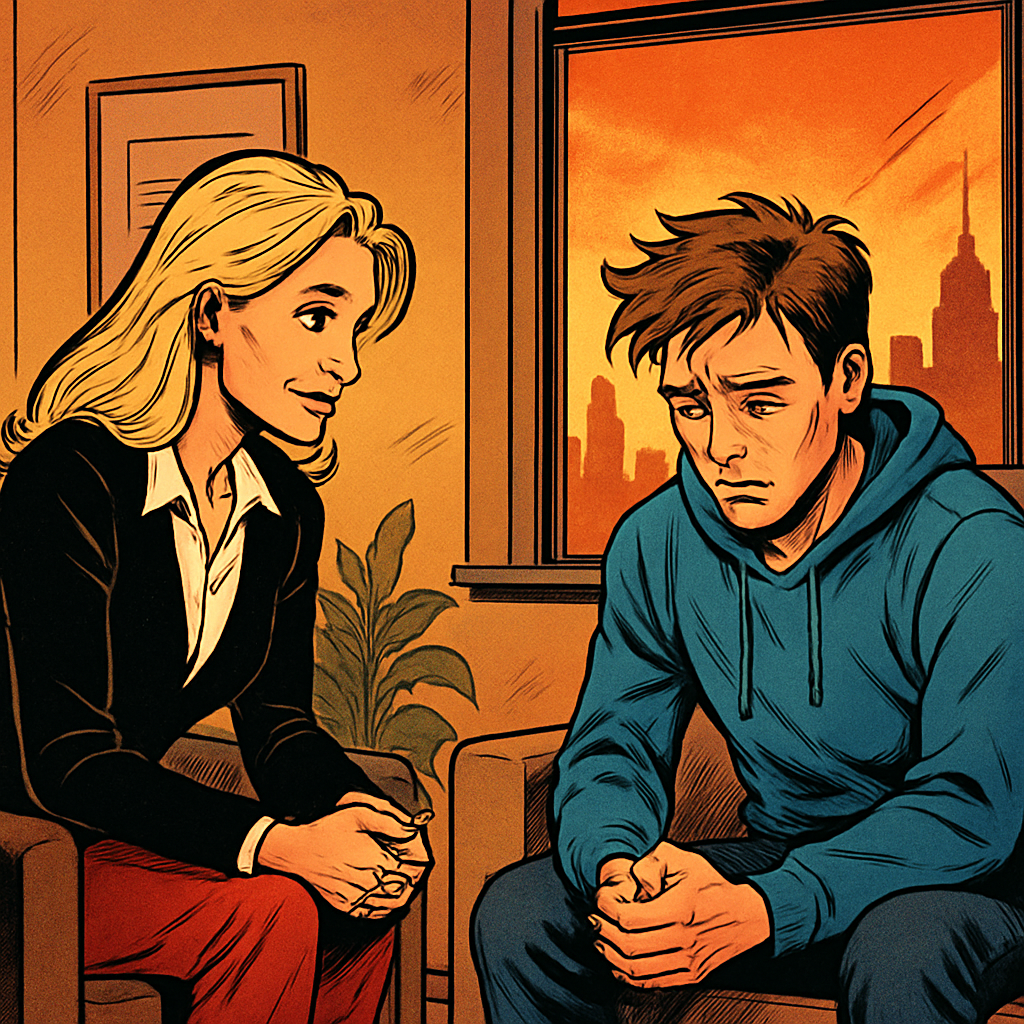
I first spotted Kayden in the back corner of my favorite West Village coffee shop. Not unusual – I’ve built half my practice through chance encounters at Brookside Roasters. There’s something about that specific blend of caffeine and anonymity that makes perfect strangers divulge their deepest secrets to a woman clutching a dog-eared psychology journal. But this kid – because at 42, everyone under 25 is officially a “kid” to me – looked like he was carrying the weight of the entire Manhattan skyline on his narrow shoulders.
Sixteen is that peculiar age where you’re simultaneously convinced you know everything and terrified you know nothing. Kayden was firmly in the latter camp when he slid into the chair across from me after I casually mentioned my profession. “I think I really messed up,” he said, voice barely audible over the espresso machine’s hiss.
In my office the following day, the full story emerged between nervous glances at the floor. Kayden and his girlfriend had sex for the first time – unprotected – and now he was spiraling. He wasn’t sleeping. Couldn’t focus. Every phone notification triggered a mini panic attack thinking it might be her telling him she’s pregnant.
But beneath that immediate fear lay something more complex – a muddy cocktail of guilt, confusion, and self-doubt about the encounter itself.
“I’m not sure if she really wanted to,” he confessed, picking at a loose thread on his jeans. “I mean, she didn’t say no, but she didn’t exactly say yes either. And I didn’t exactly ask. Things just… happened.”
There it was. The adolescent decision-making system in all its glory – a perfect storm of hormones, underdeveloped impulse control, and zero understanding of what actual consent looks like. 🌪️
The Emotional Aftermath 💔
What Kayden was experiencing wasn’t just anxiety about potential pregnancy. He was wrestling with what I think of as an emotional breakdown: that messy tangle where physical sensations, overwhelming dread, unmet needs for certainty, and the narratives he was telling himself (“I’m a terrible person”) created a perfect storm of adolescent anguish.
“I keep replaying everything in my head,” he said during our second session. “What if I pressured her? What if she hates me now? What if she’s pregnant and it ruins both our lives?”
The rumination cycle is particularly brutal at sixteen. No adult perspective to tell you that most catastrophic scenarios never materialize. No emotional granularity to break down that overwhelming bubble of “awful feelings” into manageable components.
Instead of jumping to reassurances – which would have bounced right off his anxiety like rain off a windshield – I asked him to slow down and get curious about what was happening in his body as he spoke.
“It’s like my chest is being crushed,” he said. “And I feel sick all the time.” 😰
Facts vs. Feelings 📚
Teenagers experiencing sexual regret or uncertainty face a double challenge: limited factual knowledge colliding with overwhelming emotions. Kayden, like most of his peers, was operating with information gathered from equally clueless friends, questionable internet sources, and whatever passed for sex ed at his school.
“Can you get pregnant the first time?” he asked in a small voice. The question – so basic yet so essential – reminded me how we routinely expect adolescents to navigate adult situations with child-sized toolkits.
We spent an entire session on reproductive basics and probability. I watched his shoulders gradually relax as we translated vague fears into concrete information. Knowledge doesn’t eliminate anxiety, but it does give it boundaries. 📊
The pregnancy fear was just the surface issue. The deeper work lay in helping Kayden untangle the emotional scripts driving his behavior – those automatic patterns that had led him to that moment without either of them clearly communicating their needs or boundaries.
Warning Signs: Pressure vs. Choice ⚠️
Signs you might be operating from pressure rather than choice:
- You’re more focused on what the other person wants than what you want
- You feel rushed or unable to pause the situation
- You’re doing it to prevent disappointment or conflict
- You can’t articulate why you want this right now
- You’re concerned about losing the relationship if you don’t proceed
- The thought of discussing it openly makes you uncomfortable
The Breakthrough Moment ✨
Over several weeks, we worked through both the practical aspects (they got testing; she wasn’t pregnant) and the emotional aftermath. We explored how to recognize when his emotional frames were distorting his perception, particularly around masculinity and what it meant to “be a man.”
What struck me most was how desperately he wanted to do the right thing without having any clear model of what that looked like. The invisible structures of teenage social dynamics had created a perfect storm where two good kids made decisions neither was fully ready for.
The turning point came when he finally talked honestly with his girlfriend about the experience. “She felt the same way,” he said, wide-eyed with the discovery. “Like she went along with it because she thought I expected it. We were both doing what we thought the other person wanted.”
I couldn’t help but wonder how many adult relationships operate on exactly the same misguided principle. 💭
The Victory 🎉
By our final session, Kayden had developed something remarkable for a sixteen-year-old: the beginnings of meta-emotional intelligence. He was starting to recognize the patterns in his emotional experience rather than just being swept away by them. He’d learned to pause, to check in with himself about what he actually wanted versus what he thought he should want.
“We’re still together,” he told me, “but we decided to wait. Like, actually decide next time, not just let it happen.”
Sometimes the most profound therapeutic victories come disguised as the simplest realizations. 💡
— Lola Adams, noting that the biggest consent problem in relationships isn’t between partners, but between ourselves and the social scripts we never consciously agreed to follow 🎭
- Psychosocial Prenatal Interventions for Teenage Pregnant
- Teenage pregnancy: focus on people with mental disorders – Frontiers
- Prioritizing the mental health needs of pregnant adolescents in sub …
- Teen pregnancy and mental health | Hennepin Healthcare
- Anxiety, depression, and mental health service use among pregnant …