
The cab driver asks if I’ve had a good day. It’s Friday, 7 PM, and I’m finally heading home after back-to-back sessions. I catch my reflection in the window – designer glasses slightly askew, hair that started the day with intention but has since surrendered to Manhattan humidity.
I contemplate lying, the way New Yorkers do when asked how we’re doing, but instead I tell him the truth. “I spent the day watching a pregnant woman cry into tissues that cost more than your hourly wage while she described a relationship that’s emptier than midtown on a holiday weekend.”
He laughs nervously, probably regretting the question. I don’t blame him. After 25 years listening to high-functioning professionals describe their spectacularly dysfunctional love lives, I’ve lost the ability to make small talk about emotional devastation. 💔
The Peculiar Math of Staying When Leaving Makes More Sense 🧮
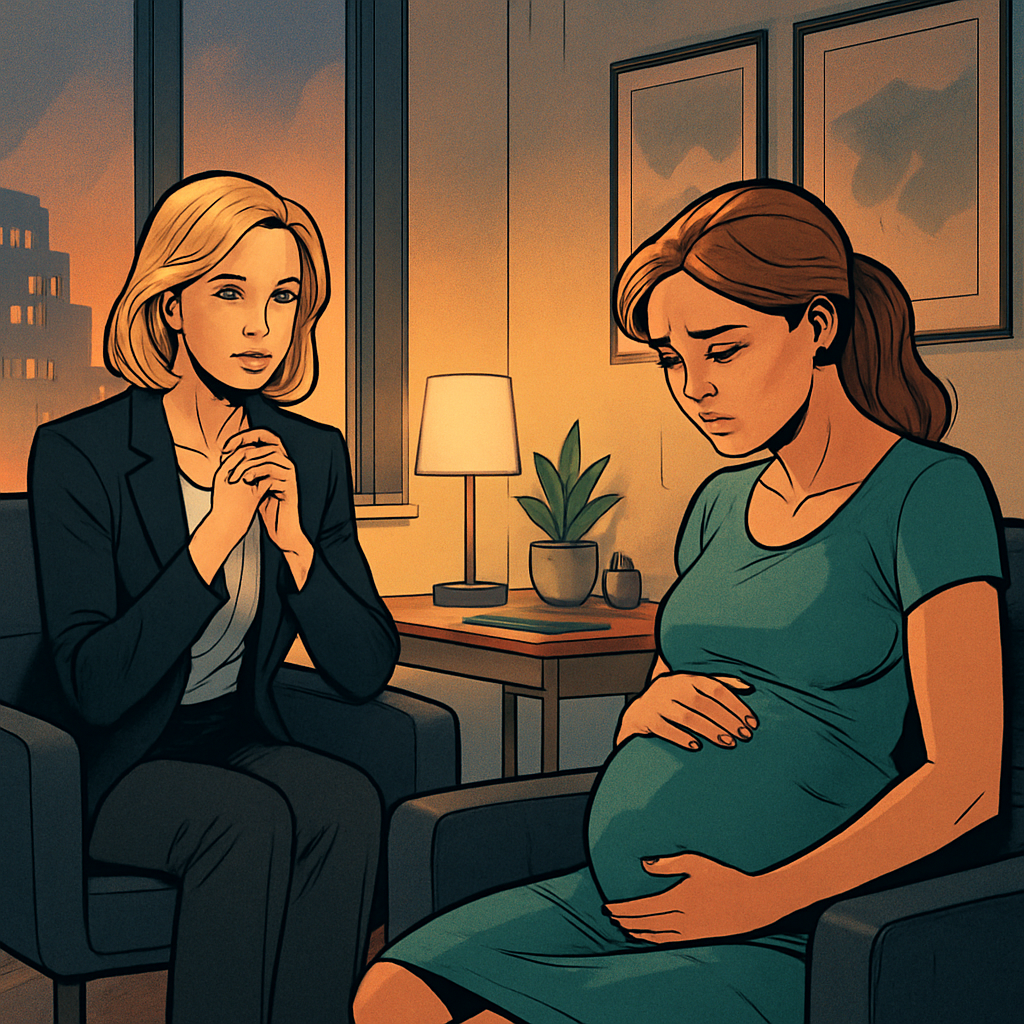
Kayla was in my office again today, five months pregnant with her second child, wearing the expression of someone who’s realized they’ve boarded the wrong train but can’t get off. She’d been coming to see me since her first trimester, when what she initially described as “communication issues” revealed themselves to be something far more fundamental.
“He hasn’t touched me in months,” she said, absently placing her hand on her growing belly. “Not even to hold my hand. Sometimes I think he doesn’t even see me anymore.”
I’ve noticed a pattern in my practice: the more successful a person is professionally, the more elaborate the mathematics they employ to rationalize staying in emotionally bankrupt relationships. Kayla, a financial analyst who could detect a decimal point error in a 500-page report, somehow couldn’t calculate that zero affection plus zero communication equals a relationship that’s functionally over.
When we first started working together, her emotional state was tightly wound with physical sensations – chest tightness, shallow breathing – paired with narratives about being trapped. Each session, I watched her frame solidify: she was seeing her relationship entirely through the lens of constraint rather than choice.
“I know I should leave,” she whispered during today’s session, “but how? I’d be a single mother with two children. I can’t afford our apartment on my own.”
The unspoken truth that hovered between us: sometimes the cage we complain about most bitterly is the one we’ve chosen to reinforce ourselves. 🔐
The Relationship Ambiguity Tax 🌫️
“I don’t even know what we are anymore,” Kayla said during our third session. “We’re not a couple, we’re not separated. We’re just… existing in the same space.”
Ah, relationship ambiguity. That peculiar state where you’re technically together but emotionally apart. Like standing in the middle of a bridge, too far from either shore to do anything but stay suspended.
What Kayla was experiencing went beyond simple uncertainty – it was a complete breakdown of her emotional navigation system. Without clear feedback from her partner, she couldn’t update her emotional understanding properly, leaving her in a constant state of hypervigilance, scanning for emotional data that never came.
“Last night I asked if he wanted to feel the baby kick,” she told me, eyes fixed on the window behind me. “He said he had a call in five minutes and walked away. I felt like I’d become invisible.”
I’ve seen this script play out countless times – the more someone withholds emotional response, the harder their partner works to provoke any reaction at all. It’s as if we’d rather receive confirmation of our worst fears than no information whatsoever.
“Have you noticed,” I asked her, “that you’re putting more energy into decoding his silences than you are into meeting your own needs?”
The look of recognition on her face was worth my graduate school debt. 💡
The Seven Signs You’re Carrying the Emotional Weight Alone ⚖️
Over our sessions, I helped Kayla identify the patterns that had become so normalized she couldn’t see them anymore:
- You find yourself constantly explaining away your partner’s emotional absence (“He’s stressed at work”)
- You’ve become a detective of micro-expressions, analyzing the slightest facial movements for clues about their feelings 🔍
- You apologize for having normal human needs for connection and reassurance
- You’re exhausted all the time but can’t explain why (hint: emotional labor is still labor)
- You’ve started questioning your own perceptions (“Maybe I’m overreacting?”)
- You feel responsible for the emotional climate of your relationship 🌡️
- You measure relationship success by the absence of conflict rather than the presence of joy
The Turning Point 🌅
By our eighth session, Kayla had developed enough emotional clarity to distinguish between the helplessness she felt about her circumstance and the grief she felt about her relationship. This distinction was crucial – helplessness paralyzed her, but grief could propel her forward.
“I realized something this week,” she said, a new steadiness in her voice. “I’ve been so focused on what I can’t do that I’ve ignored what I can. I called my sister. She has a spare room. It’s not permanent, but it’s a start.”
I felt that familiar warmth spread through my chest – not because Kayla was leaving her partner (that decision was still evolving), but because she was reclaiming her narrative. Her emotional understanding was reorganizing around agency rather than constraint.
Some therapists would have jumped straight to “leave him” sessions ago. But I’ve learned that people don’t need someone else telling them what they already know. They need someone who can help them identify the invisible emotional structures keeping them stuck – the needs unmet, the scripts running on autopilot, the frames distorting their perception.
For Kayla, the turning point came when she recognized that her fear of an uncertain future had become more manageable than the certainty of her empty present. ✨
Lola Adams, observing that the relationships we stay in longest are often the ones we’ve already left emotionally months, sometimes years, before our bodies follow suit.
- Should I Stay or Should I Go? Predicting Dating Relationship … – NIH
- Understanding your fear of being trapped in a relationship – Orit Krug
- Are You Trapped in an Unhappy Relationship? – Darlene Lancer
- Situationships: Stuck in Transition, Part 1 | Institute for Family Studies
- When You Feel Stuck—Or Choose to Remain—In A Difficult …
- Are You Feeling Stuck in Your Relationship? – Psychology Today
- “Feeling Stuck: Exploring the Development of Felt Constraint in …
- Feeling Stuck: Exploring the Development of Felt Constraint in …