
The Starbucks Sessions ☕
The Starbucks on West 58th Street has become an unofficial satellite branch of my practice. If you ever need a psychologist in Manhattan at 4 PM on a Tuesday, just look for the woman with a stack of notebooks and an expression that says, “I’ve heard it all, darling, and I’m still listening.” That’s where I met Kay—tucked into a corner table, nervously rotating a coffee cup, eyes darting from person to person as if measuring their reactions to something that hadn’t happened yet.
As I collected my triple espresso (my blood type is caffeine at this point), Kay flagged me down. “Dr. Adams? People said I might find you here.” The voice was tentative but determined, like someone stepping onto thin ice with their eyes wide open.
“Well, you’ve caught me. This is my unofficial waiting room,” I said, sliding into the empty chair. “And it comes with better coffee than my office.”
Within ten minutes, Kay was in full confessional mode. “I feel like I’m wearing someone else’s skin, but I don’t know how to find mine.”
The Costume Department of Self 👗
We all try on identities like outfits in a dressing room. Some fit perfectly from the first wear. Others require alterations. And some we hang back on the rack, pretending we never really wanted them anyway.
For Kay, the dressing room had become a battleground. Every attempted expression of femininity—a touch of mascara, a wig purchased online and hidden in the closet, clothing ordered and never worn—carried the weight of a declaration. Each item contained what I call an emotional byte—a bundle of physical sensations, emotional charges, needs, and personal narratives all wrapped up in something as simple as a tube of lipstick.
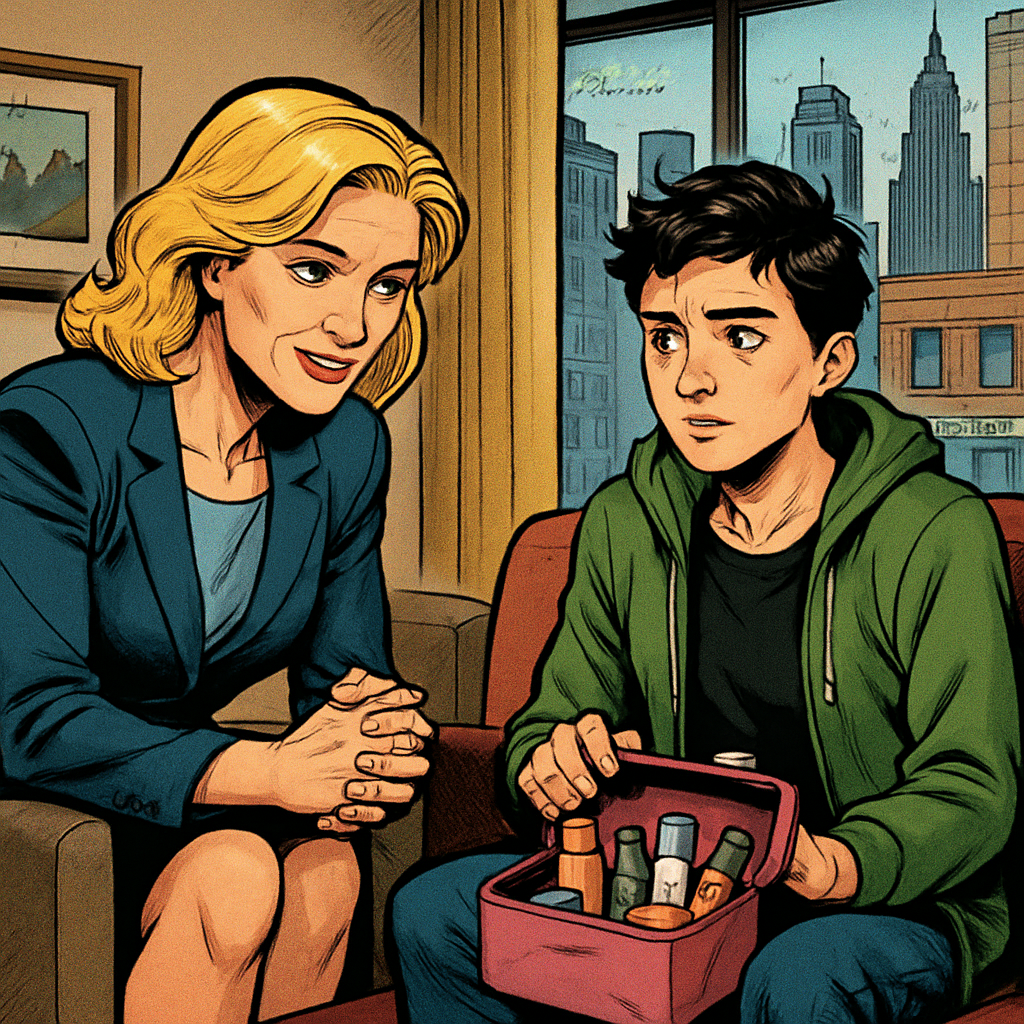
During our second session, I watched Kay unpack a makeup bag with the reverence of someone handling religious artifacts. “I bought all this, but I don’t know how to use any of it,” Kay admitted. “I feel ridiculous even trying.”
That’s the thing about identity exploration that nobody warns you about. It’s not just the big existential questions that keep you up at night—it’s the mundane, practical ones too. How do I blend eyeshadow? Where do I find shoes in my size? Who can teach me to walk in heels without looking like I’m crossing a minefield? 👠
The emotional frames we develop early in life—those invisible lenses through which we interpret everything—don’t include instructions for rebuilding yourself from scratch at thirty-five.
The Community You Don’t Know You Need 🌈
Manhattan has a community for everyone—even those who haven’t figured out which community they belong to yet. That’s the irony of identity quests in the city: you’re surrounded by eight million people, and somehow that makes loneliness even more acute.
“I don’t know anyone like me,” Kay said during our fourth session. “I mean, I must walk past them every day, but how would I know? How do I find people who understand without having to explain everything?”
Identity isn’t formed in isolation. We need mirrors—people who reflect parts of ourselves back to us, helping us understand what we’re seeing. When those mirrors are absent, we question everything, including our own perceptions.
I’ve found that most people struggling with identity questions are actually suffering from a community deficit. The solution isn’t always more introspection—sometimes it’s more connection.
So we made a list. Not of feelings or affirmations, but of places. A boutique in Chelsea where the staff was known for their kindness to newcomers. A makeup counter at Bloomingdale’s with an artist who had helped countless others. A support group that met Tuesday evenings downtown. A drag show where Kay could observe femininity in its most theatrical expression.
Because sometimes the most profound therapeutic interventions don’t happen in the therapy room at all.
Permission Slips for Adults 📝
Here’s what I’ve noticed after twenty-five years of watching people reinvent themselves: we’re all waiting for permission. Permission to explore. Permission to experiment. Permission to get it wrong.
Kay sat across from me one afternoon, eyes filled with tears. “What if this is just a phase? What if I go through all this and then change my mind? What does that make me?”
It makes you human. It makes you someone engaged in the messy, non-linear process of becoming. ✨
We’ve been fed this narrative that identity discovery should be a clean, straight line from confusion to clarity. In reality, it looks more like a Jackson Pollock painting—chaotic, colorful, and ultimately beautiful in its complexity.
The signs you’re giving yourself too little room to explore:
- You’re more concerned with what your exploration means than how it feels
- You believe there’s a “right way” to discover who you are
- You expect certainty before allowing yourself to experiment
- You think identity is something you arrive at rather than something you create
- You’re looking for the definitive answer instead of asking better questions
The Transformation 🦋
I watched Kay’s journey unfold over months—the first hesitant steps into spaces that felt foreign, the gradual accumulation of knowledge and skills, the building of a support network. There were setbacks and moments of doubt, of course. Identity work isn’t a straight-A course.
But I also witnessed something remarkable: the shift from fear to curiosity. From “What if I get this wrong?” to “What happens if I try this?”
During our last session, Kay showed up in full makeup. Not perfect—there was a bit too much blush and the eyeliner was slightly uneven—but she was out there, doing it.
“I realized something,” Kay told me, with a confidence I hadn’t seen before. “I don’t have to have all the answers yet. I just need to keep asking questions.”
Isn’t that true for all of us? 💭
— Lola Adams, noting that our identities aren’t destinations we reach, but conversations we’re having with ourselves and the world
- Gender identity development, expression and affirmation …
- Exploring Gender Identity Development for Queer Students of …
- Examining the Intersection of Sexual Orientation and …
- Non-Binary Gender Identity Development: A Qualitative Study
- Measuring Youth Sexual Orientation and Gender Identity
- Gender Identity 5 Years After Social Transition | Pediatrics
- The phenomenology of gender dysphoria in adults
- Understanding transgender people, gender identity and …
- Stability and Change in Gender Identity and Sexual …