
When a Relationship Becomes Geography 🗺️
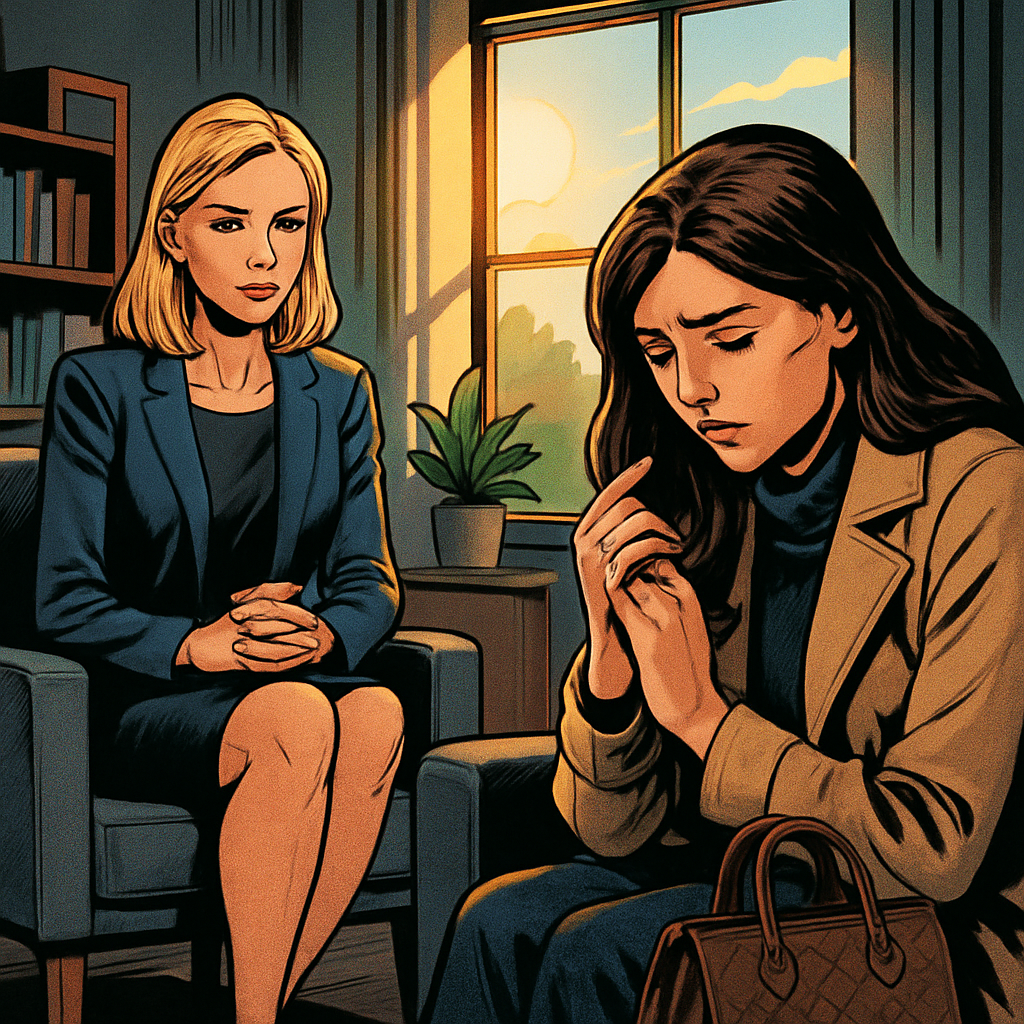
I still remember how Zephyrine entered my office that first day. Designer bag clutched like a shield, cashmere coat that probably cost more than my monthly rent, and eyes that hadn’t known proper sleep in what looked like weeks. She sank into my couch—the one clients always choose when they’re about to tell me something they’ve never said aloud—and exhaled a breath that seemed eight years in the making.
“I think I need to leave him,” she said, twisting the platinum band on her right hand. “But I’m terrified I’ll regret it forever.”
Manhattan is filled with Zephyrines. Women who negotiate million-dollar contracts Monday through Friday but spend weekends negotiating peace treaties in their own homes. Women who can silence a boardroom with a single raised eyebrow but flinch when their partner raises his voice. Women who appear to have everything but feel like they have nothing at all.
“We have a pattern,” Zephyrine explained, her voice steady even as her hands trembled. “We fight. It escalates. Sometimes it gets physical. Then we make up and swear it’ll never happen again. Until it does. Always. And I just… I don’t know who I am anymore when I’m with him.”
The thing about toxic relationships is they’re not places we visit—they’re places we live. We unpack our bags, hang pictures on the walls, and slowly forget there was ever a world outside. What started as a city of excitement becomes a country of familiar pain.
The Off-Again, On-Again Carousel 🎠
By our third session, Zephyrine revealed they’d broken up and reconciled seventeen times in eight years. “But this time feels different,” she insisted, the way they all do.
Here’s what nobody tells you about the breakup carousel: every time you ride it, you leave a piece of yourself behind. With each cycle, your sense of agency erodes. Love becomes synonymous with chaos. Calm feels like abandonment.
“I’ve built a life around our problems,” Zephyrine admitted during one particularly raw session. “My friends are tired of hearing about it. My family thinks I’m crazy for staying. Sometimes I think they’re right.”
The cruel irony of these relationships is that the worse they get, the harder they are to leave. Not just because of practical entanglements like shared apartments or mutual friends, but because our identity gets so wrapped up in the drama that we can’t imagine who we’d be without it.
The Price of Admission 💸
“What would you tell your best friend if she came to you with your story?” I asked Zephyrine one rainy afternoon, six sessions in.
She didn’t hesitate. “I’d tell her to run. Fast.”
“And why don’t you follow that advice yourself?”
Her eyes filled. “Because what if this is as good as it gets? What if being alone is worse? What if this is the price I have to pay for having someone?”
Let’s be honest about something: being alone after years in a relationship is terrifying. Our culture sells us the myth that coupledom is the natural state—that single people are somehow incomplete, waiting in life’s anteroom for the real show to begin.
But the price of admission to a toxic relationship isn’t just the pain you feel while you’re in it—it’s who you become because of it. It’s how you start walking on eggshells even when you’re alone in a room. It’s how you become fluent in the language of apology for crimes you didn’t commit.
Five Signs Your Relationship Is Costing More Than You Can Afford 💔
1. You’ve developed an advanced degree in predicting their moods but have lost touch with your own
2. Your emotional needs have been downsized to “not making them angry today”
3. Your friends have stopped asking about your relationship because they can’t bear to hear the same story again
4. You feel relief when they cancel plans or leave town
5. You’ve rehearsed the breakup conversation in your head so many times you could perform it as a one-woman show
The After That Comes Before ✨
In our final sessions together, we focused not on whether Zephyrine should leave—she’d made that decision—but on how she would navigate what came next. The most dangerous time in any toxic relationship is the leaving part, both emotionally and sometimes physically.
“I’m afraid of who I’ll be without him,” she confessed. “Even with all the bad parts, he’s been my person for eight years.”
“You know what scares me most?” she asked during our last session. “That five years from now, I’ll look back and think this was actually the best relationship I ever had.”
I leaned forward. “Zephyrine, that’s exactly why you need to leave. Because as long as this is your benchmark for love, nothing healthier will ever feel real enough.”
Three months after our work together ended, I received a card. Inside was a photo of Zephyrine on a solo trip to Portugal, smiling in front of an ocean sunset. The note read simply: “I’m still scared sometimes. But I’d rather be scared and free than safe and trapped. Thank you for helping me find the door.” 🌅
Core Insight 💎
Perhaps the most subversive act in a world obsessed with “making it work” is recognizing when the work is killing you. Sometimes the most romantic thing you can do isn’t fight for love—it’s fight for the version of yourself that deserves better. After all, what’s the point of having someone if you lose yourself in the process?
Perhaps the bravest thing we ever do isn’t staying through the hard times, but recognizing when “hard” has become “harmful”—and finding the courage to write a different story.
— Lola Adams, who knows that sometimes the most loving relationship decision is the one that breaks your heart to make 💕
Researchers identify a critical threshold for relationship …
Making Sense and Moving On: The Potential for Individual …
On again, off again relationships can have a long-lasting …
Breaking Up is Hard to do: The Impact of Unmarried …
Attachment and Breakup Distress: The Mediating Role of …
the-role-of-romantic-breakup-in-increasing-vulnerability-to- …
How Long It Really Takes to Get Over an Ex
Chapter 12: Relationship Dissolution and Emotional Recovery
12.3 The Dynamics of Relationship Satisfaction and Breakup Decisions
Contemporary research in relationship psychology has identified critical patterns in how romantic partnerships evolve and ultimately dissolve. Large-scale longitudinal studies demonstrate that relationship satisfaction follows predictable trajectories, with most couples experiencing gradual decline over time. When satisfaction drops below a critical threshold—particularly during periods of sharp decline—the likelihood of relationship termination increases dramatically (Buehler & Orth, Journal of Personality and Social Psychology).
This finding has profound implications for individuals trapped in cyclical patterns of conflict and reconciliation. The data suggests that couples who experience repeated dissatisfaction cycles may benefit from examining whether their relationship satisfaction has crossed this critical threshold, as continued investment in repair may prove futile once certain psychological boundaries have been breached.
12.4 Post-Dissolution Growth and Psychological Adaptation
The dissolution of romantic relationships, while inherently distressing, contains significant potential for individual psychological growth. Research in emerging adulthood populations reveals that individuals who develop clear understanding of why their relationship ended and who initiated the breakup demonstrate superior mental health outcomes and enhanced capacity for future relational success (Kansky, 2017, Emerging Adulthood).
This cognitive processing appears to facilitate what researchers term “meaning-making”—a psychological process whereby individuals transform relational failure into personal insight and emotional competence. The implications for therapeutic intervention are clear: supporting clients in developing coherent narratives about relationship dissolution may accelerate recovery and prevent repetitive relational patterns.
12.5 The Psychological Costs of Relationship Instability
Particularly relevant to clinical practice are findings regarding on-again, off-again relationship patterns. University of Missouri research demonstrates that these cyclical relationships impose lasting psychological distress that persists even after final dissolution (Monk et al., 2022). However, the data also suggests potential mental health benefits when individuals finally exit these unstable cycles permanently.
The psychological toll of relationship dissolution varies significantly based on relationship characteristics. Long-term partnerships and those involving children or shared life infrastructure produce more severe distress and greater decreases in life satisfaction (Rhoades et al., 2011, Journal of Family Psychology). Clinicians should normalize these responses while recognizing that relationship complexity amplifies the emotional aftermath of breakup decisions.
12.6 Attachment Patterns and Coping Mechanisms
Individual differences in attachment security significantly influence post-breakup adjustment. Recent research identifies specific coping mechanisms that either exacerbate or alleviate psychological distress following relationship dissolution. Individuals with attachment insecurities who engage in self-punitive behaviors or demonstrate reduced emotional accommodation show elevated risk for anxiety and depression (Gehl, 2023, Emerging Adulthood).
Understanding one’s attachment profile and associated coping tendencies represents a crucial component of emotional recovery. Therapeutic interventions targeting maladaptive coping responses may significantly improve post-dissolution outcomes.
12.7 Vulnerability to Emotional Disorders
Systematic review evidence indicates that romantic breakup substantially increases vulnerability to mood and emotional disorders through complex interactions between biological predispositions and psychological vulnerabilities (Clinical Schizophrenia & Related Psychoses, 2021). Factors such as perceived loss of control and pre-existing trauma histories—particularly in cases involving abuse—create compounding risk factors for severe psychological distress.
These findings underscore the importance of comprehensive mental health monitoring during relationship dissolution, especially for individuals with histories of interpersonal trauma. Early intervention and targeted therapeutic support may prevent the development of more severe psychological complications.
Clinical Implications
The convergent evidence suggests that while relationship dissolution invariably produces psychological distress, the process also contains substantial potential for personal growth and improved future relational capacity. Clinicians should focus on supporting clients in developing coherent understanding of relationship dynamics, recognizing attachment-based vulnerabilities, and implementing adaptive coping strategies during the dissolution process.