
🔍 The Invisible Architecture of Identity Collapse
Picture this: You’re sitting across from someone who’s just realized their entire sense of self has been living rent-free in someone else’s narrative. Research shows that 1 in 3 people who leave abusive relationships still struggle with self-recognition two years later. Here’s the thing: it’s not because they’re broken. It’s because betrayal trauma literally rewires how your brain processes who you are.
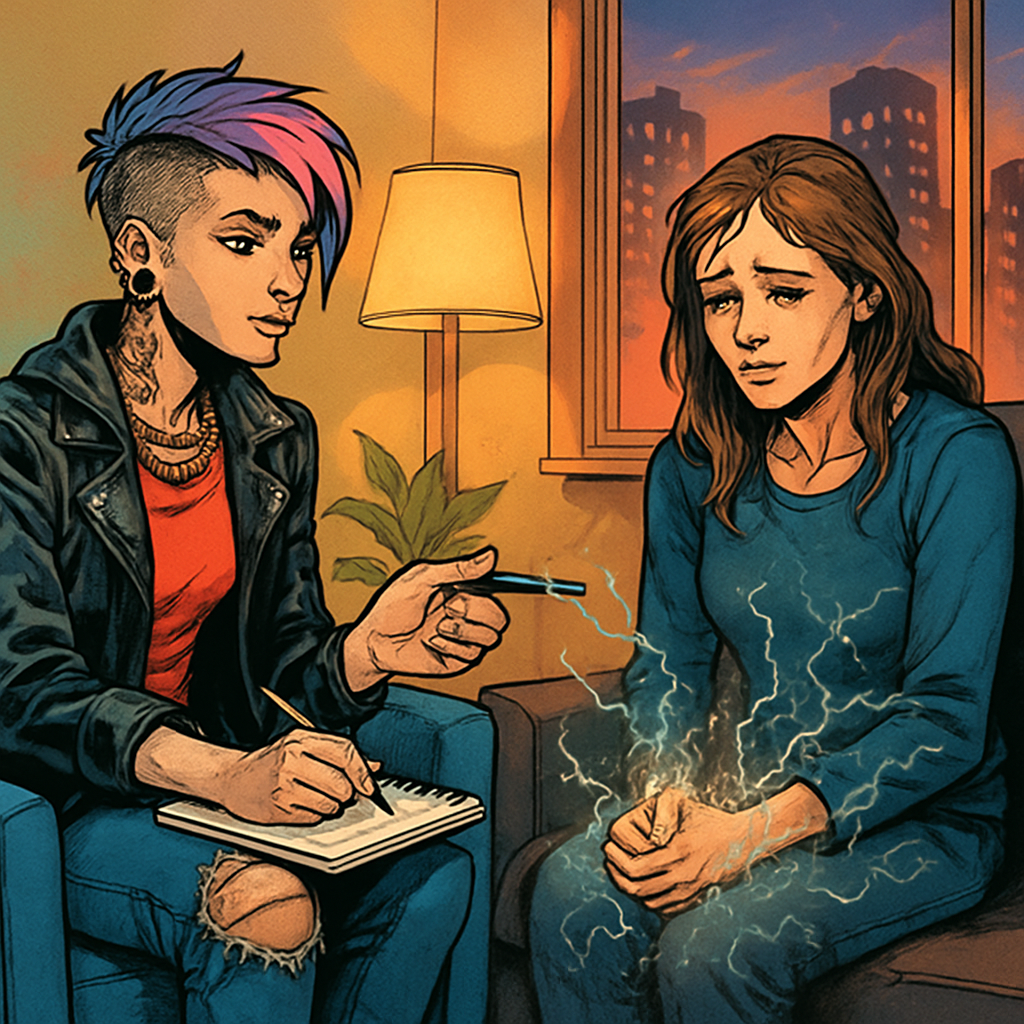
Her name was Tasmin, and when she walked into my office, she didn’t just seem small. She seemed absent.
Not physically. But there was this uncanny quality to how she moved through space—like she was performing being a person instead of actually inhabiting her body. Her voice had this careful, measured quality, the kind you develop when you’ve spent years monitoring every word to avoid triggering someone else’s rage.
She’d just left an abusive relationship. The kind that wasn’t just about one incident, but about systematic erosion. Emotional abuse. Physical abuse. Verbal abuse sprinkled so consistently that she’d stopped noticing when the air in the room felt dangerous. There was a miscarriage too—one that happened while her partner made her feel responsible for his disappointment, while his family treated her like damaged goods.
But the thing that struck me most? When I asked her what she wanted to work on, she couldn’t answer. Not because she didn’t know—but because she didn’t know how to access her own knowing anymore.
🧠 How Trauma Becomes Your Operating System
Here’s what no one tells you about living in an abusive dynamic: it doesn’t just hurt you in the moment. It creates what we call emotional frames—invisible interpretive lenses that your brain develops to predict danger and manage survival.
In Tasmin’s case, she’d developed a frame that went something like this: “If I’m small enough, quiet enough, self-aware enough about my flaws, I can prevent the next explosion.”
The problem? That frame doesn’t just dissolve when you leave the relationship. It calcifies. It becomes your operating system.
Studies show that this happens through repeated emotional bytes—little packets of experience containing physical sensations, emotional charge, and mini-stories. Every time her boyfriend echoed his mother’s criticisms about her appearance, her culture, her body, that wasn’t just words hitting her ears. That was an emotional byte being encoded: “You are fundamentally wrong. Your existence disappoints people. The safest version of you is the invisible version.”
And those bytes stacked. They layered. They became her inner monologue. Think of it like this: her mind became a building constructed brick by brick from someone else’s cruelty. Now she had to learn to renovate it, room by room, brick by brick.
😔 When Your Inner Voice Becomes the Enemy
One of the breakthrough moments with Tasmin came when I asked her to notice who was criticizing her.
She started naming people: her ex, his mother, the family members who ghosted her post-miscarriage.
Then she went quiet.
“That’s weird,” she said. “When I’m alone, it’s still happening.”
This is the part that destroys people—and what research on emotional processing reveals: your inner voice, shaped by early relationships and reinforced by trauma, becomes an internalized abuser. It’s not a metaphor. It’s neurological.
Tasmin’s inner voice had learned to encode the same narratives her boyfriend’s family had been uploading for years. She’d become fluent in her own devaluation. The emotional scripts—automatic behavioral patterns that feel inevitable—kept her performing smallness even in my office, even when the threat was gone.
She would start to speak about something that mattered to her, then catch herself: “Sorry, that’s probably stupid.” Not because I communicated that. Because her internal system had learned to pre-emptively diminish itself before anyone else could.
💡 Reminder: Your shame isn’t evidence of your failure. It’s evidence of someone else’s damage being transferred into you. And that transfer can be reversed.
👂 Rebuilding Your Ability to Know Yourself
When Tasmin talked about her ability to trust again, she framed it like a personality defect.
“I’m broken at reading people,” she said.
But here’s what the research actually shows: she wasn’t broken at reading people. She’d been trained to ignore her own needs in favor of managing someone else’s emotional state.
Attachment research reveals something fascinating—when betrayal happens early in a relationship, your brain’s threat detection system goes into overdrive. But Tasmin’s actual problem wasn’t threat detection. It was needs blindness. She couldn’t identify what she needed relationally, emotionally, or psychologically, because she’d spent years training that system to be quiet.
She’d stayed in the relationship longer than made logical sense partly because her relational needs—for availability, responsiveness, support—were so starved that she mistook his presence for care. She mistook his criticism for attention. She mistook his control for investment.
Rebuilding trust wasn’t about becoming better at reading people. It was about rebuilding her ability to read herself—to access the granular information her body was trying to send her about what felt safe, what felt depleting, what felt like genuine connection versus performative intimacy.
💔 The Grief That Doesn’t Have a Name
Nobody talks about this part: the miscarriage wasn’t just a loss of pregnancy.
For Tasmin, it was the loss of a future where someone other than her batterer got to define whether she was a good mother. The physical trauma of miscarriage during emotional abuse creates this layered emotional response that’s hard to articulate—there’s grief, but there’s also rage at the body, shame that she couldn’t protect it, and betrayal when the person who “created” the pregnancy with her treated the loss like her personal failure.
Her grief was actually healthy. What wasn’t healthy was how she’d integrated it into her self-concept: “I can’t even keep a pregnancy. I’m a failure at the fundamental things a woman is supposed to do.”
That’s not depression. That’s a corrupted emotional frame, fed by a narrative her abuser had been constructing for years.
The work involved something researchers call emotional granularity—the ability to make finer distinctions between the overwhelming tsunami of emotion and see what’s actually there. Instead of “I’m a failure,” we could distinguish: “I’m grieving a lost future. I’m furious at being treated like my body was a container instead of a home. I’m ashamed because I was told to be ashamed. And I’m also here. Alive. Still choosing.”
⚡ When Breaking Apart Means Healing
There’s a principle in trauma recovery that contradicts everything you’ve probably heard about “getting stronger”: psychological healing sometimes requires first getting worse.
This is called positive disintegration—the idea that tension, conflict, and apparent dysfunction can actually be the doorway to higher integration.
With Tasmin, this showed up as anger. Real, specific, directed anger.
By week eight, she started getting mad. Not performatively. But genuinely furious at her ex for the calculated cruelty, at his mother for weaponizing cultural criticism, at her own family for their conditional support, and—this was the big one—at herself for staying, for believing the narrative, for minimizing the abuse.
That anger felt like a breakdown. But it was actually a breakthrough.
Her emotional system was finally integrating the gap between what she was told (you deserved this, you’re too sensitive, you’re lucky he tolerates you) and what was actually true (this was abuse, you didn’t deserve it, your needs were valid).
The disintegration—the falling apart of her old survival narrative—was the prerequisite for building something real.
🔧 Rebuilding the Architecture of Your Own Consciousness
Healing from complex trauma isn’t linear because your nervous system doesn’t heal linearly. It processes in layers, through emotional bytes, through the slow rewiring of your inner voice, through the painful work of identifying your own needs when you’ve been trained to make them invisible.
What made the difference with Tasmin wasn’t me telling her she was strong. It was helping her rebuild the architecture of her own consciousness—the system that interprets whether her needs matter, whether her perceptions are valid, whether her existence is enough.
We worked with her emotional frames, not by trying to eliminate them, but by creating intentional new experiences that gave her brain updated information. When she shared an opinion and I didn’t debate it, I wasn’t just being nice—I was creating a new emotional byte: “My thoughts survive in the world without destruction.”
When she set a boundary and I honored it without punishment or guilt-tripping, we were building a frame that said: “My no is powerful. It doesn’t require justification.”
This is the invisible structure most people miss about trauma recovery: you’re not healing from the abuse itself. You’re healing from the emotional processing system that the abuse created. You’re rebuilding your needs hierarchy so that your own psychological, emotional, and relational needs actually register as valid. You’re teaching your inner voice a new language.
🚩 Learning to See What Was Always There
I don’t think Tasmin should “forgive and forget” or immediately trust her instincts again. What matters is she develops what I call discriminate awareness—the ability to notice early warning signs without letting fear paralyze her.
Red flags in potential relationships: Anyone who thinks criticism = care. Anyone who sees your boundaries as personal rejection instead of self-preservation.
Red flags in friendships: People who treat your vulnerability like entertainment or ammunition. People who position themselves as rescuers—that savior complex almost always inverts into control.
Red flags with family: Unconditional “support” that comes with invisible conditions. “I’m here for you, but…” is the same as just not being there.
Green flags she’s learning to recognize: People who respect her “no” without requiring explanation. People whose presence doesn’t require her to become smaller. People who apologize specifically, without making their apology her emotional labor.
✨ What Rebuilding Actually Looks Like
By month four with Tasmin, the breakthrough wasn’t dramatic. It was quiet.
She was eating alone without feeling guilty about taking up space. She was choosing her own music instead of defaulting to his preferences. She was having an opinion about a movie and keeping it instead of second-guessing whether she was allowed to have preferences.
These aren’t small things. These are your identity reassembling itself one micro-choice at a time.
The social isolation she’d experienced—being cut off from her own family, rejected by his—meant we had to build her support system essentially from scratch. But here’s what’s interesting: she started with friends she’d ghosted years ago, tentatively reaching out with the expectation of rejection. When they responded with genuine warmth, that wasn’t just reconnection. That was a new emotional byte being formed: “People can come back. I can be forgiven for disappearing. I’m not defined by my worst decisions.”
Her emotional regulation improved not because she learned breathing techniques (though those helped), but because she stopped needing to maintain constant vigilance. When you’re not scanning for danger from the person sleeping beside you, your nervous system can actually relax. Your amygdala stops running the show 24/7.
The path forward wasn’t about erasing what happened. It was about reclaiming the right to author her own story.
- Healing from Betrayal Trauma: Strategies for Recovery and Resilience
- Rebuilding Trust After Betrayal: A Mental Health Perspective
- Staying Together After Infidelity: An Exploration of the Decision …
- Effect of relationship experience on trust recovery following a breach
- Rebuilding After Infidelity and Betrayal – Psychology Today
- Rebuilding Trust After Emotional Abuse
- Betrayal Trauma: The Neurobiology of What Happens and How …
- Rebuilding Trust and Finding Forgiveness After Betrayal – ReachLink
- How to Heal from Betrayal Trauma: A Guide to Rebuilding Trust After …
- Building Trust After Betrayal: A Guide for Couples in Recovery – Los …
- What Betrayal Does to the Brain and Body – Dr Kathy Nickerson
- The Psychology of Betrayal: Why It Hurts So Deeply
- Practical, Science-Based Steps to Heal from an Affair
- Why You Can’t Rebuild Trust After Betrayal Without Emotional Safety
- Healing from Infidelity: How to Rekindle Intimacy and Connection in …