
When Your Identity Becomes Obsolete 🎨
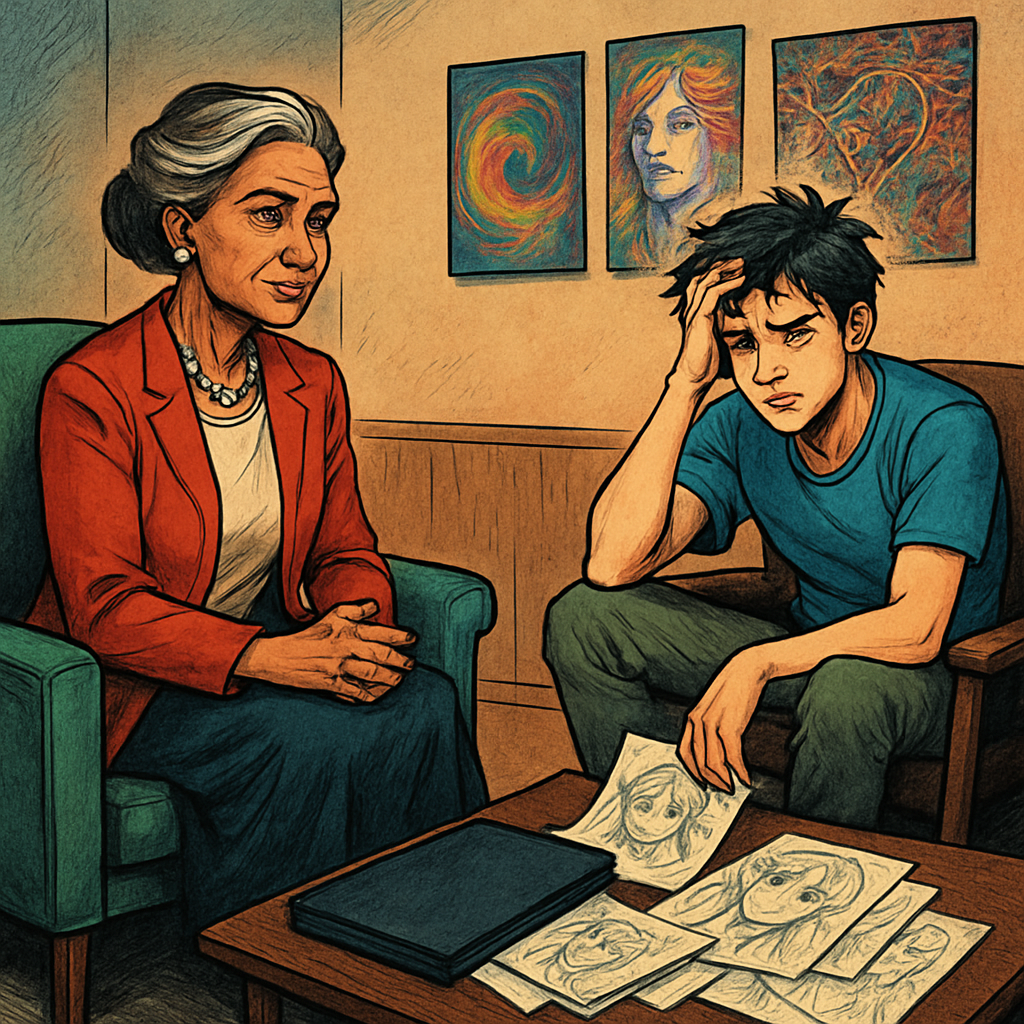
Tristan walked into my office carrying a portfolio under one arm and what I can only describe as the facial expression of someone who’d just discovered their favorite restaurant had been replaced by a vending machine. He was an anime artist—talented, technically proficient, the kind of guy who could draw characters with expressions so nuanced you’d swear they had interior monologues.
He wasn’t here to show me his work. He was here because he couldn’t figure out why he hated everything he was looking at anymore, including his own.
“I hate machine-generated art,” he said, dropping into the chair. “But honestly? I also hate what everyone’s doing now. It all looks the same. So what does that make me? A hypocrite? An asshole? Both?”
The Emotional Bytes Were at War ⚔️
Here’s what was actually happening: Tristan had accumulated decades of emotional bytes—neural patterns woven from sensations and stories—around what it meant to be an artist. Each byte contained the physical pleasure of a line coming together just right, the chest-tightening anxiety of showing work to others, the warm glow of recognition.
These bytes also carried deep narratives: Real art requires human intention. Originality matters. Technical skill is sacred.
But now he was encountering new information that contradicted his entire predictive model. Algorithms were producing technically competent work. His own style, once distinctive, now felt derivative. The emotional bytes weren’t updating—they were colliding.
This wasn’t simple cognitive dissonance. This was his entire professional identity crashing against new reality. The physical sensation? Like standing on a floor that’s slowly tilting.
“When I look at new anime,” he told me, “I feel nothing. When I look at machine stuff, I feel angry. When I look at my own work…” He paused. “I feel like I’m watching someone else go through the motions.”
The Frame Was Cracking 🔨
Tristan’s emotional frame—his interpretive lens for understanding art and his place in it—was built on a hierarchy that no longer held:
- Top: Human creativity and originality
- Middle: Technical execution
- Bottom: Reproduction and imitation
But reality was scrambling this hierarchy. The technical execution he’d spent years perfecting? Increasingly automated. The originality he valued? Harder to define when every style had been done, remixed, and algorithm-ified.
Here’s the harder question: What were you actually protecting when you clung to scarcity as proof of worth?
What made this particularly brutal was that his inner voice—that architect of emotional meaning—had become viciously critical. It had started as a motivating force. Now it sounded like: You’re obsolete. You were never that original anyway. You’re just mad because you’re being exposed.
This is what I call the alien self phenomenon—when your inner voice stops being yours and starts echoing the harshest interpretations of external threats. Tristan wasn’t just worried about machines. He was worried the machines were revealing a truth he’d been hiding from himself: that he’d never been as creative as he needed to be.
“Did you experiment with the generative stuff?” I asked.
Long pause. “Yeah. A few times. Just to see.”
“And?”
“It was… fine. Better than fine, actually. Which made me feel worse.”
The Script Was Breaking Down 📝
For twenty years, Tristan had run the same emotional script on repeat: Work harder → Improve technique → Gain recognition → Feel valuable. This script had become automatic, inevitable, the water he swam in.
But the script required a stable environment. It required that technical improvement led to competitive advantage. It required that effort correlated with output quality.
These conditions were evaporating.
The disintegration he was experiencing—this painful sense that everything was falling apart—was actually what psychologists call positive disintegration. The old structure was too rigid to accommodate new reality. It had to crack before something more complex could emerge.
But here’s what you need to hear: Understanding this intellectually doesn’t make it hurt less. Tristan was grieving. Not just for his potential future, but for the version of himself that had made sense in a world that no longer existed.
“What if my complaints don’t matter?” he asked. “What if I’m just yelling at the wind?”
“Your complaints matter,” I said. “But maybe not for the reasons you think. You’re not actually upset about machines making art. You’re upset because your needs aren’t being met anymore by the activities that used to meet them.”
Finding the Actual Needs 🔍
This is where we did the real work. We mapped his needs hierarchy—not what he thought he should want, but what his emotional bytes were actually signaling:
Autonomy: He needed to feel authorship over his work. But he’d conflated authorship with being the sole creator. Could authorship exist in curation, direction, synthesis?
Competence: He needed to feel skilled. But he’d anchored competence to technical execution. Could competence mean something different—like emotional resonance, narrative coherence, aesthetic judgment?
Identity: He needed to know who he was professionally. But his identity had been built on being irreplaceable. Could identity survive being one voice in a larger ecosystem rather than a unique outlier?
The emotional granularity we developed here was crucial. Instead of one massive emotional bubble labeled “EVERYTHING IS TERRIBLE,” we broke it into components: grief for a lost version of the profession, curiosity about new possibilities, anger at being forced to adapt, fear about relevance, and—buried deep—relief that he didn’t have to be superhuman to matter.
“I think I’ve been trying to be perfect,” he said during our fifth session, “because if I was perfect, I’d be un-replaceable.”
Bingo.
What Actually Helped 💪
I didn’t give Tristan a solution. There wasn’t one. His profession was transforming, and pretending otherwise would’ve been malpractice.
But what we did do was create intentional experiences—new emotional bytes that updated his predictive model.
He started a project combining his drawing with generative tools, not to prove a point but to see what happened. The emotional byte that formed: I can direct this. My aesthetic judgment still matters.
He visited a museum exhibit of traditional animation cells. New byte: The value isn’t just in the final image. It’s in the human decision-making across thousands of frames.
He talked to younger artists who’d never known a world without these tools. New byte: They’re not my enemy. They’re just playing a different game on a different board.
Slowly—very slowly—a new frame emerged. Not “human versus machine” but “what can only I bring to this?” Not “original versus derivative” but “what resonates versus what doesn’t?”
His inner voice didn’t magically become kind. But it became more accurate. Less alien. More like a tough coach than an executioner.
“I still don’t know if what I do matters,” he told me in our last session.
“Good,” I said. “That’s actually more honest than the certainty you had before.”
The Uncomfortable Truth 💭
Have you ever considered that your significance has always been contextual, never absolute? That’s what Tristan had to confront. His emotional bytes reorganized around a more complex understanding—that mattering doesn’t mean being irreplaceable, and that obsolescence of technique doesn’t mean obsolescence of self.
Six months later, he sent me a link to his new work. It was strange, hybrid, unlike anything in his portfolio before. Some people hated it. Some people loved it. But you could tell a human had made choices all the way through.
He’d found a way to matter that didn’t require being the only one who could do it.
The Real Lesson 🎯
Your value isn’t in being unreproducible—it’s in being irreducibly yourself.
~ Sophia Rivera, who still believes your therapist should occasionally tell you things you don’t want to hear
- Minds in Crisis: How the AI Revolution is Impacting Mental …
- How Social Media Distorts Adolescents’ Self-Identity – NSUWorks
- Researchers warn of addiction and over-dependency on …
- A Systematic Review of Social Media Use and Adolescent Identity …
- AI Technology panic—is AI Dependence Bad for Mental Health? A …
- [PDF] The effect of social media in identity formation in adolescence
- Addictive Intelligence: Understanding Psychological, Legal, and …
- STUDY ON THE IMPACT OF SOCIAL MEDIA ON ADOLESCENT …
- AI Addiction: Signs, Effects, and Who Is At Risk?
- How the Internet Effects Personal Identity – Sites at Penn State
- Generative artificial intelligence (GenAI) use and dependence
- Effects of Social Media Social Comparisons and Identity Processes …
- Is AI Our New Addiction? AI and Mental Health – Knowledge UChicago
- New study warns of risks in AI mental health tools