
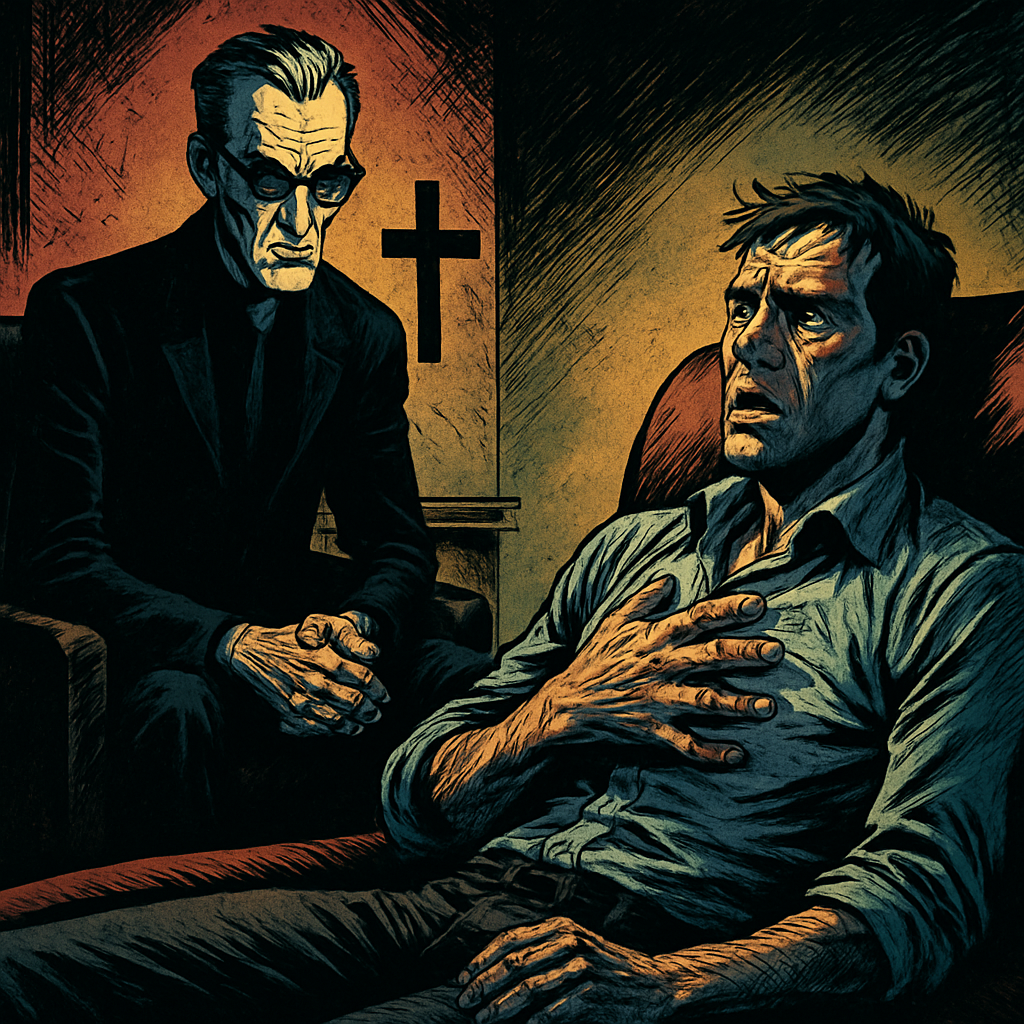
Chad was forty-three, successful by conventional measures, and utterly convinced that his life had become intolerable. When I asked him directly—without mercy, as is my practice—”What made you decide that death was preferable to living?” he didn’t flinch.
“I’ve been researching aconitum seeds,” he said quietly. “Monkshood, Wolfsbane.”
Not vague ideation. But here’s what he was really asking: “Does anyone see me as worth saving?”
The Architecture of Hopelessness 🏗️
Chad’s despair was the logical output of an emotional system organized around a single conclusion: “There is no way forward in my life that doesn’t involve unbearable pain.”
Over years, his emotional system had crystallized into an Emotional frame. Within that frame, the narrative was relentlessly consistent: “My existence causes more suffering than it alleviates.”
This wasn’t irrational. It was internally coherent. His internal narratie had organized all available evidence into a tight logical script: an automatic pathway that felt inevitable because his system had stopped generating alternatives.
But his despair also contained information. Beneath his research on natural poison lay genuine psychological and relational deprivation that his conscious mind had learned to ignore, yet was till causing him severe emotional pain.
Invisible Structures 👁️
What emerged in our first session was the presence of invisible structures: the unspoken family dynamics and culturally internalized expectations shaping his emotional experience (without his awareness).
Chad grew up in a family where emotional vulnerability was avoided. His father was stoic and pragmatic. His mother was the family’s emotional caretake. He learned early: Your feelings are not welcome here. We contain ourselves.
This pattern became encoded in his inner voice (our internal narrator who transforms our experiences into a story). Over decades, this voice had become increasingly critical, increasingly convinced of his own fundamental inadequacy. By the time he arrived at my office, his inner voice had evolved into what I call an alien self: a harsh, punisher, a commentator functioning as judge, jury and execurtioner.
His research on wolfsbane was, in a twisted way, an act of obedience to that alien self.
Naming the Judge 🏛️
My job was now to convince Chad to name the entity that had become his primary relationship.
“What should we call this voice that convinces you that death is merciful to your own existence?”
He paused. “The Judge.”
In the traditions I work with, what we call “demons” are fundamentally the rejected, demonized aspects of our own psyche. The Judge wasn’t external. It was the internalized voice of every authority figure who had taught him that his needs were inconvenient, his emotions were weakness, his authentic self was fundamentally unacceptable.
But here’s the crucial insight: The Judge only had power because Chad had given it authority. He had accepted its premise that it’s judgments equals truth, that it’s criticism equals wisdom, that his suffering was a punishment he deserved.
The rejected aspects of Chad—his anger, his hunger for recognition, his desire to be genuinely witnessed—had been driven into his psyche’s shadow precisely because his family system couldn’t tolerate them. Now those exiled parts were organizing themselves into a vengeful internal force.
The Container Under Siege ⚔️
The mind is a container—a sophisticated organizational system designed for survival. Within that container lives an internal committee: various psychological processes (the Achiever, the People-Pleaser, the Protector, the Critic) all trying to maintain what the system craves above all else: coherence.
The problem: His system had become locked into a paradoxical position. One part desperately wanted connection. Another part had concluded he was fundamentally unworthy of it. A third part had learned that survival meant never asking for help. A fourth part was now organizing the fantasy of exit as the only solution that could resolve the unbearable tension between these contradictions.
This is what happens when the Coherence Drive runs amok. The system, desperate for internal harmony, had begun to organize itself around suicide not as an impulse but as a solution. If he removed himself, his pain disappeared. Everyone else could stop being burdened. He could stop experiencing his internal contradictions.
From Overwhelm to Information 🔍
What Chad needed emotional granularity: the ability to transform the monolithic bubble of despair into something that contained information rather than just unbearable weight.
His thoughts and his feelings had become fused together. Our goal was to slow down his actual emotional experience.
We started with this: “When you feel the hopelessness most acutely, describe it. Not the thought. The actual sensation in your body.”
He described a heaviness in his chest, numbness, a particular quality of silence where thoughts had stopped generating. Radical separateness from other people, as if observing other people through a layer of thick glass. It was a start.
Those sensations weren’t just symptoms of depression. They were a need for release based in contradictions and paradox. The numbness spoke to a need for aliveness. The isolation spoke to relational hunger so deep and so defended against that he’d nearly forgotten what genuine connection felt like.
These weren’t things that needed to be eliminated. They were things to understand, to be worked with.
The Ritual 🔥
We designed what we called a ritual of descent: a ceremony that would allow Thaddeus to consciously engage with the despair he’d been trying to escape from.
He took an object from his childhood—a medal his father had given him for academic achievement. The kind of award given conditional on his good performance.
In a quiet space, he would:
- Acknowledge the structure: Speak aloud what this object represented—the bargain he’d made to be acceptable, the price that had been paid by his authentic self.
- Invoke the rejected authority: Name the voice that had used this medal as a weapon. “I name you, Judge. I see you Dad. I see your hunger to protect me by demanding perfection.”
- Perform the sacrifice: Burn it, bury it, or give it away—some deliberate act of release. “I release this. I refuse to trade my life for your approval.”
- Declare the reversal: “By my own hand and will, I reclaim the parts of myself you exiled to become whole.”
This isn’t prayer to external forces. It’s the conscious reorganization of his own internal system. It’s creating a positive disintegration—intentionally destabilizing the rigid coherence built around despair so new configurations become possible.
The Wyrd ⚡
There’s a concept from Norse traditions called wyrd—often translated as “fate,” but more accurately understood as the pattern of consequences emerging from your choices and actions over time.
The Norse didn’t believe in passive fate. They believed destiny was something you made through the decisions you took, the oaths you swore, the honor you defended.
His research on poisons was actually an act of will. But it was will deployed in service of surrender. What I asked him to do was redirect that same capacity towards a different question: What would it mean to understand his pain, rather than trying to escape it?
This isn’t toxic positivity. It’s recognizing that the capacity for agency you’re deploying toward death could be deployed toward transformation.
Over the following months, Chad’s work was about meta-emotional intelligence. Developing the capacity to see the systems creating his emotions rather than being possessed by them.
We mapped his needs hierarchy. Psychological autonomy—he’d surrendered it entirely to the Judge. Emotional safety—he’d learned it meant numbness and disconnection. Relational availability—he’d convinced himself others would be better off without him.
We examined his emotional scripts (the automatic patterns keeping him locked in the same loops). When he felt genuine connection, the Protector would activate: This is dangerous. Better to withdraw now. When the Achiever accomplished something, the Critic would whisper: Not good enough. You’re still inadequate.
The scripts were so smooth, so practiced, they felt like truth. But here’s what changed: Once he could see the script running, he saw it for what it was, it lost is power.
He didn’t become “recovered” in some clean, linear fashion. But he became interested again. And interest is the first sign that the coherence drive has stopped organizing itself exclusively towards death.
A Necessary Truth ✊
Our culture treats suicidal ideation with particular cruelty. We tell people it’s “selfish.” We suggest their pain isn’t “real.” We pathologize what is actually a symptom of profound unmet needs organized into a closed system. None of this helps. It only serves to deepen the isolation.
What actually helps is what Chad needed: Someone willing to break his pain down seriously. Someone who could say: Yes, you’re in genuine suffering. No, death isn’t the solution because death prevents the only thing that could actually help—transformation.
I won’t pretend Thaddeus is “cured.” That’s not how this works. What I will say is that last month he sat across from me and for the first time, he mentioned a future plan that wasn’t framed as escape. He’s considering going back to school for something he’d abandoned twenty years ago. He’s joined a band—something he loved before he learned joy was indulgence.
These aren’t dramatic transformations. They’re actually small acts of reclaiming his own agency. This is what happens when someone stops asking How do I escape? and starts asking How do I become the author of my own story?
That’s the work of shadow integration. That’s the work of claiming your authentic will, even when the systems that raised you taught you that exerting your own will was dangerous.
By his own hand and will, Chad discovered that suicide wasn’t his wyrd. It was just a story the Critic and Judge had convinced him was inevitable.
He chose a different story.
—Lucian Blackwood
Hail Wisdom. Hail Yourself. Hail Your Becoming.
Demons are the rejection of authority that you’ve learned to obey. The moment you recognize it as internal, the moment you name it, you’ve already begun the work of reclaiming your power.