
The Man Who Showed Up But Wasn’t There 🚪
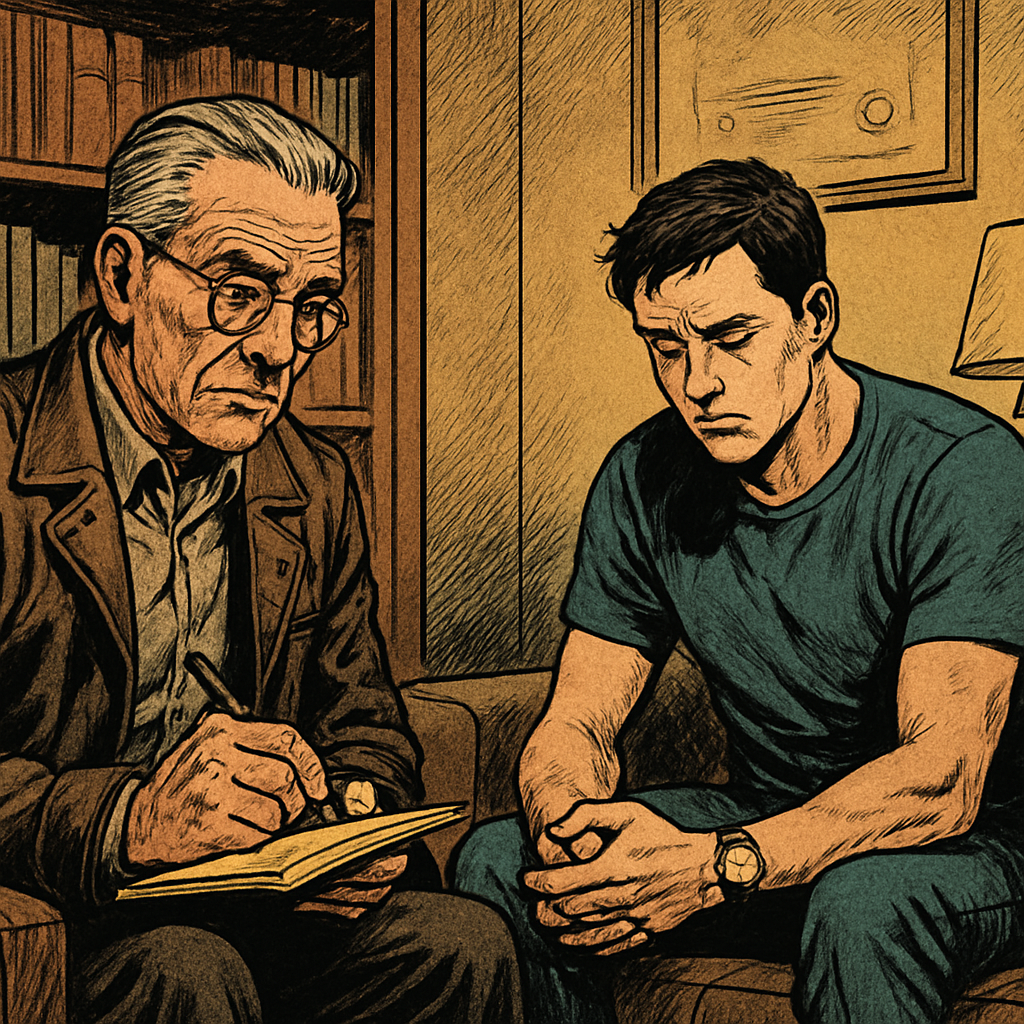
The man across from me had good teeth and good posture. He held his coffee like someone trained by military or corporate America—or both. His watch cost more than my first car. When I asked him about his father’s death three months prior, he said, “Yeah, that was rough,” the way you’d describe a flat tire. Then he stared at his hands and said nothing for four minutes. Not contemplative silence. Empty silence. The kind where you know someone’s not thinking about anything at all.
I remember Jenson because he broke every rule about what depression should look like. He wasn’t depressed. He was worse: he was gone while still showing up.
The Blank Spot Where Grief Should Live 🕳️
Jenson was 31 with a promotion coming. His social calendar was packed. His therapist before me had tried SSRIs, behavioral activation, cognitive restructuring—the full playbook. Nothing stuck because nothing was actually broken in the traditional sense. His brain wasn’t misfiring. It was protecting him by misfiling everything.
Here’s what nobody tells you about emotional numbness: it’s not the absence of emotion. It’s the presence of a very sophisticated emotional response—a compressed package of physical sensation, emotional charge, protective narrative—that’s become so dominant it’s crowding out everything else.
When the System Locks Down
When Jenson felt the weight of his father’s death, his system didn’t generate grief. Instead, it generated a protective response: a tight knot in his stomach paired with the narrative “this doesn’t matter” and the need to stay safe through disconnection. This protective mechanism had been building since childhood, but his father’s death triggered its full activation.
The physical blankness, the apathy, the absent tears—these weren’t symptoms of depression. They were symptoms of a protective system running exactly as designed, locking down the entire emotional processing plant.
The research on midlife distress in men is clear: we suffer in silence, and we suffer differently. We don’t spiral publicly. We quietly disappear while everyone thinks we’re fine. Jenson’s numbness started at birth and crystallized early. By 31, he was running on fumes of a script he didn’t even know existed.
The Invisible Frame: How Men Learn to Feel Nothing 🎭
In our second session, I asked about his mother. His face changed—not expression, but texture, like someone adjusting internal settings.
“She cried for two weeks straight,” he said about his father’s death. “Couldn’t stop. It was…” He searched for a word. “Weak.”
There it was. The invisible structure.
Jenson’s emotional frame—the interpretive lens through which he processed experience—had been installed by a value system that coded emotional expressiveness as vulnerability and vulnerability as failure. His inner voice had created a rigid script: Real men stay functional. Real men don’t burden others with feeling. Real men push through.
The Cost of Staying Strong
When loss came, his system had only one response protocol: lock down. Grief required relatedness, expression, support—all coded in his internal narrative as weakness. So instead of processing the emotions associated with grief (sadness, longing, even rage), his system bundled them into one manageable package: nothing.
This wasn’t pathology. This was his system being extraordinarily competent at what he’d trained it to do.
But here’s the real bastard part: his frame also meant he couldn’t access his own needs hierarchy. Psychologically, he needed autonomy and competence—both intact. Emotionally, he needed safety, which numbness provided. Identity-wise, he was still the guy who “handled things.” But relationally? Utterly starved. He had friends, a partner, colleagues—and felt connected to none of them because connection required the one thing his frame forbade: honesty about not being okay.
Mortality Wakes You Up, But Only If You’re Already Asleep 💀
Three sessions in, Jenson told me something: “I always knew my dad would die. Everyone dies. So I never really thought about it being a thing. A real thing. And now he’s dead and I still don’t think it’s a thing. Which means something’s wrong with me.”
Wrong. That word again.
His father’s existence had been abstracted into concept territory. “Everyone dies” is a fact. His father, dead, was somehow still a fact. Not a rupture. Not a loss. Just an update to the database.
The Trap of Efficiency
Healthy emotional granularity means breaking down overwhelming emotions into manageable pieces. Jenson had done the opposite—he’d collapsed all the complex emotions around loss (sadness, anger, fear, relief, love) into a single, flat “nothing.” His system had become so efficient at managing overwhelming potential that it had eliminated the possibility of actually feeling anything.
The cost? Purpose, direction, connection—all the things that require you to actually care about something.
Here’s the hard truth: Jenson didn’t have a chemical imbalance. He had a strategic problem. His life design was functionally excellent and existentially bankrupt. He’d optimized himself into a corner.
The Work Begins in Discomfort, Not Resolution 🔧
When we started, Jenson wanted an answer. A diagnosis. A pill. A framework that would let him understand his numbness as something external, something that happened to him rather than something he’d built.
The real work started when I stopped trying to fix him and started naming what I was actually seeing: a man whose system was doing exactly what systems do when they’re taught that feeling is dangerous. His father’s death hadn’t broken him. It had simply exposed the architecture.
Finding the Pathway Back
We used somatic work—not because his emotions were locked in his body, but because his body was the only pathway back to the emotional responses his mind had learned to bypass. Simple exercises. Breath work. Noticing the stomach sensation without immediately resolving it. The blank feeling wasn’t enemy territory. It was data.
We explored his narratives. The stories his inner voice had encoded. Why had weakness become synonymous with failure? What had he seen that taught him this? Slowly, the frame loosened. Not because I convinced him, but because he started noticing the cost.
The tension Jenson felt—between “I should be fine” and “something’s deeply wrong”—wasn’t pathology. It was necessary friction. His system was rigid enough to protect him but rigid enough to suffocate him. The discomfort wasn’t the problem. The discomfort was the solution trying to happen.
This is what separates real work from symptom management. Jenson needed to feel worse before he could feel better. He needed to let his protective frame crack enough to see what it had been protecting from.
What Success Actually Looked Like ✅
Six months in, Jenson didn’t wake up feeling joy or connection. That’s not how this works. But he did something radical: he acknowledged his blankness as information, not failure. “I’m blank again today,” he’d say.
He had a conversation with his partner about feeling disconnected. Vulnerability. The thing his frame had coded as weakness. She cried. He didn’t. But he saw her crying and didn’t immediately retreat into his narrative that feeling was pathetic.
He made one deliberate decision about his work—turned down a promotion he didn’t actually want. Not because he was depressed, but because he finally had enough internal friction to question whether he was building a life or just maintaining a performance.
What Real Change Looks Like for Men
This is what change looks like. Not transformation. Recalibration. The frame doesn’t disappear. It becomes flexible. The script doesn’t vanish. It gets a second option. The emotional responses don’t resolve. They integrate.
Most men don’t suffer from broken brains. They suffer from installed operating systems that worked perfectly for survival and worked perfectly for failure. Jenson didn’t need medication. He needed permission to be incompetent at the one thing he’d mastered: showing nothing.
That’s what the therapy room actually does. Not fix. Reveal. And once you see it—really see it—you can’t unsee it. The numbness doesn’t disappear, but it stops being the only option on the menu. 🎯
Your greatest battle isn’t fought in any field, but in the quiet moment when you finally admit the man you’ve built isn’t the man you want to be.
— Jas Mendola
- Midlife Crisis Men: 8 Warning Signs & How to Navigate – MEA Wisdom
- Midlife Crisis: Signs, Causes, and Coping Tips – HelpGuide.org
- Male mid-life crisis: causes, coping and meaning
- Development and validation of the concise midlife crisis measure
- The Midlife Crisis – Giuntella – 2023 – Economica – Wiley Online Library
- Psychometric Development of a Midlife Crisis Questionnaire (MLC-Q)