
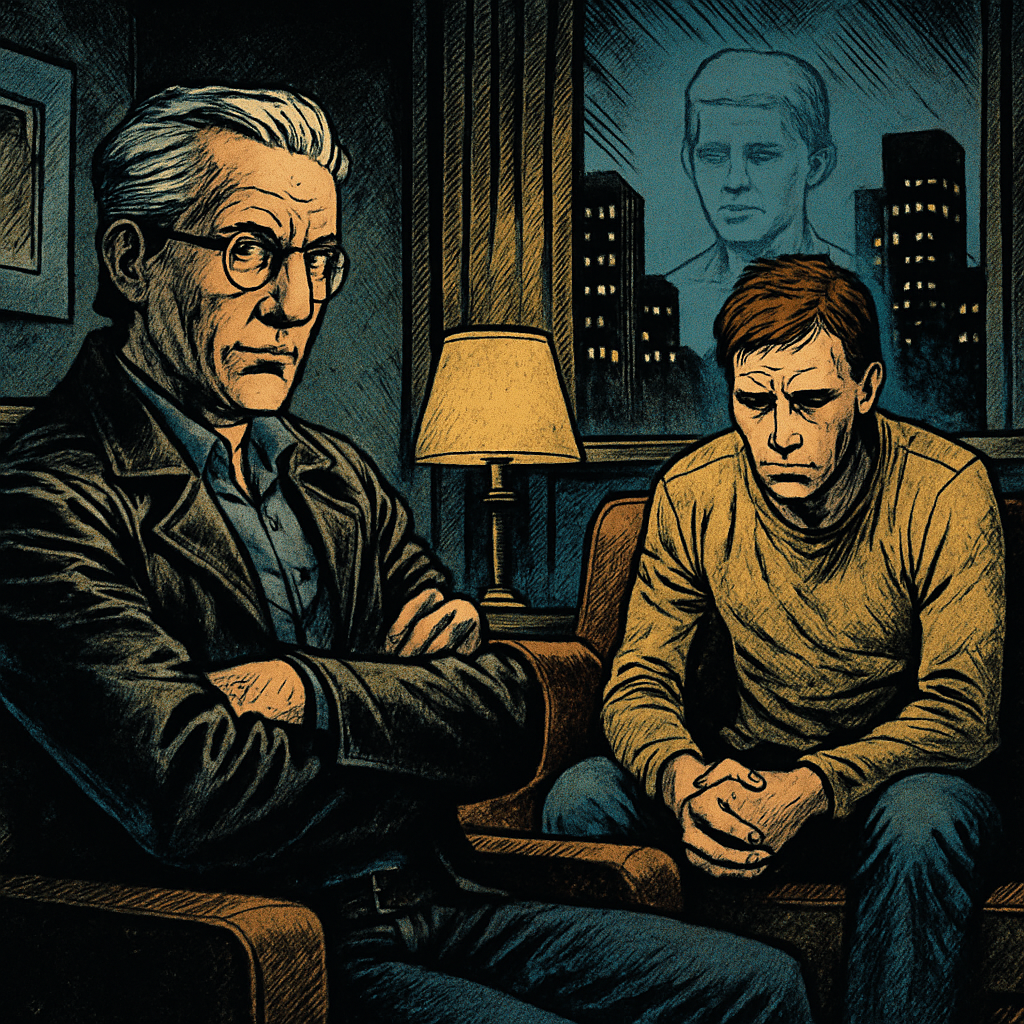
☕ A Bloke at the Café Who Couldn’t Feel Anything
He sat across from me at Three Bags Full in Fitzroy on a Tuesday morning, the kind of café where Melbourne’s thin winter light cuts through the windows like a scalpel. Jenson Reed ordered a flat white—black, no sugar, efficient—and got straight to it. “I don’t feel anything,” he said. Not depressed. Not anxious. Just… nothing. Like someone had reached into his chest and removed the machinery, left only the shell running.
His father had died three months earlier. Everyone expected tears. Everyone got silence. His mother was falling apart, and he sat beside her feeling like a fraud, unable to access the thing that should have been there.
I remembered Jenson because he was the kind of client who makes you realize how broken our diagnostic categories really are.
🎯 The Thing They Can’t Name
What Jenson was describing didn’t fit the boxes. It wasn’t depression—he still went to work, still trained at the gym, still showed up to his mates’ plans. It wasn’t anxiety because there was no edge to it, no hypervigilance. There was just a vast, blank corridor inside him where feeling should have been.
Here’s what I know now after fifteen years in this room: emotional numbness in a functional adult is almost never what the textbooks call it. It’s not a symptom of pathology. It’s a system that’s made a strategic decision.
Jenson’s internal architecture had built what I call an Emotional Byte Jam—not the loss of emotional information itself, but a complete blockage in the system’s ability to encode, recognize, and process it. His body was still collecting data: grief, confusion, identity shake-ups from his father’s death. But somewhere between the physical sensation and the conscious feeling, the wiring had corroded.
This happens to guys especially around midlife, roughly between 38 and 55, though Jenson was only 31. The research is clear—there’s a documented U-shaped dip in well-being across wealthy nations right in that zone, where men at peak earnings and fitness paradoxically fall into their darkest hole. But here’s what the research dances around but doesn’t say outright: this numbness is often a direct inheritance from how men are taught to metabolize loss. Men don’t grieve; they endure. They don’t feel; they function. By midlife, the cost compounds so severely that the system just… stops trying to translate emotion into experience.
What successful people know but don’t talk about publicly: The most dangerous men aren’t the angry ones. They’re the ones who’ve trained themselves so thoroughly to feel nothing that numbness becomes their default operating system. And the worst part? It works—until it doesn’t.
📖 Reading Between the Lines: What the Blank Feeling Actually Is
His identity had been constructed—like most functional men’s—on a rickety scaffolding of achievement, competence, and relational availability. Work was solid. Gym routine was solid. Mates and social circle, solid. These weren’t fake; they were real. But they were also Emotional Frames—interpretive lenses he’d built to organize his entire reality around what he could control and measure.
Then his father died. And the frame shattered.
What happened next was textbook: His father’s death triggered mortality salience—a sudden, visceral awareness that death is coming for him too. The entire edifice he’d built on “being capable” suddenly felt meaningless because capability can’t stop time. That realization is existentially terrifying. Most people process this by grieving; they feel the loss, they integrate the change to their identity, and over months or years, they reorganize.
But Jenson had a different problem. Somewhere in his early years, he’d learned that emotions were either dangerous or irrelevant. His Inner Voice—that internal narrator we all carry—had been trained by early experiences to interpret emotional information not as valuable data but as a liability. Maybe his father had modeled stoicism as strength. Maybe his mother’s needs had been too much, and he’d learned young that the safest response was psychological retreat. Whatever the blueprint, his system had organized itself around a core principle: feeling deeply is not safe.
So when his father died and all that grief showed up—legitimate, real, appropriate grief—his system did what it had always done: it created a blockade. Not consciously. The system doesn’t work through conscious decisions. It works through protective patterns so old and so embedded that they feel like truth.
That blank feeling in his stomach? That wasn’t the absence of emotion. That was the physical sensation of a complete emotional traffic jam.
⏰ The Midlife Crisis That Started Early
“You’re in a midlife crisis,” I told him. “Except you’re doing it fifteen years early.”
The research on midlife crisis shows a clear pattern—a universal psychological confrontation with finitude that has nothing to do with how much money you make or how fit you are. It’s characterized by identity uncertainty (Who am I now that I’m not my father’s son?), existential regret (Have I made the right choices?), and emotional distress including numbness and anhedonia. The joy doesn’t leave gradually; it just becomes inaccessible, like it’s behind glass.
Most men experience this at 45. Jenson was experiencing it at 31 because his father’s death had accelerated the whole process. He was being forced to confront questions most men avoid for another decade: What happens when the people who defined us disappear? Who are we then?
But here’s what gets lost in the research data: men’s midlife crisis is silent. Women talk about it. They process it with friends, therapists, sometimes publicly. Men internalize it. They look fine. They perform fine. They’re quietly disintegrating.
Jenson’s anger at his own numbness—the frustration that kept surfacing in our sessions—that was actually a healthy sign. It meant some part of him was still fighting against the blockade.
“I’m angry that I can’t feel angry about losing my dad. Does that make sense?” he said in our third session.
Perfect sense. That’s a man whose system recognizes it’s trapped itself.
🔧 The Invisible Structures Nobody Mentions
What none of the diagnostic manuals capture is how Invisible Structures shape this experience. These are the unspoken social rules, the cultural gravity fields, the expectations that organize a man’s entire emotional apparatus without him knowing it.
Jenson had absorbed a specific invisible structure early: men don’t need things from people; people need things from men. His relational identity had been built around being capable, available, competent. His mother grieved. His mates didn’t. He was positioned as the strong one—the one who showed up, who had it together, who didn’t collapse under the weight of loss.
That’s not strength. That’s a performance so well-executed that he’d confused it with actual personhood.
The deeper issue is that Jenson’s entire needs hierarchy had been inverted. His psychological needs (autonomy, competence, relatedness) were being met. But his emotional needs (safety to feel, permission to be uncertain, space to be vulnerable) were starving. His identity needs (authenticity, validation, self-understanding) had collapsed because so much of his identity was performance.
And his relational needs? Completely offline. He was available to everyone. He wasn’t available to anyone.
When his father died, he lost not just a person—he lost one of the few people who might have given him permission to not be the strong one. And because he’d never developed the skills to process loss in any other way, his system did what it does: it shut down the whole operation.
⚠️ Why This Matters: The Pattern Most Men Repeat
Here’s the uncomfortable truth that rings real in every neighbourhood in Australia: We’re raising men to be emotional illiterates and then punishing them when they can’t read.
Jenson wasn’t uniquely broken. He was typically broken. He was a perfectly functional man operating with a first-grade emotional vocabulary in a situation that demanded postgraduate-level complexity. His father’s death wasn’t the problem. It was the catalyst that exposed a much older problem: nobody had ever taught him how to translate physical sensation into emotional granularity, or how to distinguish between different types of emptiness.
That blank feeling in his stomach contained grief, yes. But it also contained identity crisis, existential dread, relational disconnection, and rage at himself for not being able to feel the way he thought he should. It was all mushed together into one overwhelming, incomprehensible blob. No wonder he shut it down.
🔍 The Work We Did: Starting Small
The work we did wasn’t complicated. It was just granular.
We didn’t try to unlock some hidden reservoir of grief. We started smaller. We looked at the Emotional Bytes—those units of information containing physical sensation, emotional charge, need state, and narrative—that were stuck in his system. When I asked him about that blank feeling in his stomach, I had him just sit with it. Not fix it. Not understand it. Just notice it.
“What does the blank feel like, physically?”
“Cold. Like… frozen.”
“Where exactly?”
“Center. Right here.” He pointed to his solar plexus.
That’s data. From there, we could start moving.
Over weeks, the narrative shifted. The frozen feeling wasn’t just about his father’s death. It was about the terrifying realization that he didn’t actually know who he was outside of being competent. It was about confronting that his entire relational world was one-directional—he was the one who showed up for people, and nobody was showing up for him. It was about acknowledging that somewhere in his thirties, his life had become a series of obligations he no longer questioned.
The blank feeling, it turned out, was his system’s way of saying: I can’t keep doing this. But I don’t know how to do anything else.
Here’s the truth: Emotional numbness in a functional man isn’t a bug in the system. It’s a feature. It’s what happens when the system has optimized so completely for external performance that internal experience becomes irrelevant noise.
✨ What Happened Next
I’m not going to tell you that Jenson had some breakthrough moment where he broke down crying and felt everything. That’s cinematic bullshit. What actually happened was slower and more useful.
He started noticing patterns. The way he’d positioned himself in his friend group—always the listener, never the one being listened to. The way he’d structured his work—always chasing the next achievement, never stopping to ask if any of it mattered. The way he’d related to his mother’s grief—as a problem to manage rather than an invitation to connect.
He started experimenting with Intentional Experiences—small, deliberate moments that created new emotional bytes. He went to his father’s grave and sat there doing nothing. He called his best mate and, for the first time, talked about how lost he felt instead of asking how the mate was doing. He took a week off work and just existed in his apartment without a plan.
None of this was therapeutic technique. It was just permission to be a different version of his own life.
The numbness didn’t disappear. But it became specific. He could distinguish between sadness about his father, anger at himself, and anxiety about his future. He could feel those separately instead of as one undifferentiated blob. That’s Emotional Granularity—the ability to make finer distinctions, to transform overwhelming emotions into manageable ones.
By the time we wound down our sessions, he wasn’t “fixed.” He was different. More integrated. Still functional, but in a way that included his actual experience instead of excluding it.
The strength he’d thought was about being unshakeable? He realized strength was actually about being honest about what was shaking him.
💭 What This Teaches Us
I remember Jenson because he taught me something essential about men and numbness: it’s never really about the absence of feeling. It’s about a system so committed to survival that it’s chosen invisibility as the price of safety. And because that choice happened so early, before language could even articulate it, most men live their entire lives never knowing they made it at all.
The conversation at Three Bags Full wasn’t about fixing him. It was about teaching him a different way to read the instrument panel of his own life. Every blank feeling was information. Every frozen place was protection. Every moment of numbness was his system saying: I need something, and I don’t know how to ask.
That’s not pathology. That’s just what happens when capability becomes a prison and performance becomes the only permitted language.
Your greatest battle isn’t fought on any field, but in the quiet moments when nobody’s watching, and you’re finally honest about what’s been hollow all along.
—Jas Mendola
- Midlife Crisis Men: 8 Warning Signs & How to Navigate – MEA Wisdom
- Midlife Crisis: Signs, Causes, and Coping Tips – HelpGuide.org
- Male mid-life crisis: causes, coping and meaning
- Development and validation of the concise midlife crisis measure
- The Midlife Crisis – Giuntella – 2023 – Economica – Wiley Online Library
- Psychometric Development of a Midlife Crisis Questionnaire (MLC-Q)