
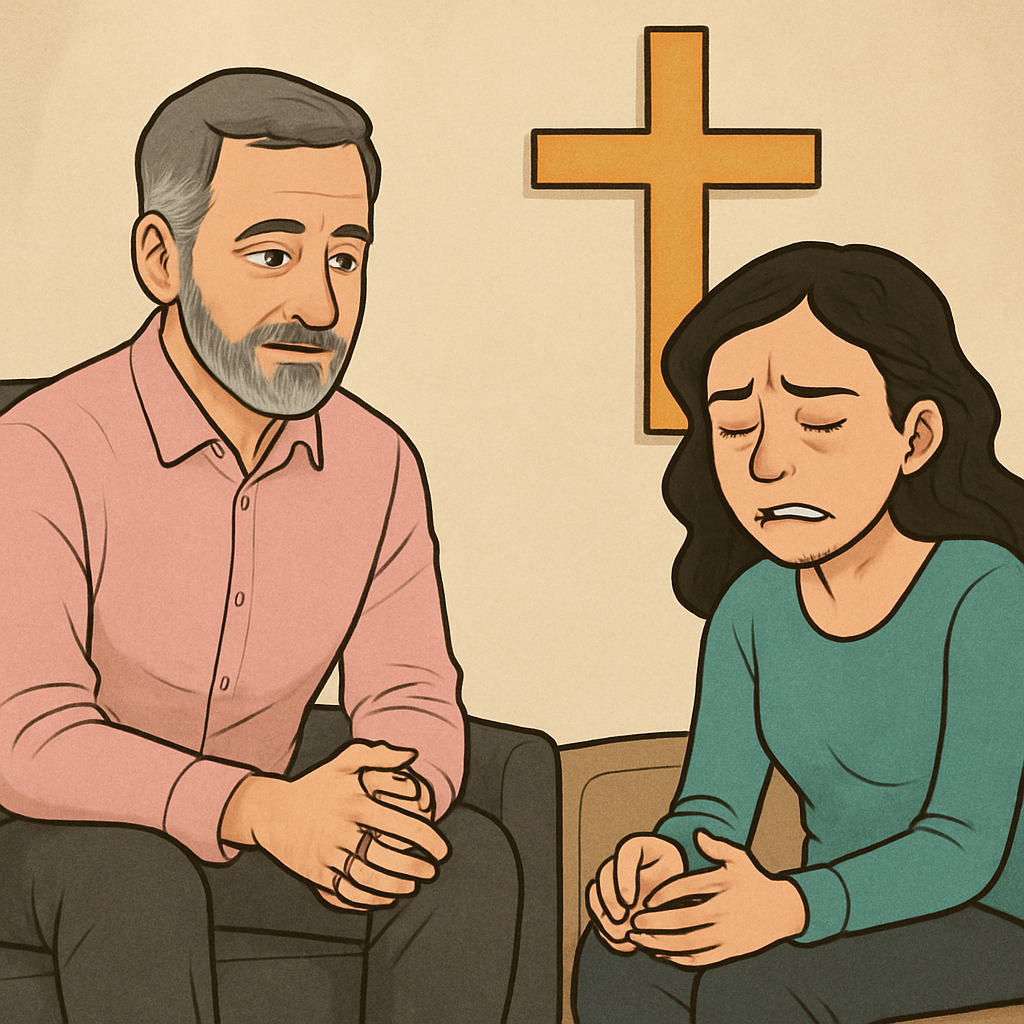
A Confessional 🪑
Tabitha sat across from me on a Tuesday afternoon, autumn light casting long shadows through my office windows. She was doing that thing—the one I’d learned to recognize over twenty-five years of sitting with wounded professionals. She was performing fine while falling apart simultaneously. Her posture was upright, her voice measured, her words carefully chosen. But her hands told a different story. They moved like frightened birds in her lap, restless and searching for somewhere safe to land.
“I know I should be over this by now,” she said, which is how most trauma survivors begin. Not with their actual pain, but with self-directed critique of their recovery timeline. “It’s been months. I left the school. The people responsible are basically gone. So why do I still feel like I’m there?”
That question—why am I still here?—is always the one that matters most. Not because the answer fixes anything, but because asking it means someone is finally ready to look beneath the surface of what they thought they understood about themselves.
The Emotional Bytes Still Firing 🧠
What fascinated me about Tabitha’s experience wasn’t simply that she’d endured toxicity. It was that her nervous system continued generating the same emotional patterns it had learned in that poisoned environment, even though the environment itself was now a memory.
An emotional byte, in its simplest form, is a complete package: a physical sensation, an emotional charge, a need-state, and a mini-story that ties it all together. When Tabitha worked at that school, her system learned certain bytes very well. The tightness in her chest when she saw the counselor’s name in an email. The flutter of dread during silent staff meetings. The shame crawling up her neck when she thought about not protecting her child better.
These weren’t just emotions—they were information packages her nervous system had encoded as predictive models: This is what danger looks like here. This is what you need to watch for. This is what happens when you’re not careful enough.
The problem was that Tabitha had left the school, but her emotional bytes hadn’t gotten the memo.
“Tell me about last Thursday,” I said. “You mentioned in your intake form that something triggered you.”
She nodded slowly. “I was at the grocery store. I heard someone laugh—a laugh that sounded like one of the teachers who sided with the counselor. Not the same person, obviously. Just a similar laugh. And suddenly I’m standing in the cereal aisle with my heart pounding like I’m back there, like they’re about to whisper something about me.”
This is the haunting that toxic workplaces leave behind. Not ghosts, exactly—but the remnants of emotional bytes that continue firing in the absence of the original threat. Her body had learned a language of survival in that environment, and now it was speaking that language to the grocery store, to the neighbor’s laugh, to innocent emails from current colleagues.
What Tabitha was experiencing was what I call entrenchment. Her emotional frame—the interpretive lens through which she now saw the world—had become so organized around threat-detection that it was reading danger into benign stimuli. This is what happens when an environment has systematically violated your sense of safety and your child’s safety. Your system doesn’t trust neutral anymore.
The Invisible Architecture of Self-Doubt 🏗️
Here’s what Tabitha didn’t initially understand: her self-doubt wasn’t about the soundness of her decision to leave. The decision itself was sound, protective, necessary. But her inner voice had become something like a prosecuting attorney, marshalling evidence not to set her free but to keep her imprisoned.
“Maybe I overreacted,” she said in our third session, and I heard the familiar refrain of someone in the grip of what I call retrospective reframing—the tendency to rewrite your own story in service of self-protection. By convincing yourself you were overreacting, you get to tell yourself the environment wasn’t as bad as it was, which means maybe you weren’t in as much danger, which means maybe you weren’t as vulnerable as you felt.
But vulnerability isn’t weakness. It’s the accurate registration of threat.
“Tell me about the counselor’s behavior with your child again,” I said gently.
Tabitha’s hands resumed their restless movement. “They were boundary-crossing. Commenting on my child’s home life. Asking leading questions. Once, I found out my child had shared something intimate that I’d never told them. And when I brought it up professionally, the counselor made me feel like I was being overprotective. Paranoid. Like I was the problem for having normal parental boundaries.”
There it was: the classic architecture of toxicity. A boundary violation followed by gaslighting. Someone crossing a line, then making you feel unstable for objecting.
This is where emotional frames become so imprisoning. Tabitha had developed a frame around her own judgment: I thought I was protecting my child, but maybe I was overreacting. I thought the behavior was inappropriate, but maybe I’m anxious. I thought I needed to leave, but maybe I should have tried harder.
Each “maybe” was an emotional byte—a physical sensation of self-doubt, an emotional charge of guilt, a need to be seen as reasonable, and a mini-story: I’m the kind of person who can’t trust her own perception.
The tragedy was that Tabitha’s perception had been accurate. The counselor’s behavior was inappropriate. The environment was toxic. Her decision to leave was correct. But her inner voice had organized itself around doubt because doubt—at least—felt more controllable than rage. Rage would require action. Rage would require believing she was wronged. Doubt was smaller, manageable, hers to carry alone.
The Needs Beneath the Narratives 💔
As I listened to Tabitha across several sessions, I began noticing the deeper architecture of her struggle. Beneath her self-doubt was a fundamental injury to her psychological needs—particularly her need for autonomy and competence.
In that school environment, she’d been systematically disempowered. Her concerns were dismissed. Her professional judgment was questioned. Her protective instincts regarding her child were pathologized. Over time, this eroded not just her confidence but her basic sense that she had agency—that she could trust her own mind to interpret reality correctly.
But there was another layer: an identity need for authenticity. Tabitha was someone who wanted to advocate for others. She had genuine care for her students. She valued fairness and loyalty. The toxic environment had weaponized these values against her. By staying in the environment trying to fix it, she was simultaneously honoring her authentic self and abandoning her own safety. That’s a devastating contradiction to live inside.
Then there was the relational need. Tabitha had expected that in a school community—a place ostensibly dedicated to nurturing young people—there would be responsiveness and support when she raised legitimate concerns. Instead, she encountered silence, manipulation, and protection of the perpetrators. The system failed to respond to her vulnerability with care, which created a secondary wound: not just that she was unsafe, but that she was unsafe in a place that claimed to be about care.
The Emotional Scripts That Became Her Prison 🔄
By our fifth session, I was beginning to see how Tabitha’s experience had generated full emotional scripts—automatic patterns of behavior that had begun to feel inevitable, like just “who she was now.”
One script went like this: Perceive social cue (colleague’s tone shift, admin’s email) → Scan for threat (Is this another setup? Another betrayal?) → Activate shame (This is happening because I’m not good enough) → Perform competence and professionalism (Be small, be careful, be perfect) → Experience exhaustion and disconnection.
It was a loop. And the insidious part was that it worked, in a sense. She wasn’t getting attacked again. But she was living in perpetual self-protection, which is just a slower form of the same violence the toxic environment had inflicted.
Another script was even more painful: Notice self-doubt → Reinterpret the past → Question whether you were right to leave → Feel guilty for chaos that followed → Conclude maybe you were the problem → Ruminate on everything you could have done differently → Return to the beginning.
This is what I call a self-perpetuating emotional frame. It creates its own evidence. The rumination feels like deep thinking, but it’s actually your nervous system running the same pattern over and over, hoping for a different outcome. It won’t produce one. That’s not how rumination works.
Where Grace Meets Neurobiology ✨
Here’s what I wanted Tabitha to understand—and this is where my theological convictions as a pastor collide with my training as a clinician in ways that feel absolutely essential.
Tabitha had been raised in a church tradition that emphasized forgiveness, grace, and letting go of bitterness. These are beautiful values. But she had internalized them in a twisted way: as an obligation to forgive herself for being hurt. To release her anger at injustice. To stop being “difficult” about boundaries. To perform grace in ways that required abandoning her own protection.
That’s not grace. That’s spiritual weaponization.
Real grace—the kind that actually heals—begins with something much more foundational: acknowledgment. God’s heart toward your struggle isn’t to rush you past the pain to forgiveness. It’s to meet you in the reality of what happened. To say with absolute clarity: That was wrong. You didn’t deserve that. Your child didn’t deserve that. Your boundaries weren’t unreasonable. Your anger is valid.
Only from that foundation can real grace begin.
I remember the moment it shifted for Tabitha. She was doing her usual thing—reinterpreting the past, softening what happened, preparing to forgive everyone including herself for having suffered. And I interrupted her gently.
“Tabitha, you keep trying to make sense of what happened by figuring out what you did wrong. What if nothing you did caused this? What if the problem genuinely wasn’t you?”
She looked at me, and I watched her eyes fill with tears—not the careful, controlled tears of someone being professional, but the raw tears of someone finally allowing themselves to feel betrayed.
“That doesn’t make it better,” she whispered. “That just means it was unfair.”
“Yes,” I said. “It was unfair.”
And something in her—some tightly wound mechanism—finally began to release.
Rewriting the Scripts 📝
The healing that followed wasn’t about Tabitha “getting over it” or “moving on.” Real recovery looks like updating your emotional bytes. It looks like your nervous system learning new information and beginning to generate new patterns. This takes time and what I call intentional experiences—creating new moments of safety, new moments where her boundaries were respected, new moments where she was seen and believed.
Some of this happened in therapy itself. Tabitha would share something that had happened—a moment where she advocated for herself, a moment where she noticed her self-doubt pattern activating, a moment where she felt the old shame byte beginning to fire. And I would simply witness it. I wouldn’t minimize it or rush past it or offer solutions. I would sit with her in the accuracy of her perception and the legitimacy of her experience.
Over time, her emotional frame began to shift. Not because she convinced herself to think differently, but because she had consistent evidence that her perceptions were reliable. That her boundaries were reasonable. That her protective instincts toward her child were exactly right.
We also worked with what she called her “prosecutor voice”—that inner voice that had organized itself around finding evidence of her failure. We didn’t try to eliminate it. Instead, we began to hear what it was actually trying to protect: a version of Tabitha that desperately wanted to believe she could have controlled the situation, because control feels safer than vulnerability.
“Your voice is trying to protect you,” I told her. “It’s saying, ‘If you were the problem, then at least the problem is knowable. At least it’s fixable.’ But you have agency anyway, Tabitha. You already proved that. You left. You protected yourself. You got out.”
The scripts began to change, very slowly. Gradually, her nervous system began to trust new information.
The Deeper Pattern: What Toxic Environments Actually Do 🌪️
What struck me about Tabitha’s case, reflected across my years working with people in poisoned professional environments, is how these spaces don’t just damage you in the moment. They reorganize your entire interpretive apparatus. They create what we might call invisible structures—unspoken rules, power dynamics, and expectations that burrow so deeply into your being that you continue operating by them long after you’ve left.
One of the invisible structures in Tabitha’s school was the understanding that advocating for yourself was selfish. That staying professional meant staying silent. That being kind meant absorbing others’ cruelty. These weren’t explicit rules. They were the water everyone was swimming in, and Tabitha had learned to breathe it.
Even after she left, she found herself applying these rules to her own recovery. She was being “selfish” by prioritizing her healing. She was being “unprofessional” by being angry. She was being “unkind” by not giving people the benefit of the doubt indefinitely.
These invisible structures are so powerful because they operate beneath consciousness. You don’t realize you’re still following the rules of a place you’ve left. Your behavior feels like just who you are. This is why there’s no substitute for actually naming these patterns. For bringing them into consciousness where they can be examined and questioned. For asking: Who made this rule? What purpose did it serve? Does it still serve me?
For Tabitha, the answer was no. The rules of the toxic environment had been necessary survival tools. But survival isn’t living.
Pastoral Observation: The Spiritual Dimension of Self-Doubt ⛪
I want to speak directly to something I observed in Tabitha’s spiritual life, because I think it’s relevant to many people who’ve endured toxicity in religious or quasi-religious institutional contexts.
Tabitha had been taught that God works through all circumstances for good. That there’s a reason for suffering. That she should be grateful for what the experience had taught her. These are comforting theologies when you’re safe. They become suffocating when you’re trying to process trauma.
What Tabitha needed to hear—what I believe is actually biblical—is that sometimes what God does is witness injustice without explaining it. When the Psalms are full of cries of abandonment, when Job demands that God answer for innocent suffering, when Jesus cries out “Why have you forsaken me?”—these aren’t moments of weak faith. They’re moments of honest relationship with a God who is big enough to handle human rage.
I remember saying to Tabitha: “Your anger at what happened isn’t a sign you don’t trust God. Your anger might actually be evidence that you know God’s character well enough to recognize that what happened violated it.”
She wept when I said that. Not because it solved anything, but because it gave her permission to feel what she actually felt, rather than the feeling she thought she was supposed to have.
God’s love for you—and I’m telling you now, if you’re reading this while drowning in a similar experience—is not diminished by your struggles, but demonstrated through His
- How Toxic Workplace Environment Effects the Employee Engagement
- Study Details Negative Effects of Toxic Leadership and Workplace …
- The Long-Term Mental Health Impact of Toxic Work Relationships –
- How to Spot a Toxic Work Environment | Berkeley Exec Ed
- Toxic workplaces leave employees sick, scared, and looking for an …