
🔍 The Spreadsheet of Betrayal
I once knew a woman who kept a mental inventory of her boyfriend’s daily behavior—every delayed text, every defensive flinch when she mentioned the party where he’d entangled himself with someone else. She calculated percentages like a day trader: 73% chance he’s sincere, 27% I’m an idiot. The numbers never added up to trust, only exhaustion.
That’s what betrayal does—it turns your brain into an accountant for a debt that can never quite be paid.
🏠 Rebecca’s Problem: The Eggshell Economy
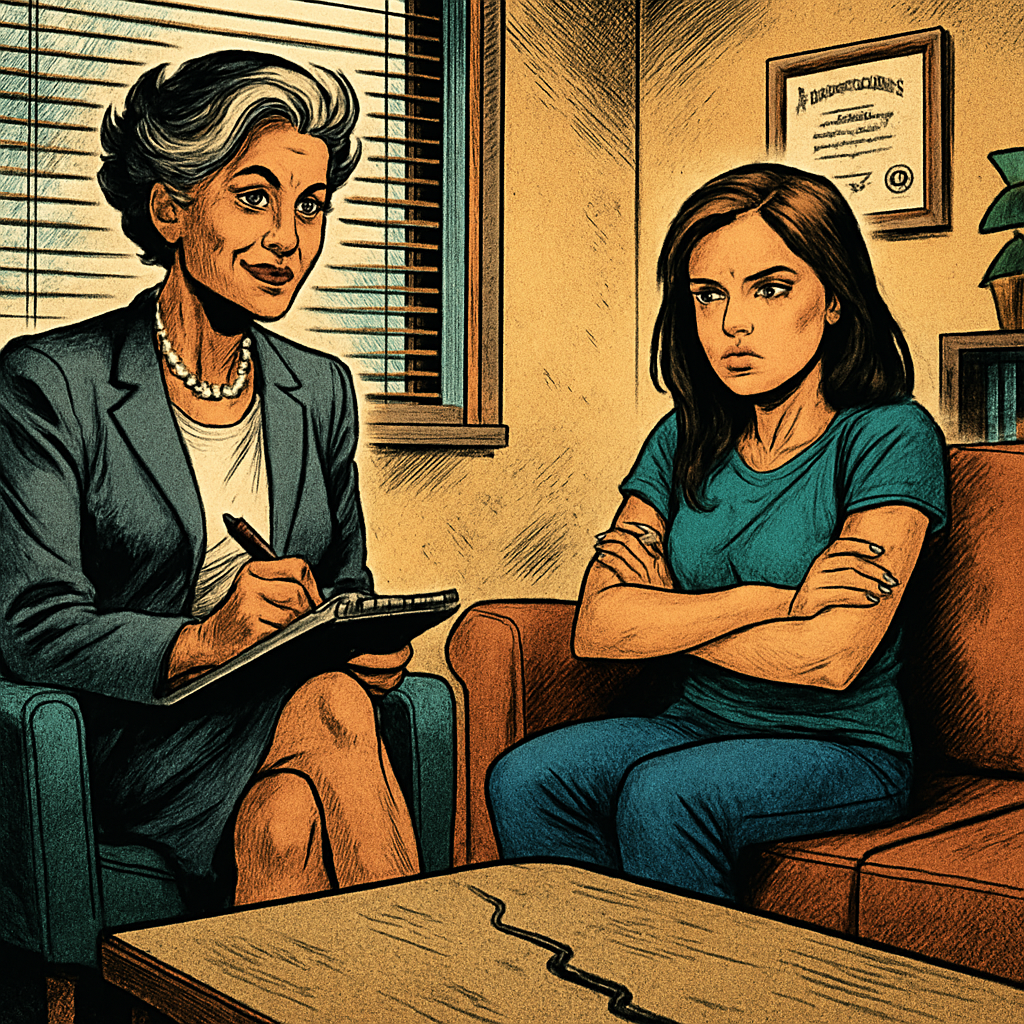
Rebecca sat across from me with the particular tension of someone who’d been holding their breath for a year. Her boyfriend had gotten physically intimate with another woman at a party—not sex, but enough to detonate the relationship. He’d begged his way back in, done the work, dialed down the defensiveness. By most measures, he was trying.
But Rebecca felt like she was living in a house where the foundation had cracked, and everyone kept insisting the paint job looked great.
Here’s what she actually said: “I don’t know if I’m staying because I want to, or because he won’t let me leave.”
That sentence contains the entire problem. She’d given him a second chance, but her emotional system was still screaming the original verdict: unsafe. Every attempt to discuss what happened triggered his defensiveness, which reinforced her narrative that she wasn’t allowed to feel what she felt. Her needs for emotional safety and relational validation were in direct combat with his need to stop being the bad guy.
Neither could win.
🧠 The Hidden Architecture of Distrust
Research shows 60-75% of couples attempt reconciliation after infidelity, with about 57% still together five years later if they disclose fully and engage in therapy. Secret affairs? Those crater at 80% separation rates. The difference isn’t transparency alone—it’s whether new emotional experiences get created to challenge the predictive model now running Rebecca’s system: He will hurt you again.
Her brain had encoded the betrayal into her body. Every conversation about it triggered the same loop: anticipate defensiveness, brace for invalidation, feel unheard, question reality. This is an emotional script running on autopilot—a behavioral pattern that feels inevitable because it’s built from repeated experience. The script doesn’t care that he’s improved. Scripts don’t update themselves just because someone says “I’m sorry.”
Rebecca’s unconscious fight-picking made perfect sense. Her emotional frame had shifted from “we’re a team” to “I’m waiting for proof this will fail.” So she’d unconsciously test it. Create small conflicts. Look for the flinch, the deflection, the confirmation that her distrust was justified.
It wasn’t self-sabotage—it was her emotional system desperately gathering data about whether this relationship was survivable.
⚖️ The Ambivalence Trap
Rebecca wasn’t just dealing with trust issues—she was caught in what research calls “ambivalence assimilation.” She was trying to hold two contradictory realities at once: He’s changed and I’m not safe. Both felt true. Both had evidence. Her inner voice couldn’t reconcile them, so it looped endlessly: Maybe I’m crazy. Maybe I should leave. Maybe I’m trapped.
I asked her what scared her more: staying or leaving.
“The unknown,” she said.
Of course. Leaving meant dismantling a year of trying, admitting the sunk cost, facing the terror of starting over. But staying meant living in perpetual uncertainty. The emotional charge around both options was overwhelming—a massive bubble of dread she couldn’t see through.
So we worked on emotional granularity. Breaking that bubble into fizz. What specifically felt unsafe? Not “I don’t trust him”—what sensations, what scenarios, what needs weren’t being met?
When she said “walking on eggshells,” her body tightened. Hypervigilance about his mood. The need to manage his reactions so she could express her pain.
That’s not partnership; that’s emotional labor to avoid his discomfort with her hurt.
🔨 What Trust Actually Requires
Here’s the hard truth about rebuilding trust after betrayal: it’s not about forgiveness or time. It’s about whether both people can create new experiences that genuinely contradict the betrayal narrative.
His defensiveness was a wall preventing that. Every time she tried to express lingering pain and he turned it into his hurt feelings, he was essentially telling her: Your needs threaten my identity, so I’ll make this about me. That’s an invisible structure in their dynamic—an unspoken rule that his comfort mattered more than her healing.
Studies on infidelity therapy show that couples who recover go through distinct phases: emotional discharge (the raw grief and rage), meaning-making (understanding why it happened without minimizing it), and trust assimilation (slowly rebuilding safety through consistent action). Rebecca and her boyfriend were stuck in phase one because he kept trying to skip to phase three. He wanted credit for changing without sitting in the wreckage long enough for her to feel heard.
His year of improvement meant nothing if her emotional system hadn’t received new information that challenged the betrayal script. “He’s less defensive now” isn’t the same as “he can hold space for my pain without collapsing into his shame.”
❓ The Question She Wasn’t Asking
After weeks of unpacking these patterns, Rebecca said something that shifted everything: “I keep waiting for permission to leave.”
She’d been looking for a catastrophic failure—a second betrayal—because she didn’t trust her own needs as sufficient reason to end it. That’s the real ambivalence trap: the belief that you need a dramatic justification to honor what your emotional system has been screaming all along.
I asked if she’d stay if she knew with certainty he’d never cheat again.
She paused. Then: “I don’t know if I even like who I am in this relationship anymore.”
There it was. The issue beneath the issue. This wasn’t just about his betrayal—it was about her identity need for authenticity colliding with a relationship that required constant self-editing. The eggshells weren’t just about his defensiveness; they were about her losing herself in the effort to make this work.
Ask yourself: Are you staying because you want to, or because you’re afraid of what leaving means about you?
🔄 Where She Landed
The last time I saw Rebecca, she hadn’t made a decision yet. But she’d stopped picking fights. Not because she’d found peace, but because she’d stopped needing him to prove her distrust was valid. She was allowing the disintegration—that necessary psychological tension—to do its work.
Sometimes growth doesn’t look like resolution. Sometimes it looks like sitting with the uncertainty long enough to see what it’s actually made of.
She told me she’d started asking herself a different question: not “Can I trust him?” but “Do I want to build the kind of trust this relationship would require?”
That shift—from passive suffering to active evaluation—was everything. Because reconciliation isn’t doomed, but it also isn’t inevitable. It’s a choice that requires both people to create new emotional architecture together, not just repaint a condemned building.
Trust isn’t rebuilt by erasing the crack—it’s rebuilt by both of you learning to walk across it without pretending it isn’t there.
— Sophia Rivera, who once watched a client spend thirty minutes explaining why she couldn’t leave a relationship before realizing she’d already left it emotionally six months prior. The body knows before the spreadsheet does.
- [PDF] Infidelity and Behavioral Couple Therapy: Relationship Outcomes …
- Full article: Grappling with Infidelity: The Experiences of Therapists
- How Long Do Couples Stay Together After Infidelity?
- [PDF] The consequences of spousal infidelity for long-term chronic health
- Couple healing from infidelity: A grounded theory study
- Staying Together After Infidelity: An Exploration of the Decision … – NIH