
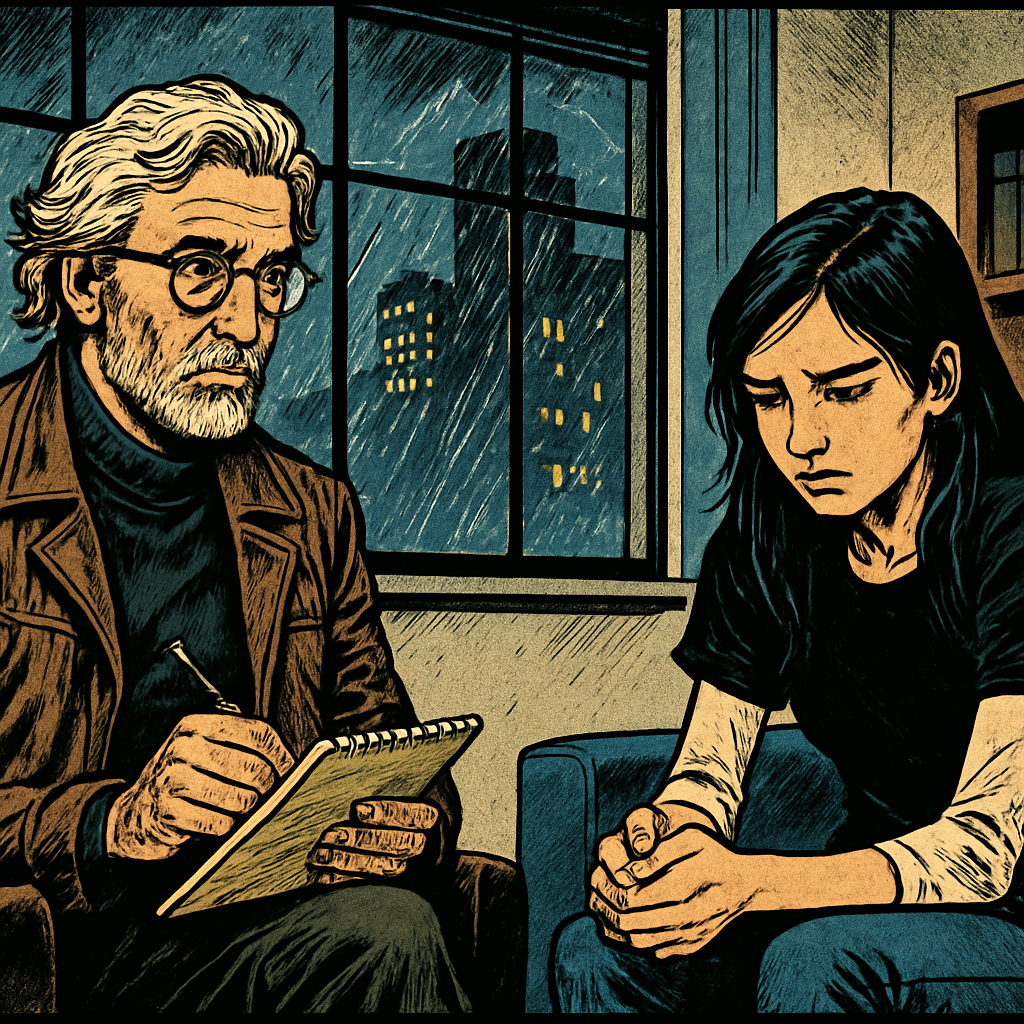
The rain fell heavy outside my office that Tuesday. Kaia-Renee had been coming to see me for eight weeks. This was the session where everything shifted, though neither of us knew it yet.
She was sixteen, and she was certain there was something fundamentally broken inside her. Not broken like a car with a bent fender. Broken like a monster wearing a girl’s face.
That’s when she asked me the question that would haunt me for a week: “Am I a bad person, or am I just broken?”
I knew the answer, and I knew it was going to hurt her before it healed her.
Kaia-Renee had been bullied, sexually abused, isolated through homeschooling, and left alone with a body she hated. Her dad died. Somewhere between third grade and now, she lost the happy girl. So her mind—smart, adaptive, survival-focused—built something. A system that looked like classic vulnerable narcissism on paper: grandiose fantasies of being perfect and loved, intense focus on how others perceived her, jealousy that could flip to rage in seconds, confusion about whether she could actually feel real empathy.
That’s a kid’s brain saying, “I’ve been hurt. I’ve been rejected. I’ve been invisible. So I’m going to build a version of myself that’s impossible to hurt, and I’m going to study everyone else so intensely that I can predict their rejection before it comes.”
I had to explain something to Kaia-Renee that most therapists dance around: her mind wasn’t operating on conscious logic. It was operating on Emotional Bytes—compact packages of information her nervous system had compiled from years of experience. Physical sensations plus emotional charge plus needs plus mini-stories about what safety meant.
When she was bullied for her weight, she didn’t just learn “people will judge me.” Her system learned: Closeness equals judgment equals pain. Check others before they check you. Your body is the enemy. Other people’s opinions literally determine your worth.
Those bytes got organized into an invisible lens that colored everything. When her mom lost weight, Kaia-Renee didn’t just feel jealous. A whole script activated: She’s becoming beautiful and leaving me and I’m getting bigger and more invisible.
But here’s what matters: scripts can be updated. Frames can become flexible. Bytes can be reprogrammed when you understand what information they’re carrying.
Your Inner Voice 📡
One session, Kaia-Renee told me something that broke my heart: “I don’t know if I actually care about people or if I’m just really good at pretending. When my mom got cancer, I didn’t even cry. But then I cried for like six hours about my body. Am I a sociopath?”
I’ve read every study on adolescent narcissism and trauma-shame cycles. Here’s what they’re not saying loudly enough: the traits that look like narcissism—image obsession, empathy struggles, jealousy, manipulation—are often just sophisticated survival mechanisms in disguise.
Kaia-Renee scanned conversations because she was trying to predict rejection. She questioned whether her care was real because she’d learned her instincts couldn’t be trusted. She fantasized about being perfect and loved because her actual life was rejection. The violent urges toward family? That’s shame converting to rage when it has nowhere else to go.
Her inner voice had been shaped by conditional acceptance—people who showed up only when she performed correctly, peers who loved her only when she was entertaining. So that voice became a scanner instead of a feeler.
Most clinicians would diagnose her as “vulnerable narcissism with insecure attachment.” What I saw was a girl whose needs hierarchy was totally inverted. Her emergency emotional needs (safety, stability) buried her psychological needs (autonomy, competence, connection). Her identity needs (authenticity, validation) depended entirely on external mirrors that kept breaking.
So she built a container—an internal system—that didn’t require others. Then she hated herself for being the kind of person who didn’t require others, because that felt like proof she was a monster.
The Coherence Drive ⚙️
One of the most useful things I explained was this: your mind isn’t trying to be happy. It’s trying to be coherent. It’s trying to make all the contradictions fit into a story that makes sense.
Kaia-Renee’s logic was elegant: I don’t feel normal empathy. Normal people would have cried about mom’s cancer. Therefore I’m a sociopath. Therefore I’m bad. Therefore I should isolate. Therefore no one can hurt me, which means I’m safe, which means the system is working.
That’s coherent. And also a prison.
Her system was burning massive amounts of energy trying to maintain this coherence. The people-pleasing, the image management, the fantasies, the violent thoughts, the mood swings—all of it was her container trying to coordinate contradictory impulses: I want closeness but closeness means pain. I want to be seen but being seen means being judged. I want to be good but I don’t know how.
Coherence, when you’re running on corrupted data, looks like dysfunction.
The Conversation 🔄
I didn’t tell Kaia-Renee she wasn’t a narcissist. I told her something more useful: “The patterns you’re describing—the image obsession, the empathy confusion, the jealousy— They’re your system telling you what needs aren’t being met.”
Then I asked her something specific: “When you fantasize about being perfect and loved, what are you actually feeling?”
She thought for a long time. “Calm. Safe. Like… everything makes sense.”
“And when you come back to reality?”
“Panicked. Like I’m failing at something I’m supposed to be.”
That’s an emotional byte transition. That’s her nervous system moving between two states: fantasy (coherent, safe) and reality (fragmented, unsafe). Her mind wasn’t broken for preferring the first state. Her mind was working overtime to create conditions where she could feel safe, because her life hadn’t provided them.
We started doing something that sounds simple but requires precision: emotional granularity work. Breaking down “I’m a bad person” into smaller, specific emotional bytes that could actually be examined.
“When your mom lost weight, what specifically happened?”
“I felt… invisible.”
“And the need underneath all of that?”
Long pause. Then, quietly: “To matter.”
That’s where the system starts to transform. When you can break down “I’m a narcissist and a sociopath and a bad person” into “I need to matter and I’m terrified I don’t,” you’re no longer dealing with pathology. You’re dealing with legitimate human need running on corrupted data.
The Real Deal on Empathy 💙
There’s a myth that empathy is some pure, unconditional thing. That good people have it and bad people don’t. That if you have to think about someone else’s feelings instead of automatically knowing them, you’re deficient.
That’s garbage. That’s the kind of thinking that made Kaia-Renee hate herself for her analytical approach to emotions.
Empathy exists on a spectrum. Some people feel it automatically. Others—especially people who’ve been betrayed—have to learn it cognitively first. They have to think their way into feeling. And that’s not less legitimate. That’s actually harder. That requires more intention.
I can’t tell you that Kaia-Renee walked out “fixed” and “happy.” That’s not how this works. What I can tell you is that the frame started to shift.
We worked on identifying shame triggers—moments when her system went into defensive mode. We practiced what I called “frame flexibility”—the ability to notice when she was interpreting everything through the lens of I’m invisible and unlovable and defective and consciously choose a different interpretation, even if it felt fake at first. That’s how you update emotional bytes. Intention. Repetition. New experiences that contradict the old data.
She started noticing when her inner voice became the critical, scanning, never-satisfied narrator, and recognizing it as protective rather than true. This voice learned to do this because it was trying to save my life, she wrote in a journal. But I don’t need saving like this anymore.
The jealousy didn’t disappear. But she started understanding it as shame information rather than proof of evil. When the rage rose about her mom’s weight loss, instead of acting it out, she could say: My system is telling me I’m being left behind. That’s the message. What’s the truth?
Slowly—and I mean slowly, over months—she built capacity to hold both things: the automatic reaction and the conscious knowledge that her mom’s weight loss success didn’t erase her worth.
That’s integration, not elimination. That’s the goal.
The Thing That Actually Matters 🎯
The patterns that look like narcissism in traumatized adolescents are almost never the actual disorder. They’re a container system trying to function with insufficient information and constant threat signals.
The rigid frames, the scripts, the people-pleasing, the image obsession—those are adaptive responses to real harm. They’re a nervous system doing exactly what it should when it’s operating in survival mode.
The question isn’t “Is she a narcissist?” The question is “What information is this system running on, and what would change if we updated that information?”
Humans have to keep changing.
The Real Talk 🗣️
Most adolescents sitting in therapists’ offices convinced they’re sociopaths are actually just kids whose nervous systems got really good at one thing: survival.
And survival skills, when the threat is gone, start looking like character flaws. The hypervigilance looks like paranoia. The people-pleasing looks like manipulation. The protective detachment looks like coldness. The frantic searching for security looks like neediness.
Kaia-Renee asked me once, near the end of our work: “Do you think I’m actually a good person, or are you just saying that because that’s your job?”
I told her the truth: “I don’t think you’re good or bad. I think you’re a person. And right now, you’re choosing to understand yourself instead of condemning yourself. That choice? That’s the whole ballgame.” – Jas Mendola
- Narcissistic traits in young people and how experiencing shame …
- Understanding Narcissistic Personality Disorder in Teens
- Teenage Narcissism: What Narcissistic Personality Disorder Is
- What Is Narcissistic Personality Disorder? – Psychiatry.org
- Investigating the Link between Narcissism and Problem Behaviors …