
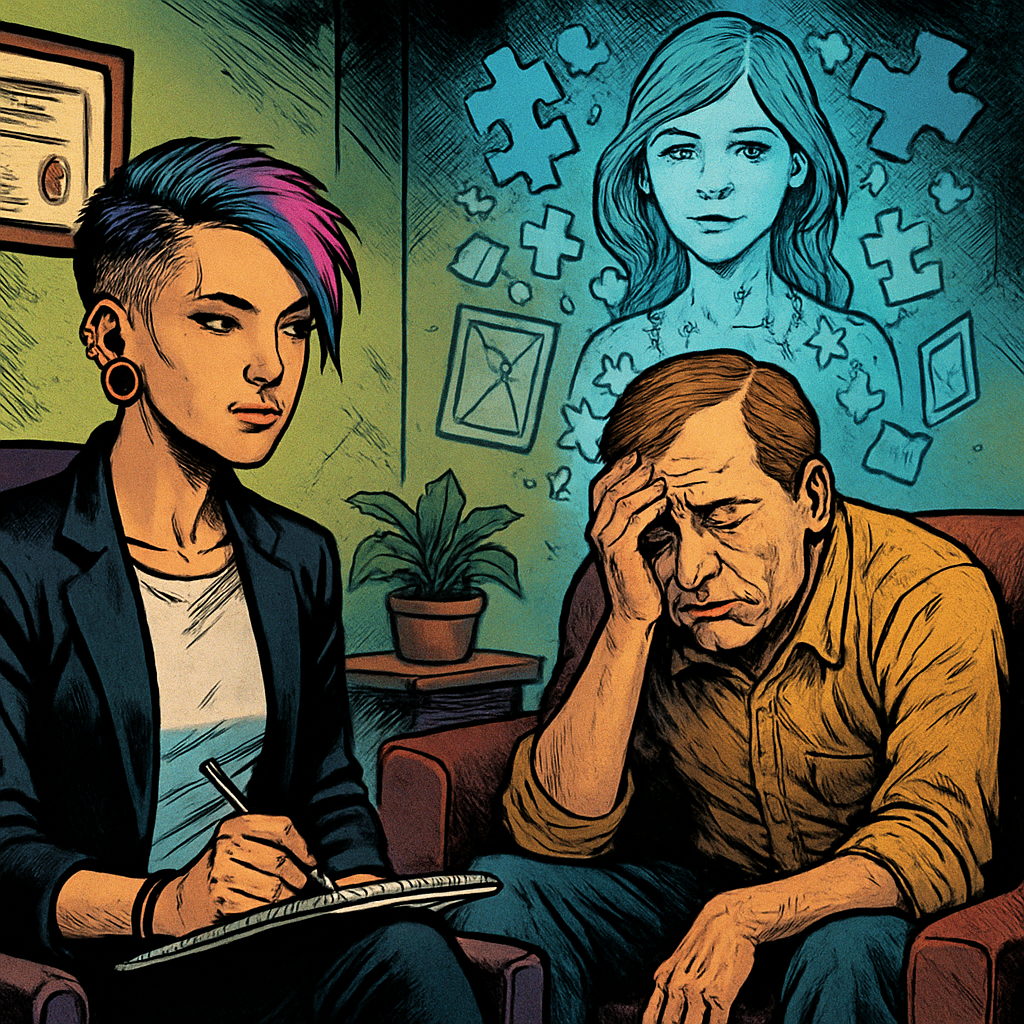
Picture This: Tuesday Afternoon 👻
Tristan walks into my office like a man carrying something invisible but impossibly heavy. He’s 55, well-dressed in that careful way that suggests he’s still trying to get things right. Within ten minutes, he tells me a story that demolishes him in real time.
Fifteen years. That’s how long he’d been a father figure to his ex-stepdaughter. Fifteen years of school pickups, asking about her day, being Dad even after the marriage dissolved. Then one comment—a joke that landed wrong—and suddenly he was excommunicated. No explanation. No conversation. Just radio silence so complete it felt like death, except worse because she was still out there, just not for him anymore.
He kept checking his phone, waiting for a text that would never come, and the weight of that absence was eating him alive.
🚩 What No One Tells You About Being Left Behind
Roughly 25% of family estrangements are initiated by younger adults cutting contact with older family members, and almost nobody talks about how absolutely destroying this is from the other side.
Tristan was experiencing something that looks like grief but operates like a psychological earthquake. His emotional bytes—those fundamental units of emotional experience containing physical sensations, emotional charge, and meaning—had been built over fifteen years of consistent presence and caregiving. Every school event, every birthday, every “Dad, can you help me with this?” had encoded itself into his internal landscape as data about his identity and purpose.
Then, in one moment, the frame shifted. 💔
What he was actually dealing with wasn’t just losing contact with her—it was the sudden violent dismantling of the emotional frame through which he’d understood himself. He wasn’t just a rejected stepdad. He was a man who’d spent fifteen years building an identity that had just been deleted.
Three Truths I Had to Gently Introduce
1. The Comment Wasn’t Actually the Problem
It was the spark, not the fire.
When Tristan walked me through what he’d said—a joke about her boyfriend that he thought was light teasing—I could see he’d been locked in the script of “I said a bad thing and now I’m being punished.” But that’s the emotional script talking, the automatic narrative his brain had encoded.
One poorly-timed comment doesn’t erase fifteen years of investment unless something else is already fractured underneath. We started unpacking what was actually happening: Was the relationship built on shaky ground? Had the divorce from her mother created invisible structures and unstable foundations that made the bond fragile? Was he perhaps not reading her emotional landscape as well as he thought?
2. Grief and Guilt Are Not the Same Thing
One is about loss. The other is about judgment. They need different responses.
Research shows that people often collapse these two experiences into one overwhelming emotional bubble. What I worked on with Tristan was emotional granularity—the ability to make finer distinctions between these states. When he said “I feel terrible,” what he actually meant shifted depending on the moment.
Sometimes it was grief: the genuine loss of a person who’d mattered to him. That was real and deserved space to exist.
But the guilt? That was his inner voice doing something much more dangerous. It was telling him he was bad, that he’d destroyed something, that he was fundamentally flawed for making a misjudgment. That’s a different beast entirely, and it was keeping him stuck in a story where he was the villain.
3. Attachment Without Reciprocal Vulnerability Is a Setup for Devastation
This is the one nobody wants to hear.
Tristan’s fifteen-year investment had created a profound attachment, but that attachment had been operating on an invisible foundation. He was meeting his own needs for purpose, relevance, and identity through a relationship where she could exit with zero accountability to him. That’s not her fault—she’s allowed to cut contact—but it’s crucial information about the asymmetry at play.
The relational need he was trying to satisfy (being needed, being valued, having ongoing connection) was getting met in a one-directional way. When the relationship ended, there was no structural mutuality to protect him from free-fall.
The Granular Truth of the Matter
What Tristan needed wasn’t to “fix” the relationship or even to accept the loss in some zen, mature way. What he needed was to understand that the emotional bytes encoding this experience—the physical sensations of rejection, the narrative of failure, the identity crisis of losing his role—were all manageable pieces once he stopped trying to keep them locked in a single, overwhelming “bubble” of pain.
He needed to see that his inner voice had been running a story where her silence meant he was fundamentally unlovable, when actually it meant something much smaller and less lethal: a young adult set a boundary he didn’t expect, and now he’s grieving the loss of a role that was always going to be temporary.
One is devastating. The other is just… sad. Different.
The Plot Twist Nobody Expects
Here’s what actually shifted for Tristan, and it’s the part that feels important to say out loud:
He didn’t get his stepdaughter back. The contact didn’t resume. No text, no reconciliation, no moment where she realized she’d made a mistake and came crawling back (which is what he was half-waiting for, if I’m being honest). 💀
But something else happened instead.
Once we stopped orienting everything around the question of “Can I fix this?” or “Is this my fault?”—once he stopped living in the emotional script of shame and rejection—something became available to him: the ability to grieve only what was actually lost, not some imagined perfect relationship that never existed.
He started understanding that his value wasn’t contingent on being needed. His identity didn’t require him to have a specific role in her life. He wasn’t a bad person for making a bad joke. And the relationship, for all its meaning, had always been shaped by forces outside his control.
Sometimes the person who cuts contact is protecting something you can’t see from where you’re standing. That doesn’t make your grief invalid. It just means the story you told yourself about what you meant to each other was never the whole story.
What I Actually Told Him, in Plain Language
🥲 You’re not being punished for one comment. You’re experiencing the consequence of building an identity that was dependent on access to another person. That’s not a character flaw—that’s just information about what you actually needed from this relationship.
✨ The silence you’re experiencing feels personal, but it might be nothing personal at all. She might be protecting herself, processing her own stuff, or just not knowing how to navigate the complexity of being a step-child in a post-divorce world. None of that is actually about whether you matter.
🤌 Fifteen years of real care doesn’t get erased. It just changes shape. You were a father figure. That happened. The relationship exists in your history regardless of whether she’s acknowledging it right now. That’s yours to keep.
Living Rent-Free in Your Own Head
What Tristan was doing—and what I see a lot of people do—is letting one moment live rent-free in his entire emotional ecosystem. He was replaying it constantly, examining it like it contained the secrets of the universe, trying to extract some meaning that would make sense of the silence. This is what an emotional script does: it loops, it repeats, it feels inevitable and true.
The real work wasn’t about getting him to stop thinking about what happened. It was about helping him see that the story his brain had attached to that moment was editable.
It wasn’t: “I made a comment, therefore I’m bad, therefore I deserve this.”
It was: “I made a misjudgment in a relationship that had underlying fragility. That’s what humans do. And now I’m experiencing the loss of something that mattered to me.”
Different story. Same facts. Completely different capacity to move forward.
— Melanie Doss
The person you cut off isn’t haunting you because you’re fundamentally wrong. They’re haunting you because you built an identity around being needed by someone who never promised to need you back. That’s not a failure of character. That’s just the human condition being its usual devastating self. ✨
- From family estrangement to empowered exits: new emotional …
- Family Estrangement: Why Adults are Cutting Off Their Parents
- Family Estrangement and the Unseen Work of Not Doing Family
- Estrangement is never easy or straightforward. Psychologists can help
- Mother-Adult Child Estrangement: Patterns and the Role of Transitions
- What Research Tells Us About Family Estrangement
- The Pain of Family Estrangement – Cornellians – Cornell Alumni Affairs