
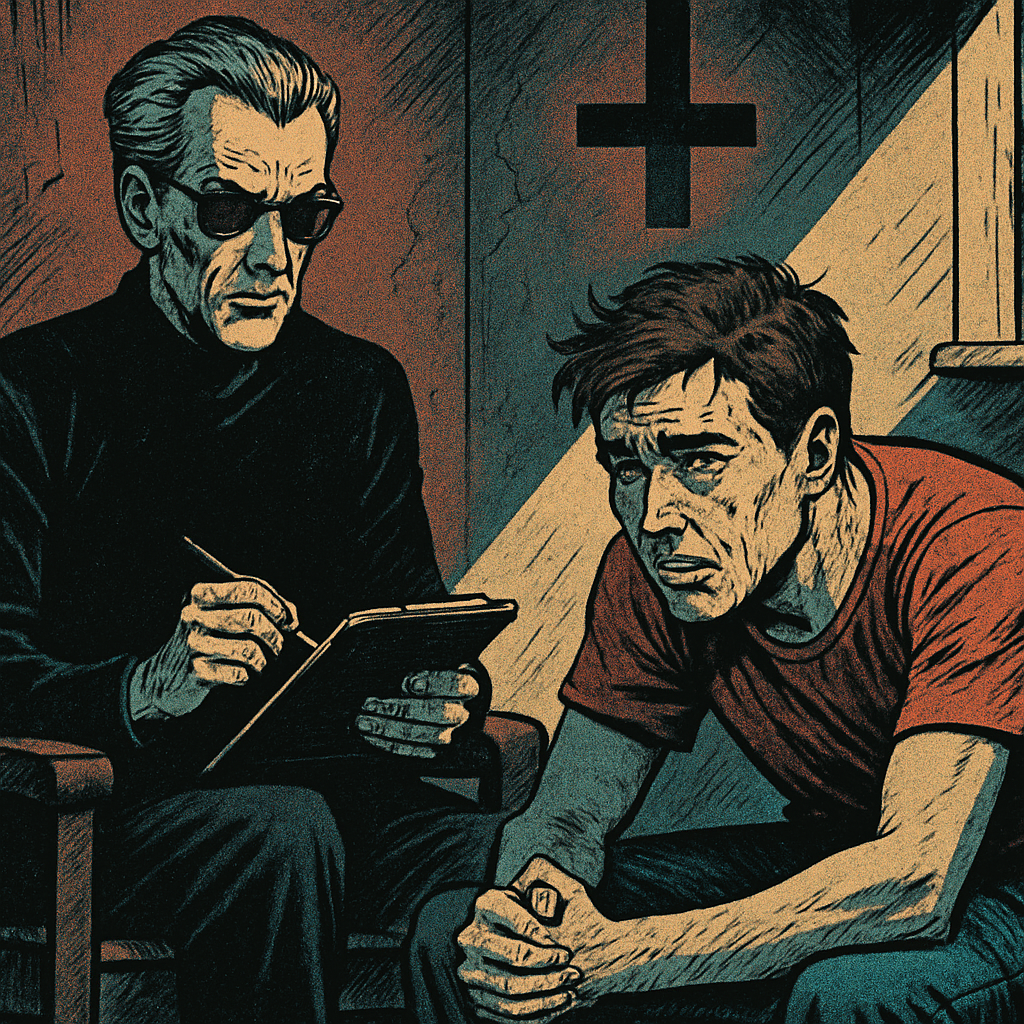
Tobias sat across from me on a Thursday evening in late October, the kind of night when the city feels like it’s holding its breath. His heart, he’d told me during intake, “just starts racing” whenever he thinks about actually having the conversation. I watched him for a moment before speaking. Not out of compassion—though that was there—but because silence is sometimes the cruelest mirror a person can face.
“Let me ask you something, Tobias,” I said. “If you stay in this relationship for another six months, what dies? What part of you atrophies? What becomes impossible? What future version of yourself gets erased by your paralysis?”
This is where the real work begins—not in techniques or scripts, but in confronting the mythology we construct around our guilt.
⚡ The Emotional Architecture of Suffocation
Tobias’s anxiety around his potential breakup wasn’t a simple fear response. It was an Emotional Byte—a complex unit containing his churning gut, and the narrative that “I’m a bad person if I hurt her.” Beneath it all screamed a fundamental need for autonomy, simultaneously suppressed by relational responsibility.
The problem: this narrative had become so massive and overloaded with conflicting signals that Tobias could barely perceive its components. All he felt was suffocation. He couldn’t distinguish between his legitimate need for self-determination and his guilt about leaving. They’d fused into one overwhelming blob of emotional noise.
Then thoughts would arrive—images of her crying, memories of her past betrayals, a voice saying you’d be like all the others.
“Whose voice is that originally?” I asked.
He was quiet. Then: “My mother. She always said I was like my father.”
There it was. The invisible structure—the inherited narrative encoded into his emotional bytes before he had any say in the matter.
🔗 The Frame That Became a Prison
What Tobias was experiencing wasn’t simple anxiety. It was an emotional frame—a cluster of emotional bytes organized into a coherent interpretive lens through which he perceived the world:
If I Cause Pain, I Am Evil
Her emotional fragility became the architecture of his prison. And because frames operate invisibly, shaping attention and perception without conscious awareness, Tobias experienced this as truth rather than interpretation.
Individuals who perceive their partners as vulnerable experience heightened guilt and empathy that actively delays breakups and increases initiator distress. But the lived experience is subtly different—it’s the sensation of moral obligation so complete that your own needs become almost obscene to consider.
“When you imagine actually saying the words,” I asked him, “what’s the first thing you feel?”
“Shame,” he said immediately. “Like I’m proving I’m a bad person.”
“And if you don’t say the words?”
“Relief. But also suffocation.”
He’d named it perfectly. His frame offered a binary: shame or suffocation. No third option. No possibility of kindness that doesn’t require self-erasure.
🔄 Avoidance
The month-long delay wasn’t laziness. It was emotional scripting—automatic behavioral patterns creating self-fulfilling prophecies that felt inevitable and natural:
Rehearse → Feel anxiety → Postpone → Temporary relief → Accumulating dread → Increased rehearsal → Repeat
Each cycle reinforced itself. The relief from postponing taught his nervous system that avoidance works. Meanwhile, dread accumulated like pressure behind a dam—the suffocation he described.
He was literally making himself sick by trying to handle it “the right way.”
“So you’re willing to stay in this relationship longer, continue making yourself more anxious, and prolong her pain—because you’re trying to be respectful about breaking up?” I asked.
The contradiction landed.
📊 The Needs Hierarchy Inverted
Tobias’s fundamental problem wasn’t moral—it was structural. His needs hierarchy had been inverted.
At the base of healthy functioning sit psychological needs: autonomy, competence, and relatedness. Tobias’s autonomy was being systematically sacrificed. His competence as an adult capable of difficult conversations was being undermined. Genuine connection was impossible in a relationship he’d already emotionally exited.
Emotional needs followed: safety, stability, growth, and consistency. He felt none of these. He was in constant low-grade crisis. His identity needs—self-understanding, authenticity, validation—were crumbling. His authenticity was compressed into a shape that fit her needs.
The entire structure was inverted because he’d placed her emotional needs above his own systemic functioning.
“When you stay and keep pretending everything’s fine, are you actually protecting her?” I asked. “Or are you protecting yourself from her pain?”
The distinction matters enormously. One is caretaking. The other is avoidance wearing a compassion costume.
“Both,” he admitted.
🧠 Hypervigilance Masquerading as Intuition
Tobias mentioned something in passing that I wanted to address directly.
“Sometimes I feel like I can sense her emotional state,” he said. “Like I know when she’s fragile. It’s almost supernatural.”
“That’s not supernatural,” I told him. “That’s hypervigilance encoded into your nervous system. You’ve been trained—probably since childhood—to monitor other people’s emotional states as a survival mechanism. Your mother needed you to know when she was volatile. Your girlfriend’s vulnerability became a trigger for your protective response.”
As the great Ozzy Osbourne sang, “Crazy Train” indeed—and Tobias had been riding it for years.
“The problem is that this sensitivity, which could be a gift, has become a cage. You’re so attuned to her distress that you can’t perceive your own needs anymore. Your empathic engine is running in overdrive while your needs navigator is offline.”
Tobias’s “intuition” wasn’t mysterious. It was a predictable output of his psychological architecture.
✍️ The Ritual of Unbecoming
By our third session, Tobias was ready. Not because I’d convinced him with logic—logic wasn’t going to move someone whose entire emotional frame was organized around protective caretaking. But because the suffocation had exceeded his tolerance.
I proposed something that integrated both his philosophical question (“How do I do this with integrity?”) and the psychological reality of his situation.
“I want you to perform a ritual,” I said. “Not magical. Psychological. A ceremony of honest speech.”
Here’s what I suggested:
First, he would write two letters. One to himself, articulating every reason he was leaving—not to justify himself, but to clarify his authentic will. The second would be the breakup script: compassionate, validating her experience, clear about his reality. No manipulation. No false hope.
The physical act of writing would create new emotional bytes—intentional experiences designed to update his predictive model. Instead of the byte “speaking my truth = causing harm,” he’d begin encoding “speaking my truth = acting with integrity.”
Then, when ready, he would deliver it. Not by text. In-person.
“The point isn’t to minimize her pain. She will hurt. That’s not your responsibility to prevent. The point is to be honest, to be kind, and to reclaim your own autonomy. Those three things aren’t contradictory. They only feel contradictory because your frame makes them so.”
🕊️ What Happened
Three weeks later, Tobias sent me an email. He’d done it.
Not perfectly—he’d gotten emotional, his girlfriend had cried, which activated all his old guilt responses. But crucially, he’d held the boundary. He’d spoken his truth. He’d acknowledged her pain without accepting responsibility for it.
“I realized,” he wrote, “that I was more afraid of her pain than she was. She’s resilient. She told me she already knew it was coming. I was the one making her suffering into something catastrophic.”
That’s the thing about frames, about emotional scripts, about the invisible structures we inherit: they’re not based on reality. They’re based on old stories, old neural pathways, old mandates from people who may have meant well but didn’t know any better.
His girlfriend moved through it. He moved through it. The relationship ended not with the catastrophe his frame had predicted, but with the clear, honest closure that both of them needed.
More importantly, Tobias began the work of rebuilding his emotional architecture—learning to distinguish between empathy and responsibility, between compassion and self-erasure. His intuitive sensitivity didn’t disappear. It simply found a new context, one where it could serve wisdom rather than cage him.
The suffocation lifted. In its place came something harder but ultimately liberating: the clear-eyed recognition that his authentic will and another person’s wellbeing can coexist. They don’t require him to annihilate himself.
🔓 Reclaiming the Invisible
By your own hand and will, the framework we inherited can be examined. The scripts can be rewritten. The invisible structures can be made visible. The emotional bytes can be reintegrated.
That’s not supernatural. That’s sovereignty.
The demon you fear most is your own unlived life—the future you abandon by honoring everyone else’s present. Reclaim it.
“Hail Wisdom, Hail Yourself.” —Lucian Blackwood –