
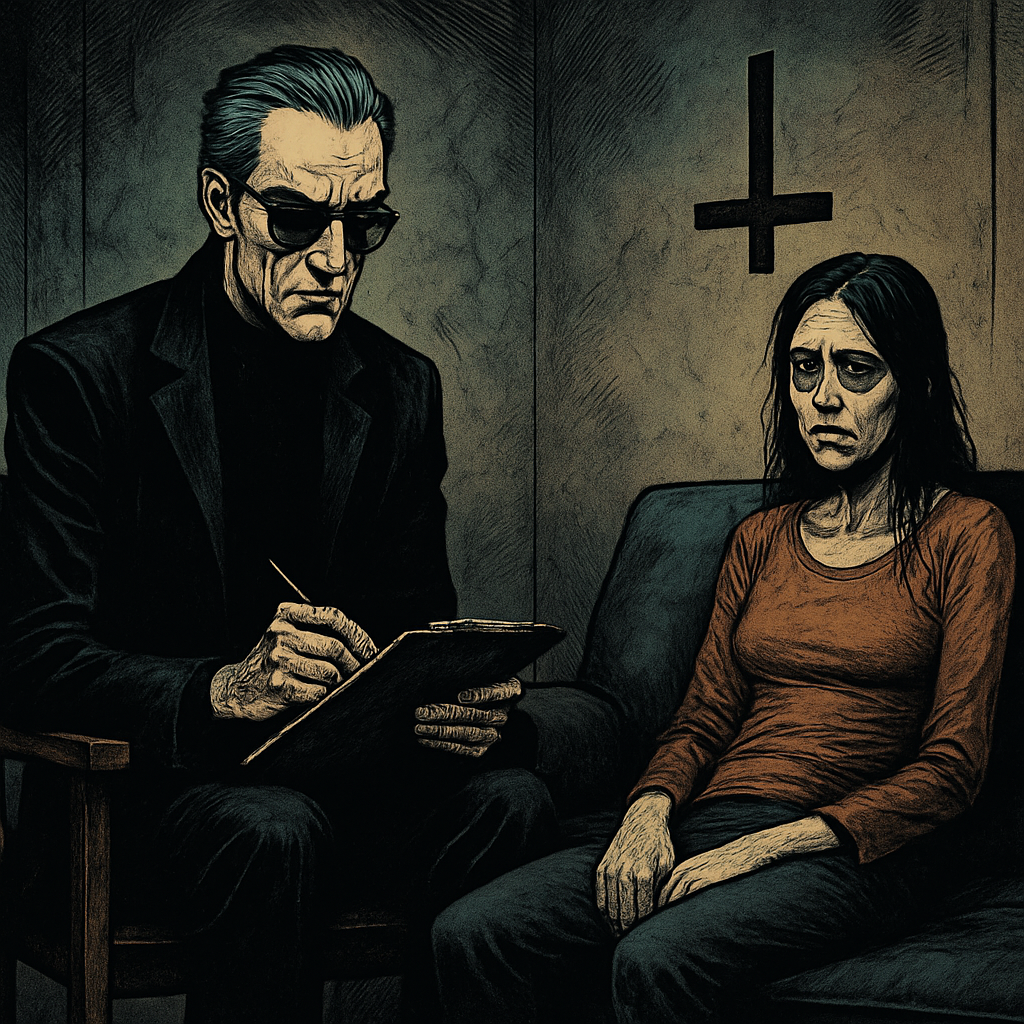
She sat in my office like a painting someone had forgotten to finish—all the elements present, but nothing complete. Cassandra had the peculiar exhaustion of someone who’d been fighting herself longer than she could remember, and had finally stopped believing in the possibility of victory.
Her eyes held that particular quality I’ve come to recognize in thirty years of this work: the look of someone who’s already said goodbye. “I’m just tired,” she said, her voice flat as a photograph. “I’m ready to go to sleep.”
The way she said it—ready—wasn’t poetic or philosophical. It was practical. Like someone discussing a train schedule. 💤
When Hopelessness Becomes Architecture 🏗️
In my experience, hopelessness isn’t about circumstances. It’s about the architecture of how someone has learned to process their own life. Cassandra had built herself a prison with such meticulous craftsmanship that she couldn’t see the unlocked door anymore.
My job wasn’t to convince her the door existed. My job was to dismantle the invisible blueprints she’d internalized so thoroughly that she’d mistaken them for reality itself.
What I began to understand was that her hopelessness wasn’t a symptom—it was a script. An emotional script is an automatic pattern so deeply encoded that it feels like truth rather than programming. Cassandra’s script had been running for so long that she’d forgotten she wasn’t the author; she was the character playing out lines written by earlier versions of herself.
The Emotional Frame That Became a Prison 🔒
At the foundation of her despair sat what the Emotional Bytes framework calls emotional frames—invisible interpretive lenses through which she’d learned to perceive herself and her capacity for change. Her primary frame crystallized around a singular narrative: I am too damaged to heal.
Once an emotional frame calcifies, it becomes self-fulfilling. Cassandra would attempt recovery, and through the lens of her damage-narrative, she’d interpret every setback as proof rather than process. Her inner voice had become a malicious narrator, constantly gathering evidence for a pre-written conclusion: You cannot change. You are broken. Stop trying.
The Emotional Bytes framework calls this meta-emotional intelligence—the ability to see the systems creating emotions rather than being trapped inside them. Cassandra had become trapped so deep in her emotional frame that she couldn’t see the frame itself. She could only see the world through it.
The Attachment Wound Behind the Despair 💔
“Tell me about the first time you felt like this,” I asked. “The first time you believed you couldn’t change something.”
Cassandra began talking about her mother—a woman who loved conditionally and critiqued constantly. A woman who’d made it clear, through ten thousand small moments, that Cassandra’s worth fluctuated based on performance.
This is what attachment research reveals: our earliest relationships teach us how to interpret ourselves. Cassandra had learned to interpret her struggles as personal failures, evidence of fundamental inadequacy. Her anxious attachment pattern had created what I call emotional byte loops—automatic cycles of sensation, emotion, unmet need, and story:
- Sensation: Tight chest, heaviness, numbness
- Emotional charge: Despair, shame, resignation
- Unmet need: Unconditional acceptance, proof of inherent worth
- Story: If my mother couldn’t love me without conditions, then I am unlovable. Therefore, nothing will improve.
Every attempt at change would activate this byte. And the activation itself became evidence: See? Even trying confirms how broken I am.
The Mastery Hidden in Defeat ⚫
Here’s what most therapists miss about deep depression: there’s often a twisted mastery at its core. Cassandra had become extraordinarily competent at hopelessness. She’d refined it into an art.
“You’re very skilled at this,” I told her directly. “At maintaining this frame. At interpreting evidence to support it. It requires real intelligence. The question isn’t whether you’re capable of change—the question is whether you’re willing to dismantle a structure you’ve become masterful at maintaining.”
Cassandra’s defeatism wasn’t just depression. It was also a defense. As long as she believed change was impossible, she couldn’t be held responsible for not changing. There was a perverse safety in total hopelessness.
“Iron Man” by Black Sabbath: “Has he lost his mind? Can he see or is he blind?”
The Refusal Beneath the Despair 🔥
Beneath Cassandra’s hopelessness lay something more primal: her authentic will to refuse. A refusal to perform for love that should be unconditional. A refusal to contort herself into shapes that pleased others. Because this refusal couldn’t be consciously acknowledged—because it would feel selfish—it had turned inward into the slow collapse we call depression.
“What if,” I asked her, “the thing you’re most ashamed of isn’t your failure to heal? What if it’s that you’re angry? Genuinely, justifiably, righteously angry at having to work this hard just to prove your own existence has value?”
This is emotional granularity—the transformation of a massive, undifferentiated emotional bubble into distinct, manageable components. Within her hopelessness lived rage, betrayal, exhaustion, and a legitimate refusal to continue playing a game with rigged rules.
Ritual as Transformation 🕯️
After eight sessions of psychological mapping, I introduced Cassandra to what I call Greater Magic—ritual as psychodrama, ceremony as the technology of transformation.
“We’re going to create a ritual of sacrifice,” I explained. “Not sacrifice of yourself. Sacrifice of the everyday frames that have been consuming you.”
I asked her to bring objects: a letter from her mother, a journal of failures, the list of medications—physical repositories of the narratives she’d been living. In my office, we prepared a space with a candle and a bowl.
“State your intent,” I said. “Not as healing. Not as hope. As raw, authentic will.”
Cassandra’s voice shook: “I refuse to continue interpreting my life through the frame of my mother’s conditional love. I claim the right to be uncertain about my future without that uncertainty meaning I am hopeless.”
Then she burned them. The letter. The failure journal. The medication list.
She wasn’t erasing the past. She was creating a new experience, a new byte that said: I have the capacity to choose which narratives I carry.
The Ancient Wisdom That Cuts Through Lies ⚔️
The pre-Christian traditions—Norse, Germanic, Celtic—valued something modern psychology often dismisses: wyrd, or personal fate shaped by one’s own action and honor. A person’s worth wasn’t granted by others. It was claimed through authentic choice and commitment to one’s own becoming.
“In the old traditions,” I told Cassandra, “a warrior who gave up would be remembered with contempt. Not because suffering is noble, but because giving up means surrendering your own agency. The ancestors understood that choosing your own struggle, even in darkness, is fundamentally different from surrendering to it.”
“What if the antidote to hopelessness isn’t optimism? What if it’s simply the choice to act as though you matter, regardless of whether you believe it yet?”
What Actually Changed 🌑
Cassandra didn’t experience a sudden recovery. This wasn’t a redemption narrative wrapped in a bow. What happened was slower and more real: the emotional frame began to develop fissures.
She started to recognize when her inner voice shifted into the malicious narrator. She began to distinguish between I am depressed and I am broken. These sound similar, but the emotional byte-structure is entirely different. One is a state. One is an identity.
She learned to notice when her script of hopelessness was activating—the physical sensations, the familiar stories—and to pause rather than automatically obey. She required pharmaceutical intervention and eventually joined a group for attachment-related trauma. None of this contradicted the ritual work. It complemented it.
Six months in, she told me: “I still have days where I want to go to sleep and not wake up. But it’s not the same. It’s not my whole truth anymore. It’s just a day.”
That’s precision. That’s the difference between an overwhelming emotional bubble and emotional granularity.
The Guilt We Must Refuse 🚫
A final note on what I see too often in the therapy room: the cultural expectation that depressed people should be grateful for help. That suicidal ideation is selfish. That hopelessness indicates moral weakness. These are lies manufactured by systems that benefit from your compliance.
Cassandra had internalized the narrative that her struggle was something she owed others the right to solve. She needed permission to claim her own becoming, in whatever form that took. She needed to understand that choosing life could be an act of personal sovereignty rather than compliance with others’ expectations.
By the time she left my practice, Cassandra had moved toward something I’d call cautious agency. Not happiness. Not recovered hope. But the recognition that her life, in all its complexity and pain, was hers to author.
Hail Yourself. Hail Your Becoming.
—Lucian Blackwood
Hail Wisdom, Hail Yourself
The chains that bind us are often our own refusal to see that we hold the key.