
🔥 The Setup: When Your Tribe Becomes Your Trap
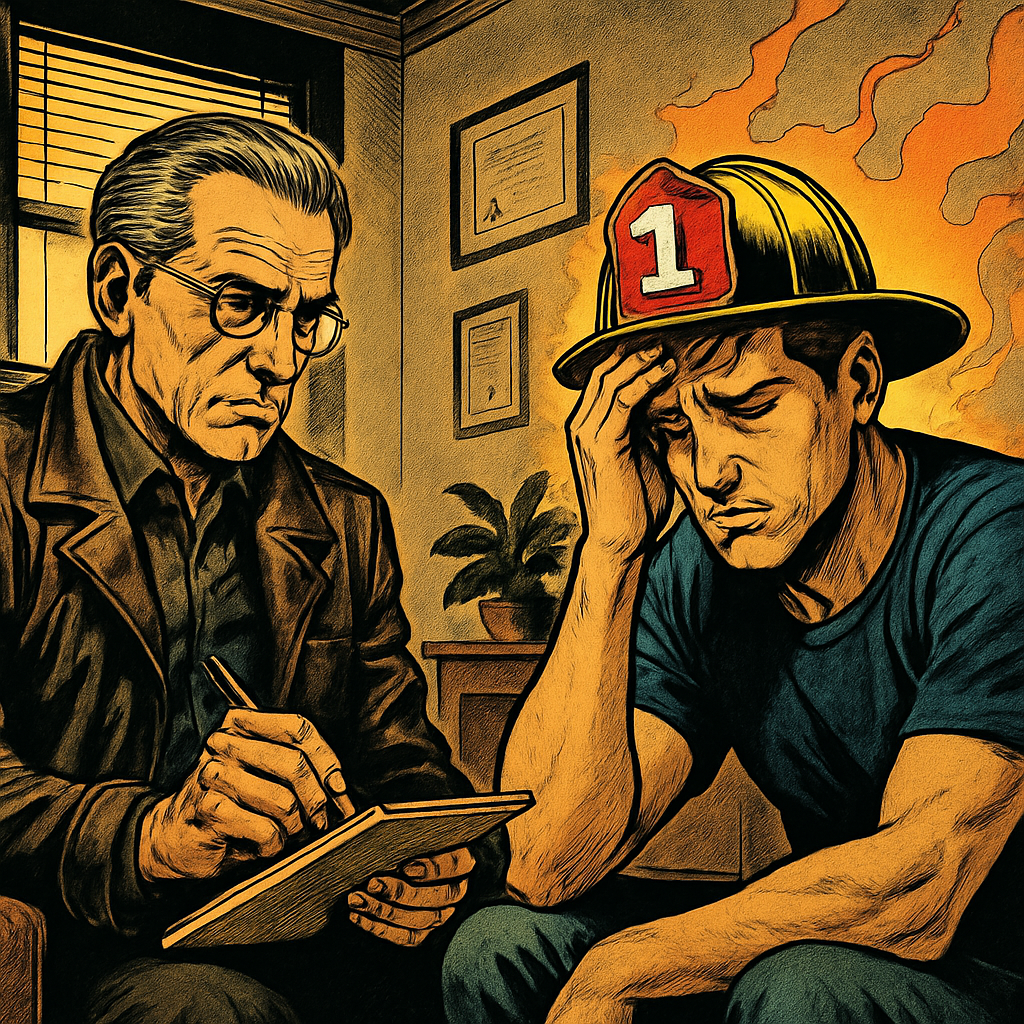
The fire station smelled like diesel fuel and old coffee. Mark sat across from me in my office and kept his hands on his knees like he was bracing for impact. He’d been coming to see me for three weeks before he actually told me why. Volunteer firefighters don’t volunteer information, especially about their own.
“I need to know if I’m a coward,” he said finally.
I remembered Mark because he represented something I’ve seen hundreds of times in my fifteen years doing this work: a good man paralyzed by the collision between two identities that feel completely incompatible. A theft at his volunteer department wasn’t his first moral crisis. It was just the one that finally cracked him open enough to ask for help.
What Actually Happened
Mark suspected a group of high-ranking officers, people with real authority and respect, had been stealing serious money. The kind that revealed years of planning and rationalization. The theft itself wasn’t the main problem. The problem was what came next: silence. Official, coordinated, suffocating silence.
Mark’s captain told him straight up: “We handle this internally.” His best friend of eight years said: “Don’t be the guy who burns down the house.” The former chief, now town commissioner, made quiet phone calls that everyone pretended weren’t happening. This is what power looks like when it doesn’t have to yell.
The thief’s mother still ran the department that reviewed the books. It was the perfect scenario to trap someone with a conscience.
⚙️ The Invisible Architecture of Your Emotional Trap
Mark’s guilt came in layers, and he needed to understand what was actually happening inside his system before we could move forward.
I call it the loyalty byte—the emotional information packet that forms when you’ve shared danger with people, trained together, answered calls at 3 AM while the rest of the town slept. This byte carries more than just feeling. It includes physical sensations (the tightness in his chest), emotional charge (genuine love mixed with genuine fear), need signals (his need for belonging), and a narrative: “Real men don’t rat on their brothers.”
That script was running Mark without his awareness. It felt less like a choice and more like gravity.
But here’s what made Mark uncomfortable: He also had a morality byte, equally strong. It carried different sensations (nausea when thinking about covering up theft), different emotional charge (rage, betrayal, disgust), and a different narrative: “Good people don’t let criminals walk.”
These two bytes were creating what psychologists call positive disintegration—psychological tension that looks like weakness but is actually his system demanding integration at a higher level. The real problem wasn’t that he was conflicted. It was that he thought being conflicted meant he was broken.
The Structures Operating Without Awareness
First: Power dynamics. The thief wasn’t just higher-ranking; he was part of a family network with town influence. The former chief had spent thirty years building relationships that felt like they had teeth. Were they actually dangerous? Probably not. But invisible structures don’t need to be real to control your behavior—they just need to feel real.
Second: The emotional frame everyone operated from. A frame is a cluster of emotional bytes that becomes your interpretive lens. In a tight-knit volunteer organization, it’s built on decades of “we handle our own.” It’s not written policy or discussed explicitly, but it shapes what gets noticed, what gets ignored, what feels possible. Suggesting external authorities activates shame bytes and violates the frame.
Third: Fear of ostracism. In a 30-person organization, this isn’t abstract. These guys see each other at the grocery store. Their kids go to the same schools. For Mark, reporting wasn’t just about one guy—it was about potentially fracturing the entire community he’d built his identity around.
I told him directly: “Your fear isn’t irrational. It’s just incomplete.”
💡 The Conversation That Changed Everything
We didn’t solve this in one session. But in week four, I asked Mark something different.
“Tell me about the worst moment of your life as a firefighter. Not the worst call—the worst moment.”
He told me about a structure fire in 2016 where someone on scene had been under the influence. Not during the call—after. But this person had a pattern. Mark said it had destroyed something in him, knowing someone could show up to a job where people’s lives were on the line.
“How many people did you tell?” I asked.
“I went to the captain. It went up the chain. It was handled.”
“Did you think about not reporting it?”
He looked at me like I’d asked if he enjoyed kicking puppies. “Of course not.”
“Why not? Was that person not your brother? Did you not have the same loyalty frame you’re protecting now?”
He was quiet for thirty seconds.
“That was different,” he finally said.
“How?”
“Because someone could have died.”
“Right. And now someone’s watching their retirement disappear. The department’s reputation is bleeding out. Members are feeling the weight of complicity. And you’re in a room with me telling me you’re a coward because you haven’t escalated yet.” I leaned back. “That’s not cowardice. That’s selective morality. Your moral foundation isn’t actually activated yet. You’re waiting for the stakes to feel as immediate as a burning building.”
That landed.
🎯 What Success Actually Looks Like
People get something wrong with ethical dilemmas. They think it means everyone accepting your decision with grace. Wrong. Success means you can live with yourself afterward. That’s it.
For Mark, it didn’t mean becoming a hero. It meant becoming someone who could look himself in the mirror without flinching. Someone whose needs hierarchy was in actual alignment—where his identity needs (integrity) weren’t being overridden by relational needs (belonging) or psychological needs (comfort).
I told him: “You’re going to lose something if you report this. Maybe not everything, but something. You might lose the easy comfort of staying quiet. Your best friend might give you the cold shoulder for a while. Some people will remember you as the snitch, at least initially. That’s the real cost—not legal retaliation, just the discomfort of being the one who did the hard thing when everyone else chose easy.”
Strength isn’t what you think it is. Most of the time, strength is just choosing the harder option because it’s the right one.
🔍 Breaking Down the Overwhelming Feelings
We spent a full session on what I call emotional granularity—breaking down his overwhelming “I feel trapped and guilty and scared” into something workable.
His guilt wasn’t one thing. There was complicity guilt (I know something and I’m not saying anything), loyalty guilt (I’m thinking about betraying my friends), and identity guilt (I’m not living according to my values). Different emotional bytes with different physical sensations and narratives.
His fear also came in layers: social fear (What will people think?), relational fear (Will I lose my friendships?), and structural fear (Can powerful people hurt me?).
Once Mark could separate them, he could actually work with them instead of being crushed under one massive blob of emotion. He discovered his relational fear was the loudest, but his identity byte was actually killing him.
📋 What Your Organization Doesn’t Want You to Know
I told Mark something that made him uncomfortable: “Your department leadership knows exactly how to create silence. The whole ‘we handle our own’ framework? That’s not about loyalty. That’s about control.”
When an organization says it values loyalty and brotherhood, it often means it values conformity to leadership’s decisions. When leadership benefits from silence, loyalty becomes a tool for suppressing the very ethics that should define the organization.
Research on volunteer organizations shows something revealing: turnover spikes after cover-ups become public. Not because people are angry at the person who reported the crime, but because they’re angry at themselves for going along with it. The organization’s decision to enforce silence actually destroys the brotherhood it claims to be protecting.
Mark’s crew would probably be healthier after disclosure than they would be staying silent while resentment metastasized.
📞 The Reality of Reporting
We mapped out actual options—real pathways, not theories.
Anonymous reporting exists for a reason. State fire marshals have hotlines. The state attorney general’s office exists. External audits are available. None of these require standing up in the firehouse and pointing a finger. But all of them require actually doing something. Making a call. Sending an email. Moving from paralysis to action.
Here’s what nobody wants to admit: taking action is actually easier than staying stuck. The anticipatory anxiety is worse than the actual doing. Mark had built this up in his head as impossible. The reality was messier, less dramatic, and actually doable.
I told him: “You don’t have to be brave. You just have to be willing to be uncomfortable for a while. Those are different things. Brave is a story you tell about yourself. Willing to be uncomfortable is just recognizing that some discomfort is worth the price.”
✅ What Actually Shifted
Mark didn’t become a crusader. He didn’t go full whistleblower with a media presence. What he did was make a phone call to the state fire marshal’s office. Anonymous. During his lunch break. Five minutes of actual action after weeks of agonizing about it.
The investigation that followed was messy. People figured out it was likely Mark. There were awkward conversations. One guy didn’t talk to him for three months. But here’s what else happened: the crew didn’t implode. They had conversations about ethics and leadership they probably should have had years earlier. And Mark slept through the night for the first time in months.
The department didn’t collapse. The brotherhood didn’t shatter. What changed was that Mark stopped being someone who participated in a cover-up, and that changed everything about how he felt when he looked in the mirror.
That was the real win.
⚖️ The Hard Truth About Moral Dilemmas
Here’s the uncomfortable truth nobody wants to hear: if you’re in this situation, you’re not going to feel good about any choice. That’s the trap of a genuine moral dilemma. Every option has a cost. The only question is which cost you can actually live with.
Staying silent costs you your integrity over time. Speaking up costs you comfort and social ease, at least temporarily. There is no free option. And the sooner you accept that, the sooner you can stop waiting for a perfect solution that doesn’t exist.
Loyalty without accountability is just coercion pretending to be brotherhood. Real brotherhood—the kind that actually holds up—can survive a hard conversation about ethics. If it can’t, then what you had wasn’t brotherhood. It was just proximity.
🛠️ The Integrity Audit You Can Use
I gave Mark something I call The Integrity Audit. It’s simple but it works.
Ask yourself: In five years, when I look back on this moment, which choice do I want to have made? Not which choice feels safest right now. Not which choice keeps people happy. Which version of yourself do you want to be living with?
Mark’s answer was clear once he actually let himself think about it. That answer didn’t change the difficulty. But it changed his direction.
Direction matters more than comfort. The discomfort is temporary. The identity you build is permanent.
🧠 The Larger Pattern
I’ve worked with dozens of people in situations like Mark’s—different industries, same psychological architecture. People in churches dealing with abuse cover-ups. People in corporations dealing with fraud. People in families dealing with addiction nobody talks about. The setup always looks the same:
- A closed group with strong internal loyalty
- A breach that threatens group identity
- Leadership that prioritizes reputation over ethics
- Individuals caught between wanting to belong and wanting to be themselves
It’s not unique to firefighting. It’s just particularly stark there because the stakes feel so high and the brotherhood runs so deep.
The people who navigate this best aren’t the ones with the most courage. They’re the ones who can separate their identity from their group membership. Who understand that being a good firefighter and reporting a crime aren’t mutually exclusive. Who can hold both things at once without needing one to destroy the other.
Strength isn’t loyalty to your group. It’s loyalty to yourself – Jas Mendola.
- 9 answers: How to handle fire department theft – FireRescue1
- [PDF] Volunteer Fire Departments: A Neglected American Voluntary …
- [PDF] Volunteer Fire Departments Confront A Challenge – Scholars Archive
- [PDF] Critical Health and Safety Issues in the Volunteer Fire Service
- The Volunteer Firefighter™ Magazine – FASNY
- The Professional Volunteer Fire Department: Theft Management
- [PDF] Assessing Fire Station Response and Coverage Ability in a …
- [PDF] Understanding Factors Impacting Volunteer Firefighters’ Work …
- [PDF] Happenings at the Local Volunteer Fire Station: Analyzing the Role …