
The Pattern Nobody Talks About 🔄
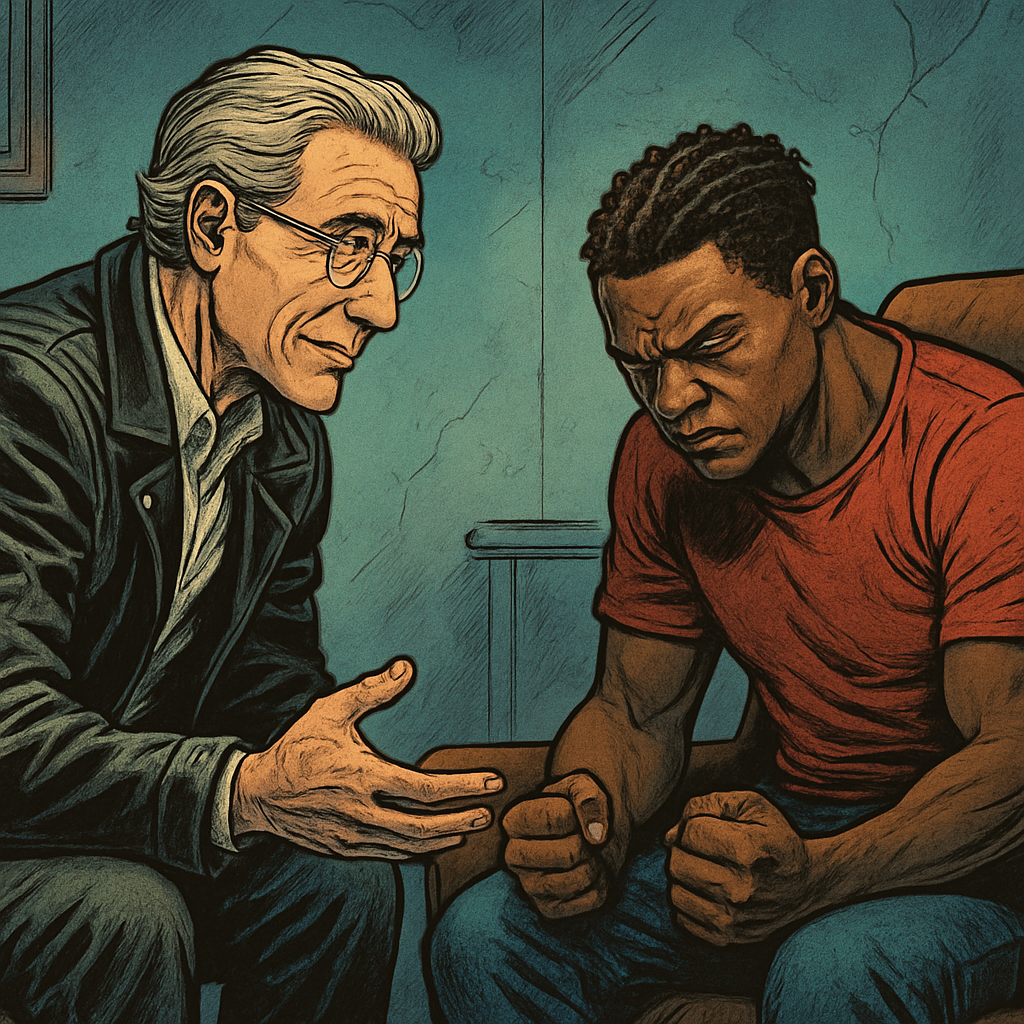
Kymani sat in the closing bar, rain streaking the windows, holding a glass of water like it might disappear if he let go. Four years since his father died, and nothing had changed. Everything he touched fell apart—his college applications, his relationships, his will to wake up. When he looked at me, I saw someone treading water in the middle of the ocean with no land in sight.
But what stuck with me was the question he asked: “Why do I keep destroying the good things before they destroy me?”
Prolonged grief doesn’t sit quietly in your chest waiting for you to “work through your feelings” on society’s timeline. It rewires you. It becomes the script you play out without knowing you’re performing it.
Kymani was trapped in what I call grief-driven sabotage—a predictable emotional pattern where his nervous system had learned a cruel lesson: love people and they leave. Trust a future and it crumbles. His inner voice had become hostile, whispering that nothing would work out anyway, that he should fail first before failure happened to him.
The research confirms this: young people who lose a parent early develop what’s called prolonged grief disorder, where emotional experiences—body sensations, emotional charges, and the narratives we tell ourselves—get stuck in a loop. His body had learned to associate hope with pain. His emotional framework had solidified into one message: “connection equals loss.”
The Invisible Structural Collapse 💔
What I discovered sitting with Kymani was devastating in its simplicity: he had no internal model for how to grieve without disappearing. His mother died when he was two—barely formed memories, pure neurological imprint. His father when he was seventeen. No family around to show him what survival looked like. No examples. No witnesses to his pain.
That’s not just loneliness. That’s a specific kind of structural poverty that research barely acknowledges. When a young person grieves without relational infrastructure—without people who reflect back that his pain matters, that he matters—his emotional scripts become entirely self-referential. He becomes his own judge, jury, and executioner.
Kymani’s friends had distanced themselves not from cruelty, but because grief without language is contagious. People sense it. They don’t know what to do with it. A young man without the framework to articulate what he needs becomes invisible.
His needs hierarchy had collapsed entirely. He needed autonomy, but grief was stripping it away. He needed competence, but everything failed. He needed to belong somewhere, and there was nowhere to land.
Here’s the uncomfortable truth: prolonged grief in isolation doesn’t make you stronger or build character. It trains you to self-destruct. And society rewards this narrative, calling it “pulling yourself together” or “being a man about it”—when what we’re actually watching is someone’s nervous system learning that survival means self-erasure.
What the Research Actually Reveals 📊
About six percent of grieving people develop these persistent, high-intensity grief trajectories. They have elevated healthcare use, higher medication consumption, and increased mortality within a decade. But here’s what that statistic really means: that’s six percent of people whose emotional systems have been fundamentally damaged and are running on a broken operating system.
What researchers call “suicidal ideation,” Kymani called “not wanting to be alive.” Same thing. Different language. The distinction matters because clinical language distances us from reality: a young man is sitting in front of you saying he doesn’t want to exist.
Grief-focused cognitive behavioral interventions work, but here’s what they don’t advertise: they work because they give people permission to actually feel the specific emotional granularity beneath “I’m sad.” They help you untangle the physical sensation from the emotional charge from the need state from the story you’re telling about why you deserve to hurt.
Kymani needed to learn that grief isn’t one monolithic weight. It’s layers. Some days it was rage at his father for dying. Other days it was shame that he couldn’t remember his mother’s face. Other days it was terror of repeating the pattern—loving someone, losing them, being destroyed in the process. Breaking it down into distinct emotional experiences gave him back a degree of agency.
What Successful Grievers Know 💪
Strength is not the ability to carry grief alone. Strength is the willingness to let others witness it.
Every young person I’ve worked with who navigated real loss successfully shares one thing in common: they stopped performing resilience and started being honest about what was breaking. That’s terrifying because vulnerability reads as weakness. But it’s the opposite. It takes more courage to say “I’m not okay” to another human being than to silently destroy yourself through self-sabotage.
Structured grief groups work for a reason that has nothing to do with psychology textbooks: they put your grief into a relational context. You stop being the only person carrying this weight. You see other people’s emotional scripts and realize you’re not uniquely broken—you’re just broken in a universal way that thousands of others have survived.
Kymani’s turning point wasn’t enlightenment. It was when he attended a group session and watched another young man describe the exact same sabotage pattern—starting relationships and then destroying them before they became real. When Kymani watched this kid’s face, something shifted. He wasn’t alone in the pathology. That normalized it. That made it fixable.
The Honest Conversation Nobody Has 🗣️
Your father dying didn’t make you broken. But unwitnessed grief combined with isolation will absolutely break you. That’s not poetic. That’s neurological fact.
The difference between people who recover from loss and people who disappear into it isn’t resilience. It’s access to what researchers call “perceived social support”—someone who genuinely cares that you’re suffering. Someone whose emotional frame includes space for your pain. Someone whose relational needs align with your need to be witnessed.
Kymani had none of that. His inner voice had become a tyrant because there was no external voice contradicting it. No one saying “You’re not worthless.” No one demonstrating through consistent presence that you can love someone and survive their leaving. He was building his entire emotional architecture on a foundation of abandonment, then wondering why everything collapsed.
The real work wasn’t fixing his thinking patterns, though that mattered. It was helping him understand that his self-sabotage wasn’t stupidity or weakness. It was his nervous system’s intelligent attempt to protect him from more loss. His emotional framework had organized around a simple survival calculation: if you don’t build anything, you can’t lose anything. If you stay small, you can’t fall far.
That’s not a pathology to eliminate. That’s a protective mechanism to befriend, understand, and gradually update with new information. Integration means allowing the grief-driven impulse to exist while building competing evidence that other outcomes are possible.
Once Kymani could ask his question out loud, once another human witnessed the asking, he could begin to notice when he was running that script. He could feel the anxiety rising when a relationship got too real and recognize it for what it was: not a sign to run, but a sign that his nervous system was activated, remembering an old threat.
The grief didn’t vanish. But it stopped being the entire landscape of his world. It became one region on a map he could navigate.
Integration Over Overcoming ✨
This is what happens when you stop pretending grief is something you overcome and start treating it as something you integrate. When you stop expecting yourself to do it alone and start accepting that strength is fundamentally relational.
The greatest measure of a man isn’t what he can carry alone, but what he’s brave enough to put down in front of another human being.
- Examining longer-term effects of parental death in adolescents and …
- Understanding and Responding to Grief and Bereavement in Youth
- The Profound Sadness of Prolonged Grief
- Grief trajectories and long‑term health effects in bereaved relatives
- A public health perspective on Prolonged Grief Disorder | Pursuit