
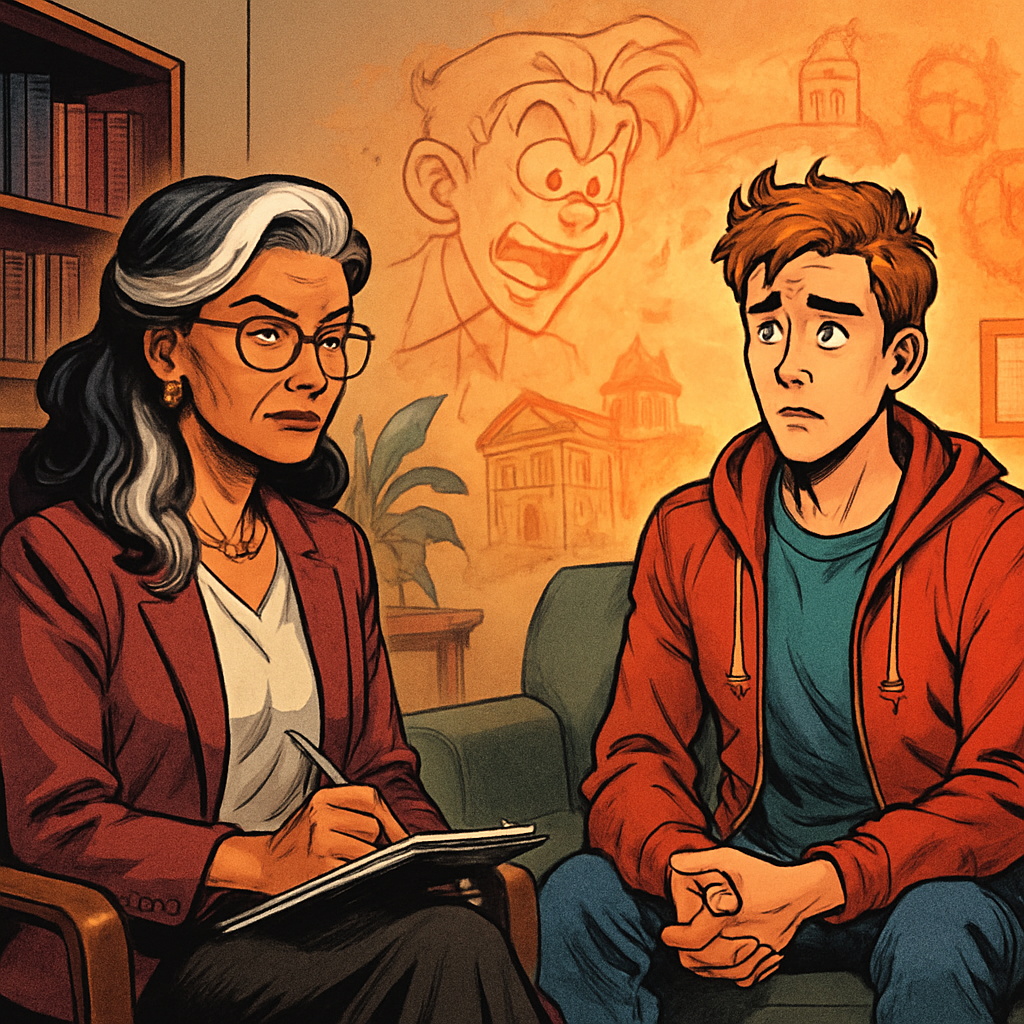
The Problem With Trevor’s Problem 🧠
Trevor sat in my office doing that thing people do when they’re about to confess something they think disqualifies them from having real problems—he apologized for “wasting my time” before he’d even told me what was wrong. Then he laid it out: he’d chosen the wrong college, quit his animation course, and now worked a job he hated while his actual dream collected dust. “I ruined everything,” he said, like he’d committed some irreversible crime against his own life.
What struck me wasn’t the regret itself—everyone has that—but the way he’d framed it as if his past decisions had permanently closed a door that was actually just… a door.
Trevor’s presenting issue sounded straightforward: career regret, anxiety, feeling stuck. But here’s what was actually happening—his emotional system had encoded a very specific story into what I’d call an emotional frame, a lens through which he was viewing his entire existence. Every time he thought about his choices, his body produced the same cluster of sensations: tightness in his chest, that sinking stomach feeling, the physical weight of “I fucked up.” These weren’t just thoughts. They were complete information packets—emotional bytes—containing the sensation, the story (“I chose wrong and now it’s too late”), and a prediction about his future (hopeless, trapped, diminished).
Research shows education and career decisions produce some of the most intense lifelong regrets precisely because we can vividly imagine alternative paths. Trevor could picture exactly what his life “should” have looked like if he’d chosen differently. His brain was running a comparison algorithm 24/7, and he was losing every time.
But here’s what Trevor didn’t realize: this wasn’t really about the college choice at all.
The Invisible Architecture of “Bad Decisions” 🏗️
When we dug deeper—and I mean really dug, past the surface story—other things emerged. His mother’s financial constraints. Her unspoken expectations. The noise in his dorm that made concentrating impossible. The teaching style that didn’t match how he learned. None of these factors showed up in Trevor’s original narrative. In his story, he was the sole architect of his misery.
This is where things get interesting from an emotional bytes perspective. Trevor had taken a complex situation shaped by multiple invisible structures—family economics, institutional failures, environmental stressors—and compressed it all into one simple story: “I made the wrong choice.”
This compression served a purpose. It gave him a sense of control, even if that control was retrospective and punishing. If he was entirely to blame, then theoretically, he could have prevented this. The alternative—that circumstances beyond his control had significantly influenced outcomes—felt more frightening because it suggested he’d never had full agency to begin with.
Studies on occupational regret reveal that comparisons to alternative paths intensify the experience, especially when combined with limited resources to change course. Trevor was caught in this exact trap. He’d compare his current life to the imagined animation career, feel the gap like a physical wound, then encounter his actual constraints (student debt, no portfolio, financial obligations), which made the gap feel insurmountable.
What Actually Happened in the Room 💭
Our work together wasn’t about convincing Trevor his choice was “fine” or that regret was “bad.” That would’ve been bullshit, and he would’ve smelled it. Instead, we started examining the emotional script he was running—this automatic pattern where every trigger (seeing animation work online, hearing about someone’s creative job, even relaxing on weekends) activated the same sequence: comparison, regret, self-blame, paralysis.
I asked him to get specific about the physical experience of regret. Not the story, but the actual sensations. Where did he feel it? What did it feel like? This is emotional granularity in action—taking that overwhelming bubble of “I ruined my life” and breaking it into smaller, more manageable pieces.
Turned out his regret had different flavors. Sometimes it was grief for the path not taken. Sometimes it was shame about “failing.” Sometimes it was rage at the constraints that shaped his choice. And sometimes—this took weeks to access—it was fear that he didn’t actually have what it took to succeed in animation anyway, and the “wrong college” story protected him from testing that theory.
We also looked at what researchers call goal discrepancy—the gap between where he wanted to be and where he was. But here’s the thing: Trevor’s discrepancy wasn’t just self-referenced. It was heavily parent-referenced. He carried a sense that his mother’s financial limitations and her influence on his college decision had derailed him, but he’d never actually said that out loud, not even to himself. Naming it changed something. Not immediately, but gradually.
Research on career adaptability shows that building resources like planning skills, active exploration, and confidence reduces burnout and distress. But when decision regret is high, these protective factors get undermined. We worked on what some researchers call “repair strategies”—small, concrete actions that rebuild agency without requiring a complete life overhaul.
For Trevor, this meant permission to pursue animation incrementally. Online courses, not a full degree. Portfolio pieces created in stolen hours, not a dramatic career switch. Lateral moves that brought him closer to creative work without requiring financial risk he couldn’t afford. These weren’t compromises in the sense of giving up—they were acknowledgments that paths aren’t linear and that his 22-year-old self’s “failure” hadn’t actually closed any doors. It had just made the path more complicated.
The Thing Nobody Tells You About Regret ⚡
Here’s what I learned from Trevor and dozens of clients like him: regret isn’t the enemy. The emotional frame that makes regret totalizing—that’s the problem. Trevor’s frame said: “One wrong choice determines everything.” Reality said: “You made a choice under specific constraints at a specific time with specific information, and now you have different constraints, different information, and different choices available.”
The work wasn’t about erasing his regret or pretending the choice didn’t matter. It was about updating his predictive model—those emotional bytes that told him what to expect from his future. Could he create new experiences that generated different information? Could he build evidence that he wasn’t, in fact, permanently trapped? Could he develop enough emotional granularity to distinguish between “I’m sad I didn’t take that path” and “My entire life is ruined”?
Slowly, he could.
The last time I saw Trevor, he still had regrets. Of course he did. But they’d become specific rather than existential. He wasn’t “the guy who ruined his life.” He was a person who’d made a college choice under difficult circumstances, discovered it wasn’t right, and was now actively—if messily—building toward work he cared about. The emotional script had changed. Same history, completely different story.
Your past decisions don’t determine your future—your current relationship with those decisions does.
— Sophia Rivera, who once chose the wrong grad school advisor and survived to have excellent material for therapy sessions
- Career sacrifice unpacked: From prosocial motivation to regret
- The Moderating Role of Career Decision Regret in the Effect of …
- Young adults regret their career the most
- Negative Career Goal Discrepancy and Goal Adjustment in Young …
- Exploring the roots of occupational regret | King’s College London
- What We Regret Most … and Why – PMC – NIH
- ‘No regrets, they don’t work’: Utilizing repair strategies to embrace …