
When His Words Live Rent-Free in Your Head 💭
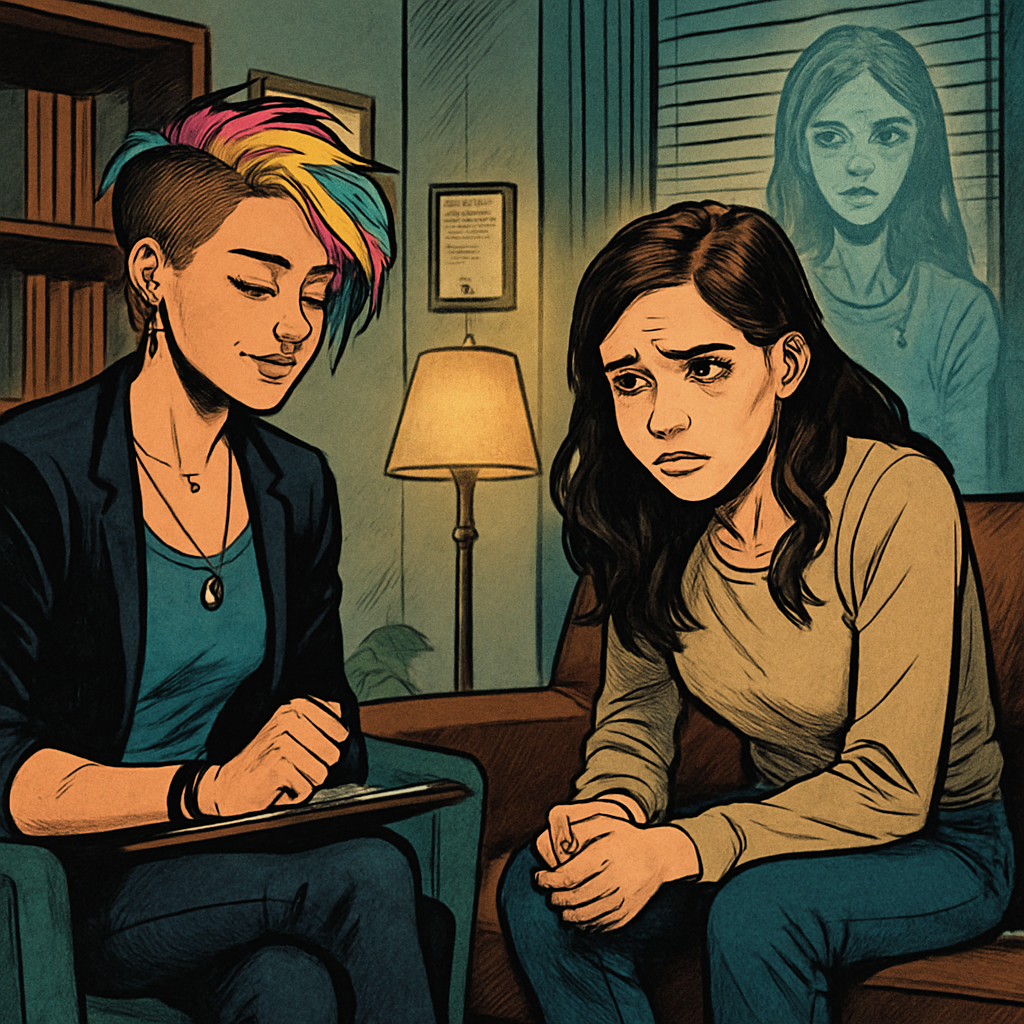
Picture Tessa sitting across from me on a Tuesday afternoon, her knee bouncing the way it does when you’re holding something you can’t name. She tells me about a sentence her boyfriend said months ago—”there are no other girls”—and how those five words have somehow become the entire architecture of her insecurity.
It’s not that she doesn’t believe him. It’s that she believes him too much, the way you believe something when you’re terrified it might not be true. She’s rewound that conversation a thousand times, each time finding new evidence she’s missing something. The irony is devastating: he was trying to reassure her.
The Rumination Trap 🚩
Here’s what nobody tells you about rumination: it’s not actually about the words anymore. Studies show that roughly 65% of people caught in repetitive thought patterns about relationship comments report feeling more anxious after analyzing them—not less. The more you pick at it, the more it bleeds.
The Truth About What’s Actually Happening Here
When Tessa first came in, she was convinced her problem was straightforward: her boyfriend said something unclear, she needed clarity, case closed. But that’s the story her conscious mind was telling. The actual story? Way more interesting.
What she was experiencing was an emotional byte—a compressed unit of information containing:
- Physical sensation (that flutter in her chest)
- Emotional charge (anxiety + shame)
- An unmet need (to feel chosen, irreplaceable)
- A mini-narrative on repeat: “He’s comparing me to her. I’m the consolation prize.”
The worst part? She couldn’t stop the loop.
3 Signs You’re Stuck in a Rumination Spiral (Not Actually Processing)
🔄 You’re collecting evidence instead of seeking understanding
You replay the conversation, reread old texts, analyze his tone—each time hoping the story will change. It never does. Your brain is literally trying to solve an unsolvable puzzle because the puzzle isn’t actually about the words.
🪞 You’re seeing the ghost girl everywhere
Tessa knew where this girl worked. Knew her name. Could probably draw her face. Every time they crossed paths, it triggered everything again. The emotional frame—the invisible lens through which Tessa perceived her own worth—was locked on comparison mode. That’s not her boyfriend’s problem. That’s her nervous system asking her to prove something.
💬 You’ve talked about it but nothing shifts
Tessa had brought this up with her boyfriend multiple times. He’d reassured her. But his reassurance couldn’t touch the actual wound because she was asking him to fix something he didn’t break. She was asking him to confirm her worth—which no partner can do. Worth isn’t a fact someone else validates. It’s infrastructure you build internally.
What I Actually Needed Her to Understand
In our second session, I asked Tessa something that made her go quiet: “What would it mean about you if he really was comparing you?”
She couldn’t answer. Not because she didn’t have thoughts—she had a thousand. But naming them meant confronting the real issue lurking underneath. This wasn’t about his words. It was about her emotional script—an automatic pattern shaped by something deeper.
Turns out, Tessa’s mom had spent years comparing her to her older sister. Nothing said out loud. Just present in the tight-lipped smile, the “well, your sister always…” comment, the subtle messaging that Tessa was always the secondary option. By the time she was dating, her nervous system had built an entire emotional frame around the belief that she was inherently less-than.
His words found existing architecture and moved in.
The Invisible Structures No One Talks About
Here’s where it gets real: Tessa’s rumination wasn’t a personality flaw. It was her emotional system trying to stay safe. If she could just analyze the comment enough, find the right interpretation, crack the code—then she could prevent being left for someone better. The rumination was protective. Exhausting, but protective.
That’s the thing about emotional bytes organized around abandonment fears: they feel like truth. They feel like facts. When actually, they’re prediction models built from old evidence.
We didn’t try to eliminate the anxiety. That would be like asking a smoke detector to stop detecting smoke. We did something different: we gave her emotional granularity—the ability to feel the actual fizz underneath the overwhelming bubble.
Instead of “I’m not enough,” we got specific:
- Right now, in this moment with him, am I actually experiencing rejection? No.
- Is there actual evidence he’s comparing me? No.
- What am I actually feeling? Fear that I could be left. Triggered by my past, not his present.
Granularity transforms everything.
When Communication Isn’t the Real Problem
Tessa mentioned feeling unheard when she tried to talk to her boyfriend about this. And here’s what she didn’t realize: he literally couldn’t hear her because she wasn’t speaking her actual need.
She was asking, “Do you really think I’m enough?” when what she was actually asking was, “Can you convince me I’m worthy of choosing?” Those are different conversations entirely.
He could reassure her until he turned blue. It wouldn’t touch the real wound because he wasn’t the one who caused it. That’s not a relationship failure. That’s a boundary.
And once Tessa understood that her emotional safety was her job—not his—something shifted. Not perfectly. Not immediately. But genuinely.
The Part That Actually Required Work
We talked about what it would mean to let the comment just… be a comment. A sentence spoken by someone in his own emotional complexity at a specific point in time, carrying his own needs and his own anxiety about losing her.
Not a referendum on her value. Not a ranking system. Just words.
The rumination started loosening when Tessa realized she could hold multiple truths simultaneously:
- She genuinely loved him
- He genuinely loves her
- Her nervous system had old programming from her mom’s comparisons that got triggered
None of those things cancel each other out. That’s integration, not elimination.
She didn’t need to believe the comment was meaningless. She needed to believe she was meaningful enough to exist in a relationship even if sometimes there’s ambiguity, even if sometimes she doesn’t feel chosen in the exact way she wants.
That’s where the actual healing starts. ✨
The Wisdom You Need to Know
Your partner’s past, his trauma responses, his unfinished business with other people—those are his emotional bytes to sort through. Your job is protecting your own. You can love him AND maintain the boundary between his healing and yours. That’s not cold. That’s wisdom.
What researchers now understand about attachment and rumination is that when your nervous system learned early on that you might be the “less-than” option, it stays on high alert. It’s not irrational. It’s protective. But here’s where it gets complicated: that protection actually prevents the safety and responsiveness you’re searching for.
You’re approaching your partner as a threat to your adequacy rather than as a collaborator in your life. The rumination isn’t a sign you’re not enough for him. It’s a sign your emotional system needs to reorganize around your own inherent worth—not his confirmation of it.
The moment you stop needing him to prove you’re adequate is usually the moment he finally feels permission to just love you. Not as consolation. As choice.
By the Time Tessa Left Therapy
She wasn’t “over” the comment. But she’d rebuilt her relationship with it. She understood that sometimes our partners say things that land differently than they intended. Sometimes we bring our own history into the room. And sometimes the bravest thing you can do is tell your nervous system: “I know you’re trying to protect me. I’ve got this.”
Last I heard, she’s doing well. The rumination loop broke because she stopped feeding it evidence and started feeding herself curiosity instead.
There’s a difference.
“The words don’t have power. Your story about the words does. And unlike his comment, that’s actually something you control.” 🤌
— Melanie Doss
- A Rapid Review of Dual-Trauma Couples – Sage Journals
- Growth after trauma – American Psychological Association
- The relationship between childhood trauma and romantic … – NIH
- Dating Someone with Relationship Trauma | Charlie Health
- Psychology of Healing: The Neuroscience of Trauma Recovery
- Healing trauma through safe relationships – Mindview Psychology
- How to let go of the past: Tips for relationships, regret, and trauma
- How past trauma impacts emotional intelligence – Frontiers
- Recovery from psychological trauma – HERMAN – Wiley Online Library