
What No One Tells You About Reading Social Signals After Trauma 🧠
Here’s the thing living rent-free in every trauma survivor’s head: 73% of adolescents who’ve experienced relationship betrayal report feeling unable to accurately read others’ intentions.
It’s treating ambiguous signals like potential threats.
When Tessa described Noah’s behavior—the comment, the apology, the gifts—she kept apologizing for “overthinking it.” I stopped her mid-sentence.
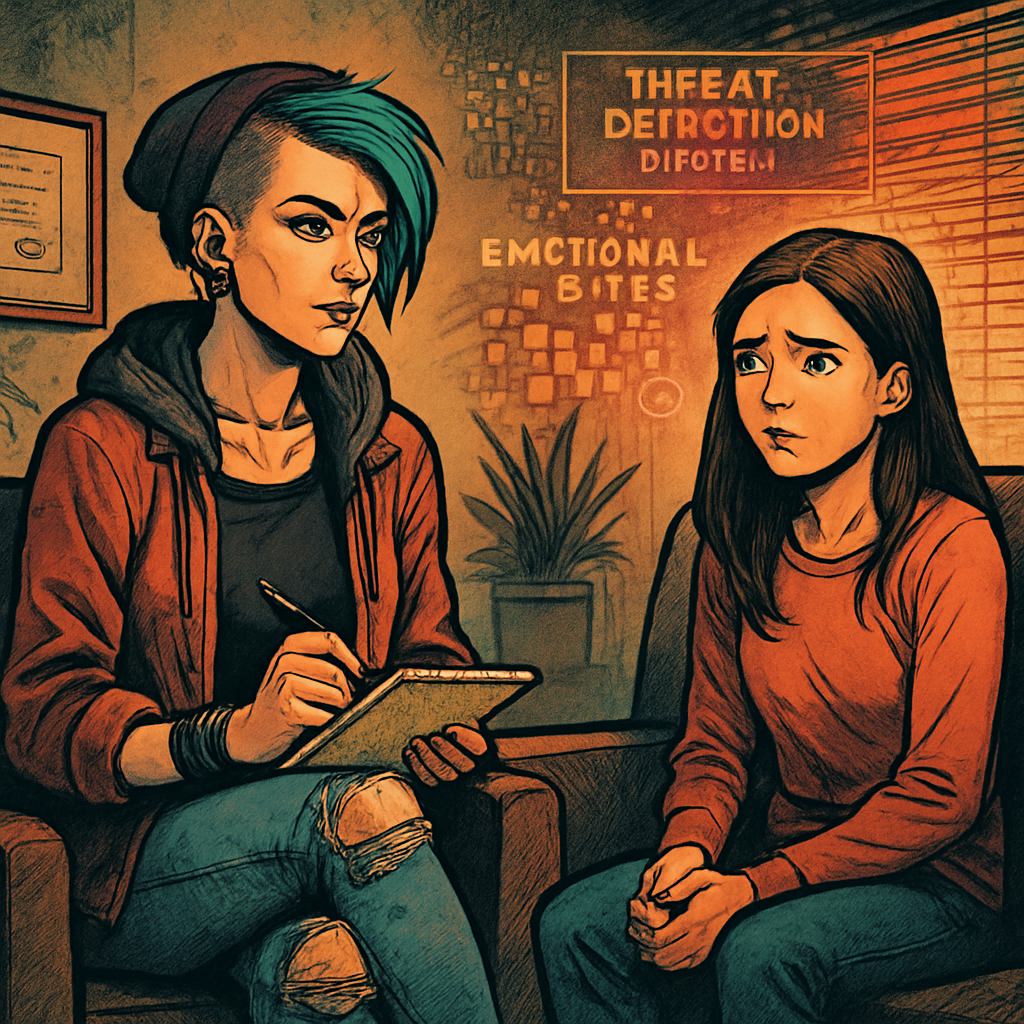
“Your brain isn’t malfunctioning,” I told her. “It’s running a threat detection system that got trained in an environment where nice gestures sometimes came with invisible price tags.”
🚩 The Emotional Byte That Wouldn’t Shut Up
Every experience creates what we call an emotional byte—a little packet of information containing the physical sensation you felt, the emotional charge it carried, what need was threatened or met, and the story you told yourself about what it all meant.
Tessa had emotional bytes from past experiences screaming:
Gifts = expectations.
Apologies = manipulation incoming.
Mini-Story = you’re about to pay for this.
These bytes weren’t random paranoia. They were her nervous system’s Rolodex of “situations that go sideways.”
The problem? Noah’s behavior was genuinely ambiguous. Was he apologizing? Flirting? Both? Creating plausible deniability for future hurts?
Tessa’s inner voice—that constant narrator shaped by early relationships—had learned to interpret uncertainty as danger. Not because she was dramatic, but because uncertainty had been dangerous before.
The Truth About “Mixed Signals” 💭
Research shows that adolescent friendships exist in this weird liminal space where platonic and romantic interest aren’t clearly demarcated. Most teenage romantic relationships actually emerge from friendships first, which means the transition zone is intentionally blurry.
Translation: Noah might genuinely not know what he wants yet. The ambiguity isn’t necessarily manipulation—it might just be confusion wearing a hoodie.
But here’s what made Tessa’s situation complex: she had an emotional frame—a lens built from clusters of past emotional bytes—that was primed to see threat first in that ambiguity.
I asked her to describe the physical sensation she felt when Noah handed her the gifts.
“Like my stomach dropped,” she said. “And my head got tight.”
“Not excitement or gratitude?”
“No. Dread.”
That’s your nervous system talking, bestie. 🥲
✨ The Granular Truth of the Matter
Friendly reminder: The goal isn’t to decide whether your instincts are “right” or “wrong.” The goal is to develop emotional granularity—the ability to distinguish between “I feel unsafe because this situation is objectively threatening” versus “I feel unsafe because this situation resembles a past threat.”
Same sensation. Different meaning.
With Tessa, we worked on her Needs Navigator—a system for identifying what emotional need was actually being triggered. I taught Tess to identify whether her feelings were being constructed by:
- Psychological need: Autonomy (feeling like she couldn’t say no to the gifts)?
- Emotional need: Safety (worried about what Noah might expect in return)?
- Identity need: Twinship/Belonging (questioning whether their expectations were aligned in this relationship)?
- Relational need: Support (wanting to clarify Noah’s actual intentions)?
Turns out it was all four. 💀
What Healing Actually Looks Like (Not the Instagram Version)
I told Tessa something that initially pissed her off: “You might never get clarity about Noah’s intentions. He might not even be clear about them himself.”
She stared at me like I’d just told her Santa wasn’t real.
“So I just… what? Guess?”
“No. You decide what your boundaries are regardless of his intentions.”
This is where most therapy content stops—at the “just set boundaries” advice that sounds great in theory but feels impossible when you’re seventeen and don’t want to lose your only friend in a new place.
So we got specific.
3 Signs You’re Confusing Boundary-Setting with People-Pleasing 🚨
- You’re trying to set boundaries “nicely enough” that the other person won’t notice. That’s not a boundary—that’s a suggestion wrapped in anxiety.
- You’re waiting for permission to feel uncomfortable. You keep looking for “proof” that your discomfort is valid before you’ll act on it.
- You’re more worried about preserving the relationship than preserving yourself. This one’s the kicker. Healthy relationships survive boundaries. Exploitative ones don’t.
Tessa was doing all three.
The Emotional Script Running the Show 📜
We identified Tessa’s emotional script—the automatic behavioral pattern emerging from her emotional frame: When I feel something is off, minimize my own discomfort, perform a role, react in a way that I think they want to see, wait to see what they want, try to give what they want to maintain the peace.
This script felt natural to her. Inevitable even. It had become a self-fulfilling prophecy where her fear of exploitation made her more vulnerable to it.
“What would it look like,” I asked, “to rewrite that script before you get to the performance?”
The Conversation She Was Terrified to Have 💬
We role-played approximately forty-seven versions of Tessa talking to Noah. Here’s what we landed on:
“Hey, I wanted to talk about the gifts. I appreciate the apology, but it made me kind of uncomfortable. I’m not really a gifts person, just acknowledging what you said was hurtful would be enough.”
Notice what that doesn’t include:
- Accusing him of ulterior motives ❌
- Over-explaining her trauma history ❌
- Apologizing for having boundaries ❌
The beauty of this approach? It works whether Noah’s intentions are pure or sketchy. If he’s genuinely just apologizing, he’ll respect it. If he’s testing boundaries, he’ll reveal himself.
Either way, Tessa gets information instead of staying in anxiety limbo.
What Happened Next (The Part That Actually Matters) 🎯
Tessa had the conversation. Noah was confused but not defensive. Turns out he did have a crush on her but hadn’t figured out how to say it directly, so he’d been operating in that teenage boy zone of “be aggressively nice and hope she gets it.”
The rude comment? Nervous deflection. The expensive gifts? Overcompensation.
Still not great communication skills on his part, but not manipulation either. Just garden-variety adolescent emotional illiteracy. 🤌
Here’s the important part though: Knowing his intentions didn’t actually change what Tessa needed to do. She still needed to communicate clearly and continue without the gift-giving.
Noah backed off. They’re still friends. She wasn’t interested in a romantic relationship. Crisis averted.
But Here’s What Really Changed ✨
The external situation resolved pretty predictably. What shifted fundamentally was Tessa’s relationship with her own perception.
She learned that her nervous system’s threat detection wasn’t wrong—it was just working with incomplete information. Those emotional bytes from past experiences weren’t lying to her. They were saying: This situation has elements that match previous danger patterns. Proceed with caution and gather more data.
That’s not paranoia. That’s meta-emotional intelligence—understanding the system creating your emotions, not just trying to manage the emotions themselves.
The work wasn’t convincing Tessa she was “overthinking.” It was teaching her to distinguish between:
- The sensation (stomach drop, throat tightness)
- The emotional charge (fear, dread)
- The need being threatened (safety, autonomy)
- The story she was telling about what it meant (he’s trying to manipulate me vs. he’s expressing interest awkwardly vs. I’m being taken advantage of again)
When you can separate those elements, you can respond to situations instead of just reacting to your internal alarm system.
The Invisible Structure Nobody Mentioned 🏗️
We live in a culture with deeply weird invisible structures. These unspoken social rules were shaping both Noah’s behavior and Tessa’s interpretation of it—creating what felt like a personal problem but was actually a collision of scripts.
This wasn’t about Tessa being damaged or Noah being predatory. It was about two people navigating an invisible structure that makes clear communication unnecessarily difficult.
But psychological tension and conflict are often necessary for higher integration. That discomfort was actually her growing edge—the place where her old protective patterns were bumping up against new experiences that didn’t quite fit the established templates.
The anxiety was the signal that her emotional system was trying to update its predictive models and didn’t quite know how yet.
That’s development happening in real time. ✨
Tessa learned that her instincts weren’t wrong—they just needed more nuance. The goal wasn’t eliminating the emotional bytes from past experiences. It was integrating new emotional bytes that said: Sometimes ambiguous behavior is just ambiguous. Sometimes people apologize awkwardly without ulterior motives. Sometimes I can set boundaries and the friendship survives.
Not erasing the old information. Adding new data points that create a more complete picture.
That’s healing. That’s actually using your empathic engine and needs navigator to develop a more sophisticated understanding of social dynamics.
Which is genuinely the main character energy we should all be channeling.
Final Thought 🎁
The question isn’t whether your instincts are right or wrong. It’s whether you have enough information to distinguish between pattern recognition and present reality.
Sometimes they’re the same thing. Sometimes they’re not.
The only way to know is to test your hypotheses in the actual world instead of just running simulations in your anxious brain at 2 AM.
— Melanie Doss
Currently trying to decide if writing about teenage relationship dynamics at 28 makes me wise or just old. The jury’s still out, but my knees cracked when I stood up from my desk, so probably the latter. Remember: clarity is the gift you give yourself when other people are too confused to give it to you. 🎁
- Friends First? The Peer Network Origins of Adolescent Dating – PMC
- Adolescent Intimacy Revisited – PMC – PubMed Central – NIH
- How to Help Your Teen Set Boundaries with Friends (Especially if …)
- Adolescents’ perceptions of digital media’s potential to elicit jealousy …
- Healthy Relationships in Adolescence
- A qualitative exploration of students’ experiences flirting online