
The Impossible Position 🤐
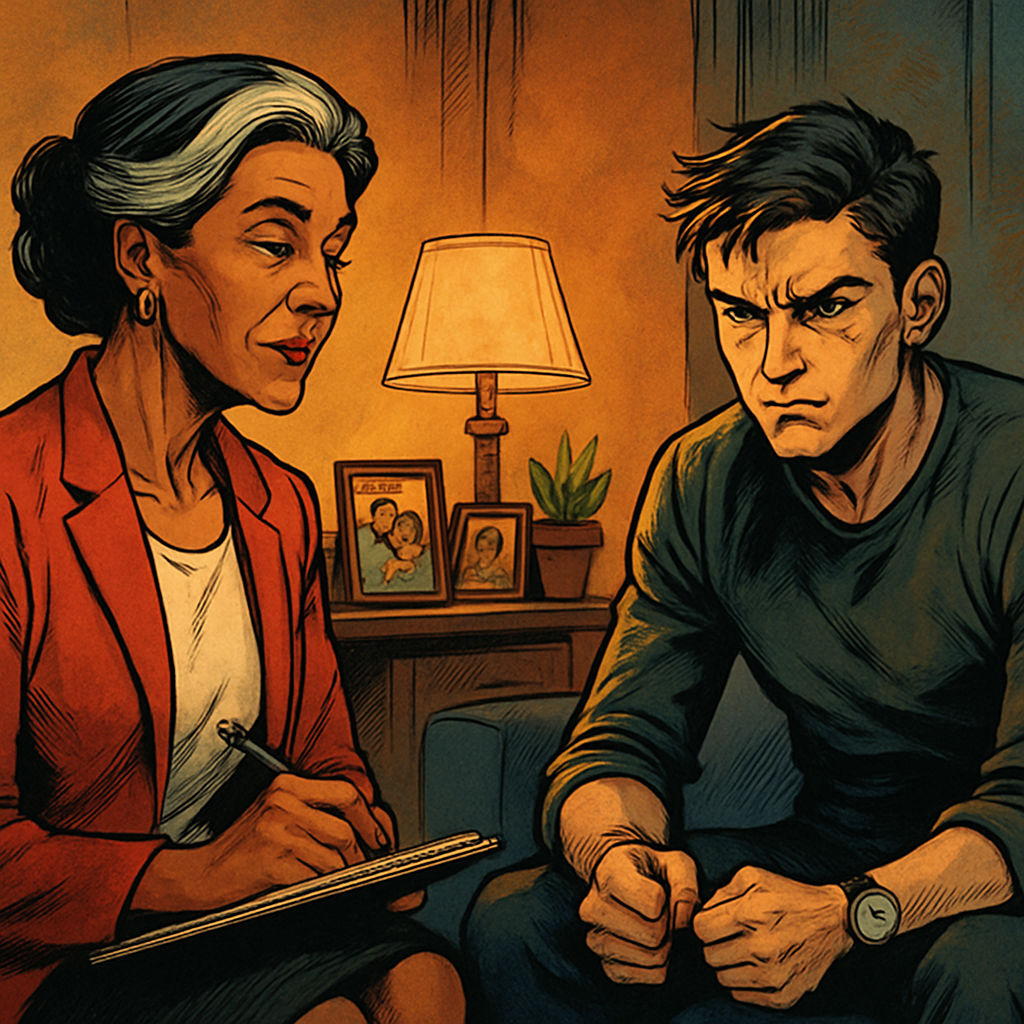
Fifteen years ago, I met Brandon—a sharp-eyed 24-year-old who walked into my office with his shoulders curved inward like parentheses around a secret. He carried himself like someone who’d accidentally wandered into a movie he never bought tickets for.
“I don’t know if this is something people talk about in therapy,” he said, fidgeting with his watch strap, “but I found my dad’s OnlyFans account.” The way he said it—flat, measured, careful—told me everything about how hard he’d worked to contain the explosion happening inside him.
Brandon had discovered his father—a respected elder in their Jehovah’s Witness congregation—was having an affair. The third one, actually. The evidence was tucked into his father’s poorly hidden email account: explicit messages, transaction receipts, and private content exchanges that left no room for misinterpretation.
“If I tell my mom,” he explained, “she might leave him. But she has no job, no money of her own. Our congregation would be torn apart. And if she stays? I’ll know I’m making her live a lie every day.”
Brandon was caught in what I call an emotional double-bind. Each emotional byte he was processing contained contradictory need states: protect his mother versus preserve family stability, honor truth versus prevent catastrophe. These incompatible needs created a paralysis where any action felt morally wrong.
The Religious Complication ⛪
Brandon’s situation was further complicated by his family’s religious context. In their congregation, divorce was permitted only for sexual infidelity—technically applicable here—but would likely result in social ostracism. His mother would lose her community support precisely when she’d need it most.
“My dad quotes scripture during family worship while sexting other women,” Brandon said during our third session. “Last week he gave a talk about moral purity. Do you know how insane that makes me feel?”
What Brandon was describing wasn’t just hypocrisy—it was a complete collapse of his emotional frame about his father. Every memory and interaction was being retroactively rewritten through this new lens. The invisible structure of his family’s religious life, once a source of security, had transformed into a prison of silence that protected his father while trapping everyone else.
Breaking the Triangulation 🔺
In our work together, I noticed how Brandon had unconsciously taken on an inappropriate emotional script—becoming the family protector, secret-keeper, and emotional shock absorber. He was triangulated between his parents, carrying the weight of knowledge his mother didn’t have while simultaneously shielding his father from consequences.
“I’m not sleeping. I can’t look at him. Mom keeps asking what’s wrong, and I just…” he trailed off.
“Brandon,” I said, “you’ve been drafted into an adult situation without consenting to it. Your father’s actions have effectively turned you into an unwilling accomplice. That’s not your burden to carry.”
The revelation visibly shifted something in him. He’d been so focused on everyone else’s needs that he hadn’t recognized the violation of his own boundaries. His father’s infidelity wasn’t just a betrayal of his mother—it was a betrayal of Brandon too.
The Path Forward 🛤️
Our work focused on helping Brandon navigate his emotional reality without taking responsibility for outcomes he couldn’t control. I encouraged him to develop emotional granularity—distinguishing between his anger at his father, concern for his mother, fear of community rejection, and his own grief over losing the father he thought he knew.
We explored how he could honor his own values without becoming his mother’s rescuer or his father’s judge. Most importantly, we worked on how he might claim his own authentic voice in a system that demanded silence.
Three months in, Brandon made his decision. “I told my dad he has one week to tell Mom himself, or I will.” He reported this calmly, without the anxious energy that had previously surrounded the topic.
When his father predictably failed to follow through, Brandon did something brave—he told his mother the truth, not to punish his father, but because he couldn’t participate in the lie any longer. He helped her access therapy and connected her with resources for financial independence.
Living with the Consequences 💪
The fallout was messy, as real life tends to be. His parents didn’t immediately divorce. His mother initially struggled with the congregation’s mixed response. But something fundamental had changed—Brandon had reclaimed his right to live authentically rather than serving as a repository for family secrets.
In our final session, Brandon told me, “I still don’t know if I did the right thing. But it’s the first time in months I feel like I can breathe.”
That’s the thing about impossible situations—sometimes there is no perfect solution. There’s just the choice that lets you continue to live with yourself.
Truth isn’t always a kindness, but secrets are rarely a protection. 💭
Sophia Rivera is a licensed therapist who believes that family secrets are like carbon monoxide—colorless, odorless, and silently suffocating. She specializes in helping adults navigate family system disruptions and moral injury.
- 10 Effects Of Cheating Fathers On Daughters: A Lasting Impact
- For Adult Children: What to Do When a Parent is Cheating
- 5 Negative Effects Adultery Has On A Family – MyWellbeing
- The Effect of an Affair on Adult Children – Esther Perel – YouTube
- How Does Infidelity Impact Young, Teenage & Adult Children?
- Infidelity and Parental Estrangement – Psychology Today
- The Impact of Parental Affairs on Children and Adolescents
- 7 Traumatic Effects of Cheating Fathers on Daughters – Marriage.com