
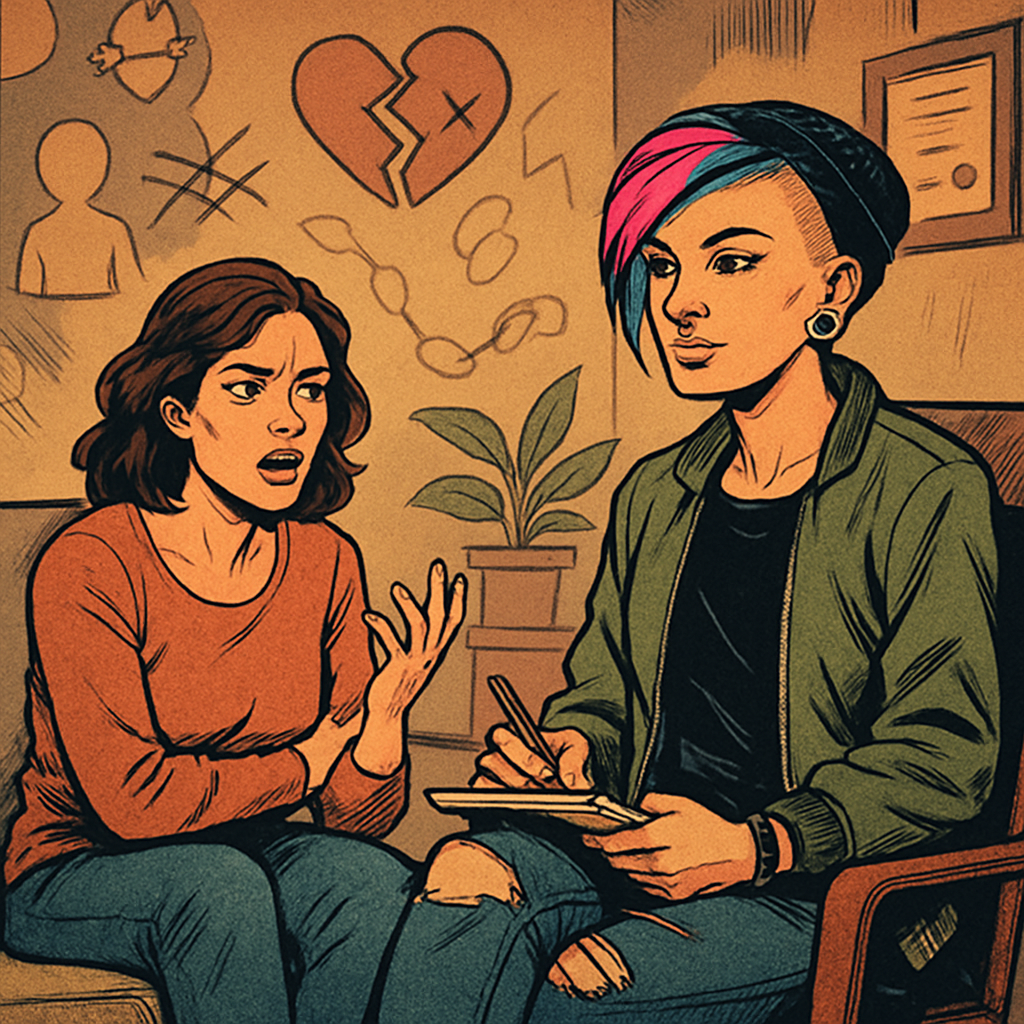
“I think I’m broken,” she said matter-of-factly, the way you’d announce you’d accidentally left your phone in an Uber. “I’ve never had a healthy relationship. Not once. And when someone actually treats me well, I get the ick so hard I ghost them within three weeks.”
There it was. The thing living rent-free in her consciousness.
What No One Tells You About Emotional Unavailability 🥲
Here’s the devastating part: 73% of people report being attracted to partners who replicate their earliest attachment wounds. We’re not just choosing people who hurt us. We’re choosing people whose specific flavor of emotional distance matches the shape of the hole we’ve been carrying since childhood.
Tabitha’s pattern wasn’t random. It was exquisitely, brutally precise.
The Hunger Games (But Make It Attachment Theory) ✨
When Tabitha described her relationships, she kept using the word “chase.” She’d pursue men who gave just enough attention to keep her orbiting but never enough to actually land. The push-pull dynamic wasn’t a bug in her dating life—it was the entire operating system.
“When someone’s stable and present, I feel nothing,” she told me. “Like I’m watching paint dry in human form.”
This is where most self-help content would tell you you’re “addicted to drama” and leave it there. But that’s not what was happening.
What Tabitha experienced as “chemistry” was actually her nervous system recognizing a familiar emotional pattern—that specific cocktail of physical sensations, emotional charge, and narratives she’d learned to associate with “love” during childhood. Her body literally encoded anxiety as affection. The racing heart, the obsessive thoughts, the knot in her stomach waiting for a text back—these weren’t signs of passion. They were signs of recognition.
Her system was running an old script: Love requires fighting. Connection demands proving. If it’s easy, it’s not real.
The Red Flags She Called Green Flags 🚩
Over our sessions, we mapped Tabitha’s attraction triggers. Every single one was a trauma response in a leather jacket:
- The “mysterious” guy who was emotionally withholding = Her father who was physically present but emotionally unreachable
- The “busy” partner who always had something more important = The core belief that her needs were inconvenient
- The “complicated” situation that required patience = Her childhood role as the person who accommodated everyone else’s problematic behaviour.
She wasn’t choosing these men despite the red flags. She was choosing them because of the red flags.
The red flags felt like home. 💀
The Granular Truth of the Matter
Reminder: Your nervous system doesn’t distinguish between “familiar” and “safe.” It just knows what it knows. When you’ve spent formative years learning that love comes with conditions, intermittent reinforcement, and emotional scarcity, stable affection registers as foreign, maybe even suspicious.
This is what psychology researchers call the paradox of emotional availability—people who most need secure attachment often find it the most uncomfortable to receive.
Tabitha’s emotional frame had been constructed entirely from experiences of conditional love. Through that lens, healthy relationships looked boring because they didn’t activate her familiar danger signals. No anxiety meant no “spark.” No uncertainty meant no investment.
She could read a room like a psychological profiler but couldn’t tell you what she actually wanted beyond “someone to choose me.”
When Boredom Is Actually Safety (And Your Brain Hates It) 😤
“I went on three dates with this guy who was… fine,” Tabitha said during one session. “He texted back. He planned actual dates. He asked me questions about my life. And I felt absolutely nothing.”
“Describe nothing,” I said.
She paused. “Calm? Relaxed? Like I could just… exist?”
“That sounds terrible,” I deadpanned.
She laughed, but it was the laugh of recognition. The uncomfortable kind.
Here’s what’s actually happening in these moments: When you’ve learned that love equals activation of your stress response system, the absence of that activation feels like the absence of love itself. Your body has encoded a specific cluster of sensations—racing heart, hypervigilance, anxiety, the dopamine hit of intermittent reinforcement—as “attraction.”
Healthy relating doesn’t trigger those sensations. It triggers different ones: steadiness, groundedness, the ability to actually relax around another person.
But if you’ve never experienced those as “love,” they register as… nothing. Bland. The ick.
The truth is: You’re not bored. You’re just not activated. And your nervous system is pissed about it because activation is its love language. 🤌
The Part Where It Gets Complicated (AKA All of It)
Tabitha mentioned something in passing that was more revealing than anything else: “I don’t really feel much about my friendships either. Like, if they ended, I’d be a bit sad but mostly fine.”
This wasn’t about romantic relationships. This was about her entire emotional architecture.
When I asked about her childhood, she described it as “normal”—a word that usually means “I learned very early that my emotional needs were inconvenient.” Her parents weren’t abusive. They were just… unavailable. Busy. Focused on practical things. She learned to be the low-maintenance child, the one who didn’t need much, the one who could handle things alone.
That became her emotional script: Don’t need. Don’t ask. Make yourself small. Love is something you earn by being undemanding.
So of course she was attracted to emotionally unavailable partners. They allowed her to stay in the only relational role she knew—the pursuer, the giver, the one who doesn’t require reciprocity.
The Hardest Part of Therapy 💔
The hardest sessions with Tabitha weren’t about understanding her patterns. Understanding came relatively quickly. She was sharp, psychologically literate, able to connect dots.
The hard part was sitting with the grief.
Grief for the childhood version of herself who learned that love was conditional. Grief for all the relationships where she performed emotional unavailability’s dance thinking that’s what intimacy looked like. Grief for the realization that changing the pattern would mean tolerating completely new sensations—ones that felt wrong precisely because they were right.
There’s this concept in developmental psychology called positive disintegration—the idea that psychological growth sometimes requires falling apart first. You can’t build new structures without dismantling old ones. Tabitha was in that excruciating middle space where the old frameworks had been exposed as insufficient but the new ones hadn’t yet solidified.
She was learning emotional granularity—making finer distinctions between “I feel nothing” (which was actually calm) and “I feel attracted” (which was actually anxiety). It’s like going from seeing “red” to distinguishing between crimson, scarlet, vermillion, and burgundy. Suddenly you have options. Nuance. Choice.
Things I Told Tabitha That Made Her Laugh (And Also Cry)
“Your type isn’t emotionally unavailable men. Your type is men who allow you to remain emotionally unavailable to yourself.”
She sat with that one for a full minute.
“Oh, I hate that,” she finally said.
“I know.”
This is the thing about therapy that TikTok mental health content sometimes misses: insight doesn’t equal change. Understanding your attachment style doesn’t automatically give you a secure one. Knowing you’re running a script doesn’t mean you suddenly have a new script ready to perform.
The work is in the creation of new emotional patterns through intentional experiences. Going on that boring date and staying present instead of ghosting. Letting a friend show up for you and noticing the discomfort without fleeing from it. Choosing partners who feel “wrong” (read: safe) and giving your nervous system time to recalibrate.
It’s exposure therapy for healthiness. ✨
The Invisible Structures Nobody Mentions
Here’s something we don’t talk about enough: Tabitha’s pattern didn’t exist in a vacuum. She was moving through a dating landscape shaped by cultural narratives about “chemistry,” rom-coms that code emotional unavailability as mysterious and attractive, the entire “he’s just not that into you” industrial complex that teaches women to interpret disinterest as challenge.
Plus, she’s 33 and single in a world that still treats that as a referendum on your worth rather than a completely neutral fact.
These structures don’t cause attachment wounds, but they absolutely reinforce them. They make it harder to see your patterns clearly because everyone around you is validating the same patterns as “normal dating.”
Signs You’re Healing (That Feel Terrible)
Tabitha asked me once, “How will I know if I’m actually changing?”
I told her to look for these markers:
- You feel bored by chaos instead of energized by it
- Healthy relationships feel uncomfortable in a different way—not boring, but vulnerable, exposing, like standing naked in good lighting
- You can identify your needs before you’re in crisis mode
- You’re grieving the old patterns even as you know they weren’t serving you
- You stay in moments of discomfort instead of reflexively exiting
Not one of these feels like winning. That’s how you know you’re actually doing the work. ✨
The Part Where I Don’t Tie It Up With a Bow
Tabitha is still in therapy with me. This isn’t one of those satisfying stories where she met a secure partner and lived happily ever after.
She’s in the messy middle. She went on a date with someone stable and didn’t ghost them, which is progress. She also still feels more attracted to the guy who takes three days to text back, which is honest.
What’s changed is her meta-emotional intelligence—her ability to observe these patterns without being entirely controlled by them. She can feel the pull toward unavailability and simultaneously recognize it as her old system running its familiar program. She can notice the boredom with stability and ask, “What if this isn’t boredom but unfamiliarity?”
She’s developing the capacity to hold multiple emotional truths simultaneously without immediately collapsing into the most familiar one.
That’s not nothing. Actually, that’s everything.
Friendly reminder: Healing doesn’t mean you stop having old emotional patterns. It means you develop new ones and get better at choosing which ones to follow. You’re not eliminating your history; you’re integrating it into a more complex understanding of yourself.
What I Think About at 1 AM 🌙
Sometimes I think about all the Tabithas out there—and there are so many—scrolling through dating apps, wondering why they keep swiping people who don’t swipe them back, believing there’s something fundamentally broken in them rather than something exquisitely, devastatingly adaptive about their patterns.
You learned to survive in an emotionally scarce environment. Of course you got good at extracting love from unavailable sources. Of course stable affection feels suspicious. Your nervous system isn’t broken; it’s doing exactly what it was trained to do.
The question isn’t “What’s wrong with me?”
The question is “What did I learn, and what do I want to learn instead?”
That’s a question with an answer. And answers, unlike unavailable partners, actually show up when you need them.
— Melanie Doss
Your attachment style isn’t your personality. It’s just the story your nervous system tells about whether people stay. And here’s the thing about stories—you can always write a new chapter, even if the first draft was written in someone else’s handwriting.
Remember: Boredom is just safety trying on a new outfit. Give it a minute to fit. 🤌
- Emotionally unavailable: Meaning, signs, and how to heal
- The Psychology Of Emotional Unavailability: Why It’s So Attractive
- Emotional Unavailability: Definition, Causes, & Signs – The Berkeley …
- Understanding Emotionally Unavailable Relationship Patterns
- Emotional availability: theory, research, and intervention – PMC – NIH
- When your partner is emotionally unavailable — do you stay?