
💔 When Love Meets Brokenness
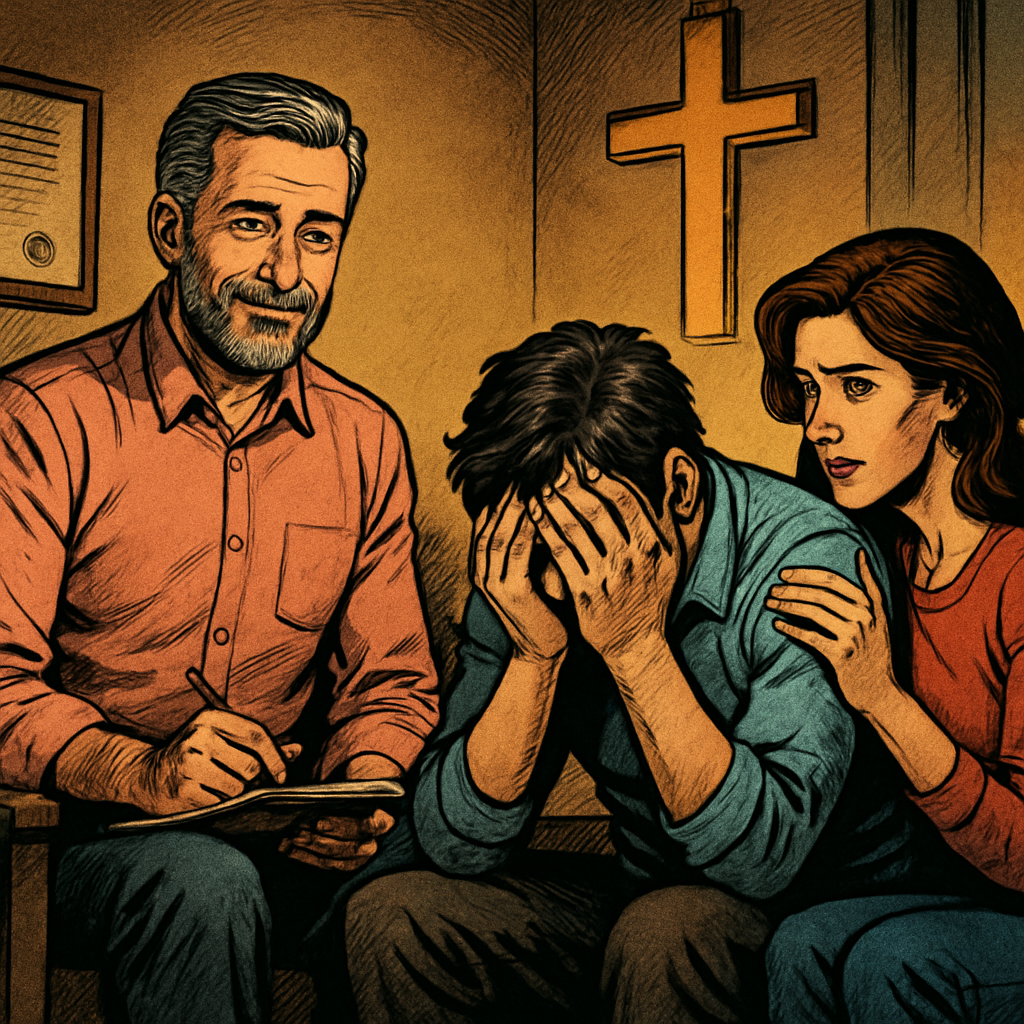
In the darkest valleys of human experience, where shadows of past betrayals stretch long across the present, God does not stand distant. He draws near. I’ve witnessed this truth unfold countless times in my therapy room—that sacred space where broken hearts find voice and divine comfort often arrives through human presence.
I remember the afternoon Brooke first came to my office. Rain tapped gently against the window as she settled into the worn leather chair across from mine. She didn’t come for herself, she explained, but for guidance on how to help her partner, James. As she spoke, her love for him was evident in every careful word, every pained expression.
“He’s drowning,” she said simply, “and I don’t know how to throw him the right lifeline.” 🆘
🌧️ The Wounded Father’s Landscape
James was battling the aftermath of his ex-wife’s infidelity—a betrayal that had spiraled into something far more insidious. Over two years, his three children had been systematically turned against him. Weekend visits became increasingly rare before stopping altogether. Phone calls went unanswered. Birthday cards were returned unopened.
This wasn’t merely a difficult divorce; it was parental alienation—a pattern where one parent manipulates children into rejecting the other. The psychological literature clearly documents this as a form of emotional abuse, leaving profound wounds on both children and targeted parents.
“He tries to hide how much it hurts,” Brooke explained, “but I see him staring at their photos when he thinks I’m not looking. Last week, he drove past his daughter’s school play, just to catch a glimpse of her from the parking lot.” 😢
What James was experiencing were complex emotional bytes—fundamental units of emotional information containing physical sensations, emotional charge, unmet needs, and painful narratives. Each rejected call or missed visitation triggered cascades of shame, grief, and helplessness that settled in his body as physical pain.
📖 Biblical Reflection: David’s Lament
James’s situation reminded me of David’s anguish when his son Absalom turned against him. In 2 Samuel, we witness a father’s heart breaking as his child becomes estranged. David’s words resonate with parents facing alienation:
“O my son Absalom, my son, my son Absalom! Would I had died instead of you, O Absalom, my son, my son!” (2 Samuel 18:33)
This raw lament reveals the depth of parental love—a love that persists even when rejection cuts to the bone. Despite Absalom’s betrayal, David never stopped being a father. His identity remained anchored in that relationship, just as James’s fatherhood remained true regardless of his current separation from his children. ❤️
What struck me most was how David’s grief found voice—he didn’t suppress it or spiritualize it away. This biblical precedent validates the profound pain parents like James experience, giving them permission to acknowledge their suffering before God.
🔍 Understanding Distorted Reality
“I think what hurts him most,” Brooke continued, “is not knowing why. His oldest son used to call him ‘best dad ever.’ Now he won’t even speak to him. How does that happen?”
What Brooke was describing were the devastating effects of distorted emotional frames—invisible interpretive lenses that shape how we perceive reality. James’s children had developed frames that cast their father as dangerous, unloving, or unworthy of relationship through subtle manipulation.
“The hardest part is watching him blame himself,” Brooke said, wiping away tears. “He keeps saying if he’d been a better father, this wouldn’t have happened. But I’ve seen him with his kids. He was patient, attentive, loving.” 💔
Parental alienation creates a particularly painful type of trauma. Unlike most wounds with clear causes, alienation presents as mysterious rejection. The targeted parent can’t identify what they did wrong because, fundamentally, they didn’t cause the alienation.
🙏 On Stolen Blessings and Divine Comfort
There’s a particular cruelty in parental alienation that echoes ancient stories of stolen blessings. Just as Jacob disguised himself to steal Esau’s blessing, an alienating parent effectively steals the blessing of relationship from both the targeted parent and the children themselves.
The parent loses the joy of watching their children grow. The children lose the unique gifts that parent would bring to their development—perhaps a father’s strength and playfulness, or values that would have shaped their character.
Yet God sees. Just as He heard Hagar’s cries in the wilderness when she and her son were cast out (Genesis 21), He witnesses the grief of parents separated from their children. ✨
When Jesus declared, “Blessed are those who mourn, for they shall be comforted” (Matthew 5:4), He wasn’t offering platitudes but profound recognition of suffering and the promise of divine presence within it.
⚖️ Supporting Without Drowning
Over several sessions, Brooke and I explored how she could support James without sacrificing her own emotional well-being. This delicate balance required attention to her own needs.
“Sometimes I feel like I’m holding my breath,” she confessed. “Like if I exhale, everything might collapse. He’s in so much pain, and I want to fix it all, but I can’t. And then I feel guilty for having my own struggles when his are so much worse.” 😰
I recognized in Brooke’s words the compassion fatigue that often affects partners of trauma survivors. She was experiencing secondary emotional trauma—absorbing James’s pain while developing her own responses to his situation.
We focused on practical strategies:
- 🕰️ Establishing times when the topic of the children wasn’t discussed
- 😊 Finding activities that connected them to joy
- 👥 Creating space for her to process her own feelings with friends
“Your presence is healing,” I told her, “but your presence requires that you remain whole. You can’t pour from an empty vessel.” 🫗
🌱 Small Victories in Sacred Spaces
Over the months that followed, both Brooke and James began developing meta-emotional intelligence—the ability to understand not just their emotions but the systems creating those emotions.
James gradually moved from seeing himself as a failed father to recognizing himself as a targeted parent experiencing a documented form of family trauma. This shift in narrative didn’t eliminate his pain but contextualized it, making it more bearable.
“I still miss them every day,” he told me during one session, “but I’m starting to understand this isn’t about me being unlovable. It’s about a broken system that’s hurting all of us, including my kids.” 💡
Small victories emerged:
- ✍️ James began writing letters to his children expressing his enduring love
- 🤝 He connected with other alienated parents who understood his experience
- 🎉 Brooke found ways to celebrate these steps while maintaining her support network
🙏 Prayer for the Journey
Healing from parental alienation isn’t linear. It involves what I call positive disintegration—the necessary psychological tension that precedes higher integration. Old patterns must sometimes fall apart before new, healthier ones can form.
For James and Brooke, each day brings both challenges and opportunities for growth. Their journey continues, marked by both tears and determined hope.
I close with the prayer we often shared at the end of our sessions:
Father of the brokenhearted,
You who count every tear and hear every silent cry,
Hold these precious ones in the palm of Your hand.
Where relationships are broken, plant seeds of future restoration.
Where grief overwhelms, provide daily strength.
Where confusion reigns, grant wisdom and clarity.
Help them to know they are never defined by rejection
But always by Your unfailing love.
In the name of the One who was forsaken
That we might never be abandoned,
Amen. 🕊️
—Dr. Samuel Hartwell, believing that even our deepest wounds can become sacred ground where God’s healing presence is most profoundly revealed
- The Impact of Parental Alienating Behaviours on the Mental Health …
- Medical–Legal and Psychosocial Considerations on Parental …
- New Research on the Science of Parental Alienation
- The Science Behind Media’s Harmful Bias Regarding Parental …
- Parental alienation – a valid experience? – Sage Journals
- Research explores perception versus reality around parental …
- Countering Arguments Against Parental Alienation as A Form of …