
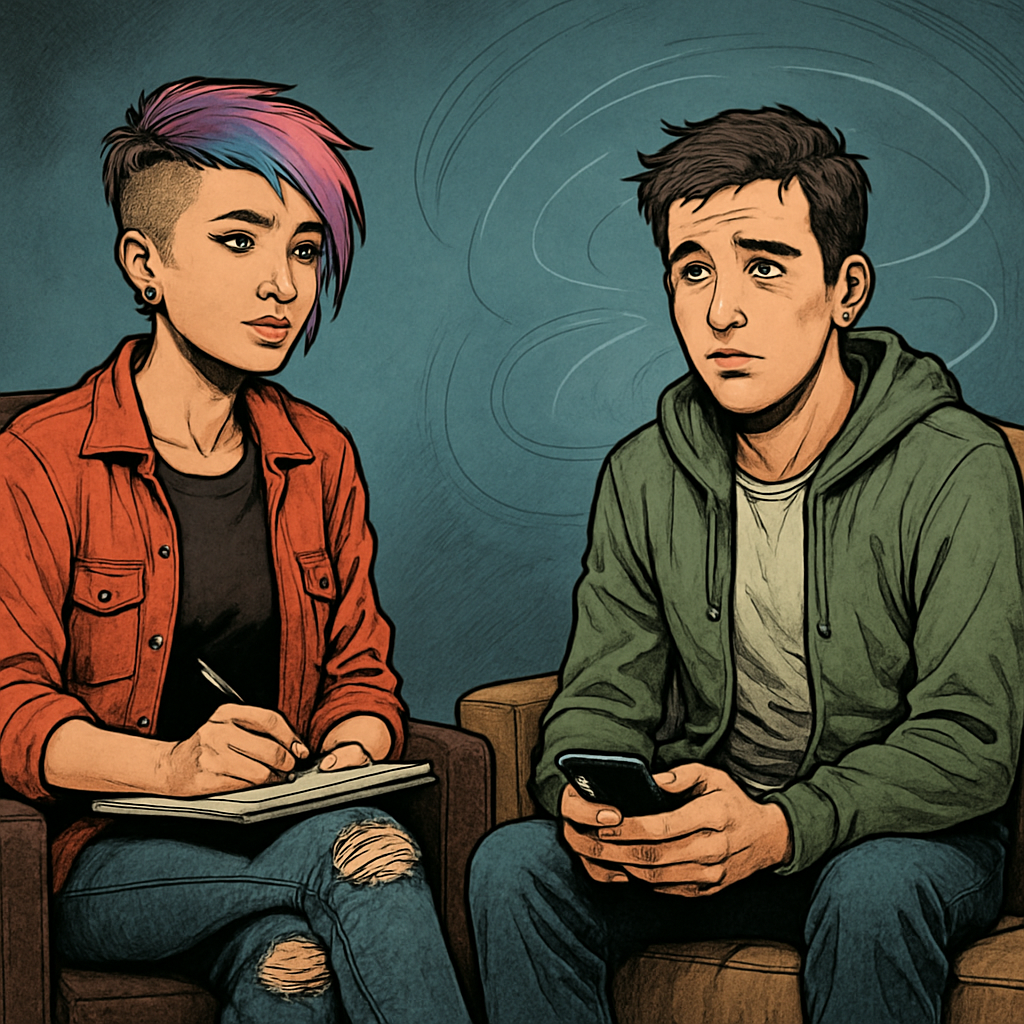
Trevor’s Dilemma 💭
Trevor came into my office with the haunted look of someone who’d spent too many nights parsing text message timestamps like ancient hieroglyphics. Twenty-six years old, personal growth journey completed ✨, therapist-approved self-improvement badges earned, and now his friend of several years was texting him daily, sharing her deepest thoughts, giving him what he called “special treatment.” The same friend who’d rejected him before. The same friend who still talked about her exes. The same friend who existed in this quantum state of maybe-interested-maybe-not that was basically Schrödinger’s situationship.
He sat across from me asking the question that’s been living rent-free in the minds of approximately 67% of people in opposite-sex friendships: “Does she like me, or am I delusional?”
The Devastating Truth About Reading Signs 👀
Here’s what researchers discovered: men report higher sexual attraction toward their opposite-sex friends than women do, regardless of anyone’s relationship status.
Which means Trevor wasn’t just reading his friend’s behavior—he was reading it through a lens already tinted by his own feelings. His emotional frame had organized itself around a specific narrative: I’ve changed, therefore everything has changed.
But emotional frames don’t just shape what we see. They shape what we can see.
The Prediction Error Problem 🚩
Trevor’s brain had been collecting emotional bytes for years. Every conversation with this friend, every laugh, every moment of connection—his system encoded them with a specific charge: potential romance. Physical sensations of hope mixed with anxiety. Need states screaming for validation and connection. Mini-narratives like “if I just become better, she’ll see me differently.”
The problem? Those bytes were now his predictive model.
When she started texting daily, his system didn’t interpret it neutrally. It interpreted it through the accumulated weight of every hopeful byte he’d ever encoded about her. Studies show this is where projection becomes indistinguishable from perception—we literally cannot see the difference between what’s there and what we’ve been praying would be there.
The Three Questions 🤔
1. What does “special treatment” actually look like when you remove your feelings from the equation?
He paused. Described her behavior. Then I asked him to describe how she treats her other close friends. Another pause. Longer this time. “I… don’t actually know,” he admitted.
This is what I mean about invisible structures. Gender dynamics create unspoken rules where women’s emotional intimacy gets read as romantic interest by men, when research on friendship norms shows women’s friendships are just… more emotionally expressive by default.
2. What need is this uncertainty actually serving?
Trevor looked at me like I’d spoken in Chinese.
But here’s the thing about ambiguity—it protects us. As long as the situation stays undefined, Trevor never has to face another rejection. He gets to exist in the liminal space where hope doesn’t have to die. His emotional script had learned that vulnerability leads to pain, so his system found a brilliant workaround: never fully commit to vulnerability.
The uncertainty wasn’t the problem. The uncertainty was the solution his emotional systems had created to avoid the actual problem: his terror of being seen and rejected again.
3. What’s the cost of staying in this loop?
This is where Trevor got quiet. The cost wasn’t just the friendship potentially staying platonic. The cost was that he’d put his entire emotional life on hold, organized around someone else’s maybe-feelings. His identity needs—authenticity, self-understanding—were being sacrificed at the altar of not wanting to “ruin the friendship.”
Getting Granular With Emotions 🔍
Emotional granularity is what transforms an overwhelming bubble of “does she like me??” into manageable fizz you can actually work with.
I asked Trevor to get specific. Not “does she like me” but: What am I actually feeling right now? Separate the physical sensations (chest tightness, stomach drops) from the emotional charge (hope mixed with dread) from the need state (wanting validation, wanting certainty) from the narrative (if she likes me, it means I’m worthy).
That last part—that’s where the real work lives.
Because Trevor’s inner voice had encoded a specific story: his worth was contingent on her reciprocation. That voice had been shaped by years of experiences where love felt conditional, where being seen meant being chosen, where rejection meant being fundamentally lacking.
The mixed signals weren’t just coming from his friend. They were coming from his own system, which simultaneously wanted connection and was terrified of it.
Signs You’re Projecting vs. Perceiving 💀
You’re probably projecting if:
- You’re analyzing every interaction like it’s the Zapruder film
- You can explain away contradictory evidence (“she talks about exes but maybe that’s to make me jealous”)
- You feel like you’re losing your mind trying to “figure it out”
- The ambiguity feels more comfortable than clarity would
- Your friends are gently suggesting you might be seeing things that aren’t there
You’re probably perceiving accurately if:
- The signals are consistent across contexts
- Other people have noticed the shift in dynamics
- She’s explicitly said things that indicate interest
- The increased attention came with her clear initiation, not your increased availability
- You can imagine the friendship continuing unchanged without feeling devastated
The Hard Truth 💯
Not “have the DTR talk” or “just ask her out” or any of that main character energy advice that sounds good on TikTok but ignores the actual emotional architecture at play.
I told him the truth: The friendship is already changed.
Not by her behavior. By his internal experience of it. He’s already not showing up as a genuine friend—he’s showing up as someone auditioning for a different role while pretending he’s not. That’s not friendship. That’s a low-grade anxiety disorder with text notifications.
The “risk” he’s afraid of—ruining the friendship—has already materialized. He’s just calling it by a different name.
Studies on opposite-sex friendships consistently show that unaddressed attraction doesn’t preserve the friendship. It slowly strangles it. Creates resentment, misunderstanding, and that special kind of suffering where you’re close to someone but can’t actually be yourself around them.
The Integration Principle 🤌
Here’s what working with his emotional system looked like instead of against it:
Acknowledging that the hope wasn’t stupid—it was his system trying to meet legitimate needs for connection and validation. Recognizing that the fear wasn’t weakness—it was his system trying to protect him from pain it had learned to expect. Understanding that the confusion wasn’t a moral failing—it was what happens when you have contradictory emotional bytes (desire for closeness + fear of rejection) trying to coexist.
The goal wasn’t eliminating his feelings or his fear. The goal was developing enough meta-emotional intelligence to see the system creating both, and then making an intentional choice about what to do with that information.
Because here’s what I’ve learned watching hundreds of Trevors sit in that chair: the actual question is never “does she like me?”
The actual question is: “Am I willing to experience the discomfort of being known, regardless of the outcome?”
That’s not a question about her. That’s a question about whether Trevor was ready to update his emotional bytes about what vulnerability means, what rejection means, what his own worth means independent of someone else’s desire for him.
The Growth in the Discomfort 🌱
Trevor left that session without the clarity he came looking for, which honestly? Was kind of the point.
Because sometimes growth doesn’t look like getting answers. Sometimes it looks like the psychological tension of holding contradictory truths: I want certainty and I might not get it. I want to protect the friendship and I might need to risk it. I want to believe I’ve changed enough to deserve different outcomes and I might get the same result anyway.
That tension—that’s not a problem to solve. That’s the developmental potential sitting in the apparent dysfunction of not knowing what to do.
The old Trevor would’ve either confessed immediately (seeking relief from anxiety) or stayed silent forever (avoiding potential pain). The Trevor I was working with was learning to exist in the space between those impulses long enough to make an intentional choice.
That’s the whole game.
— Melanie Doss
PS. Trevor eventually did have that conversation, by the way. She appreciated his honesty and confirmed she saw him as a friend. He was devastated for approximately three weeks, then started dating someone else within two months. Turns out the friendship survived just fine once he stopped trying to preserve it at the cost of his own authenticity.
Remember: Uncertainty isn’t chaos—it’s the space where actual intimacy becomes possible. Stay uncomfortably honest out there. 🥲
- Gender and Friendship Norms Among Older Adults – PMC
- 12 Male Female Friendship Boundaries to Set with the …
- The Rules of Opposite Gender Friendships – Foundation Restoration
- The Psychology of Male-Female Friendships
- [PDF] Can men and women be just friends? – UT Psychology Labs
- Can Men And Women Be Just Friends? What Science Says
- Moderators of Sexual Interest in Opposite-sex Friends – PMC
- 270. The psychology of male-female friendships
- The Male/Female ‘Friend Zone’: Is it Possible? – Psychology Today
- 270. The psychology of male-female friendships – Omny.fm