
🤐 The Void That Speaks
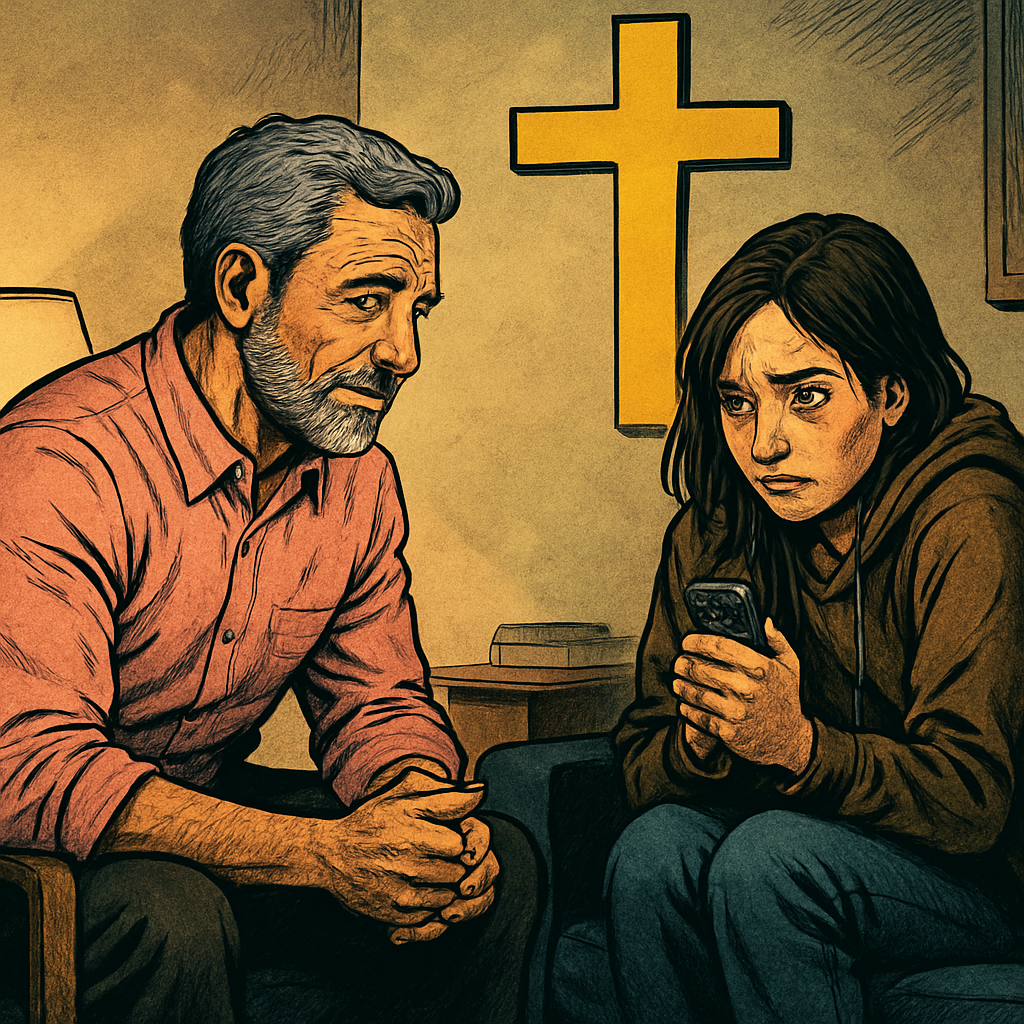
The waiting had become a presence itself, filling the room between us. Bridget sat curled into herself on my office couch, her phone clutched in her hand like a talisman that had lost its power. Seven days without contact, seven days of straight-to-voicemail calls, seven days of messages read but unanswered. 📱
The anxiety of the unknown had carved itself into the lines around her eyes. And I recognized in her the ancient human dread – not just of abandonment, but of the terrible space between presence and absence where hope and fear wage their silent war.
“He’s just… gone,” Bridget explained, tears threatening but held at bay through visible effort. “We had this stupid argument about his family’s Christmas plans, and then – nothing. For a whole week.”
At thirty-four, Bridget was accomplished and self-assured in most areas of her life. But her boyfriend Michael’s sudden disappearance had triggered what I recognized as a profound activation of her attachment system – that God-designed neural architecture that monitors our vital connections to others.
“I keep going back and forth,” she continued. “One minute I’m booking flights to check on him in Boston, the next I’m telling myself that’s completely overreacting. What if he’s actually gone? What if something happened to him?” 🤔
⚖️ When Two Stories Collide
What Bridget was experiencing was what I call a “frame collision” – two competing interpretive lenses struggling for dominance. In the emotional bytes framework I’ve developed over years of clinical practice, these frames form from clusters of emotional experiences that shape how we perceive reality.
Bridget was caught between a safety frame (“something might be wrong”) and a rejection frame (“he’s avoiding me”).
“It sounds like you’re carrying two very different stories at once,” I offered. “And both feel true.”
She nodded emphatically. “Exactly. And I don’t know which one to believe.”
✝️ Biblical Reflection: The Silence Between Holy Saturday and Easter
As Bridget spoke, I was reminded of that sacred space in Scripture between Christ’s crucifixion and resurrection – Holy Saturday. The disciples experienced perhaps the most profound uncertainty imaginable. Their Messiah was gone. Should they wait in Jerusalem or flee? Was death the end of the story?
Scripture gives us relatively little about this day of waiting, this divine silence. Yet in that gap lies a profound truth about the human experience – sometimes we must endure periods of not knowing when all our frameworks for understanding seem inadequate.
“Bridget,” I shared, “your situation reminds me of those hours the disciples spent after Jesus was crucified. They didn’t yet know resurrection was coming.”
Something in her posture shifted. “I never thought about that before… they didn’t know how the story would end.”
“No, they didn’t. And neither do you, right now. But what we do know is that even in their uncertainty, God was still at work, still present, though temporarily hidden from view.” 🙏
💔 The Emotional Bytes of Abandonment
I helped Bridget identify the distinct emotional bytes being triggered by Michael’s silence. These fundamental units of emotional information carry not just feelings, but physical sensations, needs, and meaning narratives all bundled together.
“When you imagine that something might have happened to Michael, what happens in your body?” I asked.
“My chest tightens,” she said, placing her hand over her sternum. “And I feel almost dizzy, like I need to act immediately.”
This revealed a safety-oriented emotional byte. But there was another layer present.
“And when you imagine he’s intentionally avoiding you?”
Her expression shifted. “My stomach drops. I feel small. And I hear this voice saying, ‘Of course he left. They always do.‘”
This revealed a different emotional byte entirely – one carrying a narrative about unworthiness and inevitable abandonment, connected to her father’s emotional unavailability and her parents’ divorce when she was eleven.
“The thing about emotional bytes,” I explained, “is that they don’t just contain feelings – they contain predictions. Your emotional system is trying to protect you by preparing you for abandonment.”
🎭 Made in His Image, Marked by the Fall
What struck me deeply about Bridget’s situation was how it reflected both our design and our brokenness. God created us for connection – wired us to be exquisitely sensitive to the presence and absence of loved ones. This is part of being made in His image as a relational Being. Yet the fall has distorted this beautiful design.
“Bridget, your sensitivity to Michael’s absence isn’t weakness,” I offered. “It’s a reflection of your capacity for deep connection – something God built into you. But like all good things, it’s been affected by the brokenness of our world.” ❤️
“So what do I do?” she finally asked.
“First, we honor the tension you’re in,” I replied. “There’s wisdom in both impulses – to respect boundaries and to seek connection. What if we see them as reflecting different parts of God’s character? God both respects our freedom and pursues us relentlessly.”
🎯 The Sacred Work of Decision-Making
Over the next two sessions, Bridget and I worked to increase her emotional granularity – breaking down the overwhelming emotional bubble into manageable components. By distinguishing between anxiety, concern, fear, uncertainty, and love, she gained clarity about what she was actually feeling.
We also examined the unspoken expectations between Bridget and Michael. “Relationships develop invisible structures,” I explained. “Unwritten rules and assumptions that we never discuss explicitly.”
This reframing helped Bridget recognize that her distress wasn’t simply personal insecurity – it reflected genuine relational misalignment around important expectations.
By our third session, Bridget had found her path forward:
“I’m going to text him one more time, clearly stating that I’m worried and need to hear that he’s okay. If I don’t hear back by tomorrow, I’ll call his sister. Not because I’m controlling, but because that’s reasonable concern from someone who loves him.” 💪
🌟 Grace-Anchored Growth
When Bridget returned for our fourth session, she looked both relieved and contemplative. Michael had finally responded, apologizing for his silence. He had fallen into what he called a “depression hole,” unable to respond but feeling increasingly guilty about it.
“He’s coming to visit this weekend so we can talk in person,” she said. “I’m relieved he’s okay, but I’m also clear that this pattern isn’t healthy for either of us.”
What impressed me most was not just Bridget’s relief but her clarity. The crisis had revealed not only her attachment vulnerabilities but also her legitimate relational needs.
“I’ve realized I can be both strong and vulnerable at the same time,” she reflected. “I can worry about someone without it meaning I’m needy. And I’ve learned that my feelings were telling me something important – not just about me, but about what was missing in our relationship.”
This is what I call grace-anchored growth – the ability to learn and change while remaining grounded in the knowledge of one’s inherent worthiness. 🌱
🙏 Prayer for the Journey
As we closed our final session on this issue, I shared a prayer that captured Bridget’s journey:
Heavenly Father, You who are ever-present even when silent, we thank You for Bridget’s courage to face both her fears and her truths. Thank You for designing her with the capacity for deep connection, and for Your patience as she learns to navigate the complexity of human relationships.
Grant her wisdom as she establishes clearer expectations with Michael. May your spirit create in her the courage to articulate her needs, and discernment to recognize the difference between sacrificial love and self-abandonment. May she continue to find her identity anchored not in perfect relationships but in Your perfect love – a love that never goes silent, never abandons, and never fails.
In the name of Jesus, who endured the ultimate separation so that we might never be truly alone. Amen.
The sacred space of the therapy room often mirrors the sacred space of prayer – both places where we bring our most vulnerable selves and our hope for something beyond our current understanding. In both spaces, transformation happens not through the elimination of struggle but through its integration into a larger story of redemption. ✨
—Dr. Samuel Hartwell, believing that every moment of relational pain carries the potential for deeper connection – with others, with ourselves, and with the God who designed us for love.
- 10 Red Flags of Emotional Neglect in a Relationship
- 10 Effects of Lack of Attention in Relationships & Remedies
- The Silent Killer of Relationships
- Psychological Impact of Being in an On-and-Off Relationship
- How Unspoken Expectations Can Damage Relationships
- What Are The Effects Of A Lack Of Intimacy In …
- One-Sided Relationships: Signs, Causes, & How to Fix it
- Blaming Self or Other Influences Feelings of Regret
- Missteps in Love: How Our Actions Shape Relationships
- Understanding the Deep Connection Between Missing …