
🐍 The Hidden Danger
The serpent doesn’t announce itself as evil incarnate. It slithers in under the banner of friendship. It waits patiently while the guardians at the gate—those divinely appointed to protect—stand aside with smiles and assurances that everything is fine. Sometimes the only one who sees the forked tongue darting is the one least equipped to slay the beast.
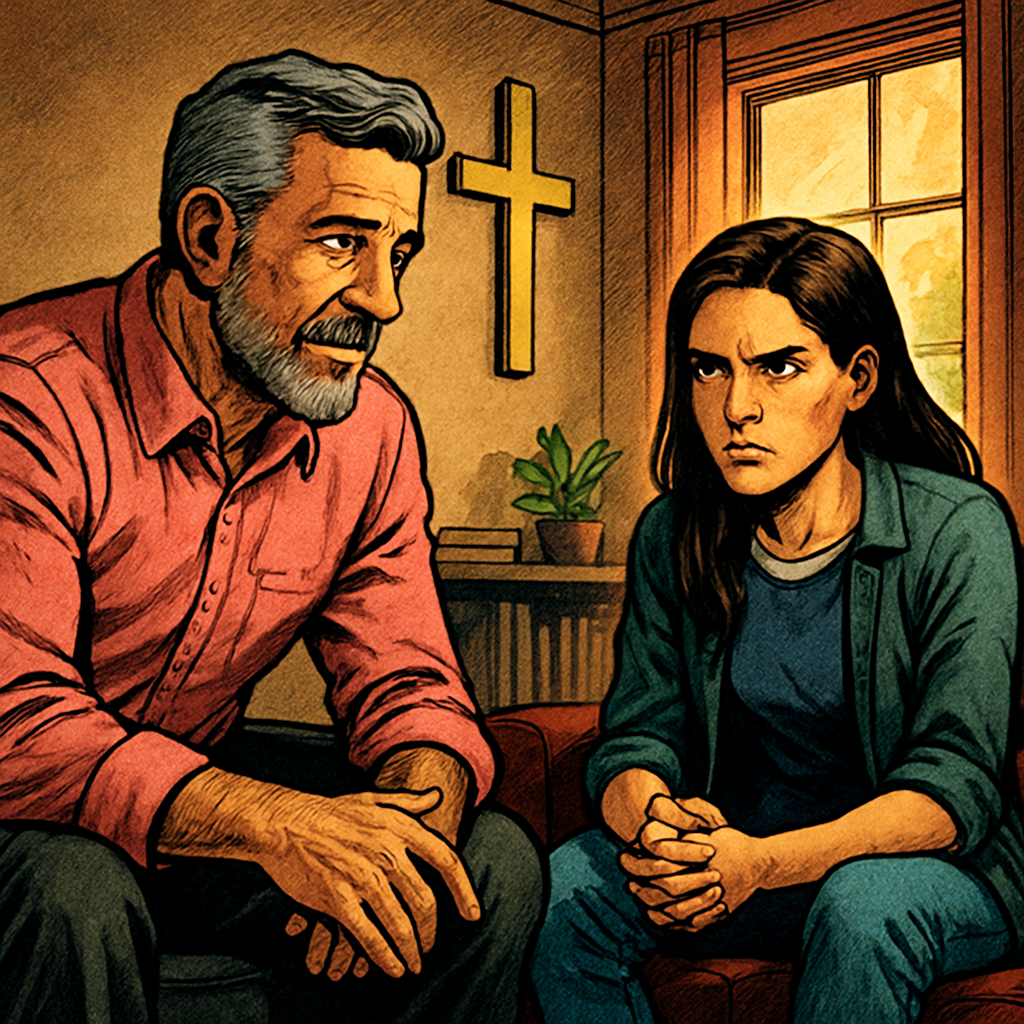
There’s something particularly haunting about sitting across from someone who bears the burden of protection when those charged with that sacred duty have abdicated their responsibility. I recall Tessa—a bright-eyed college sophomore with an artist’s soul and a warrior’s heart—who came to my office not for herself, but for her younger sister.
“I don’t know where else to turn,” she said, hands trembling slightly as she arranged and rearranged a tissue on her lap. “No one believes me, or if they do, they don’t think it’s serious enough to do anything about it.”
⚔️ The Sentinel at the Gate
Tessa was 20 when she first sat in my office, but the weight she carried aged her beyond her years. Her 14-year-old sister was being exposed to their father’s childhood friend—a 42-year-old man who had shown concerning patterns of behavior toward both sisters. Most alarmingly, this man had kissed Tessa’s sister on the lips when she was just 12 years old.
“My parents saw it happen,” Tessa explained, her voice tight with contained frustration. “They just laughed it off. Said it was innocent. But the way he looks at her isn’t innocent. And my dad—” here she paused, swallowing hard, “my dad once told me he suspected this guy might be a pedophile. But still, they invite him over. Still, they leave my sister alone with him.”
What Tessa was experiencing was what I call a “witnessing burden”—an emotional overload filled with anxiety, fear, and an overwhelming sense of responsibility that was consuming her system. Her body was constantly vigilant, scanning for threats that others refused to acknowledge.
“I feel like I’m going crazy sometimes,” she admitted during our second session. “Like maybe I’m overreacting or seeing things that aren’t there. But then he’ll say something or touch her shoulder a certain way, and I just know.” 😰
💔 The Betrayal of Sacred Trust
The most poignant aspect of Tessa’s situation wasn’t just the potential danger to her sister—it was the profound betrayal by those who should have been the first line of defense.
“My parents are good people,” she insisted, though her voice held the unmistakable crack of disillusionment. “They love us. But it’s like they have this blind spot when it comes to him. He’s my dad’s oldest friend. My sister’s godfather. Breaking that relationship would mean admitting they’ve been wrong all these years.”
What Tessa was describing is what researchers at the National Resource Center on Domestic Violence identify as “protective failure”—when adults responsible for a child’s safety prioritize other relationships or social concerns over the child’s wellbeing.
“When I brought up that he asked both of us to sleep over at his house when we were younger, my mom actually said, ‘He’s just lonely,'” Tessa recounted, incredulity coloring her voice. “As if his loneliness justifies putting her daughters at risk.” 😡
📖 Biblical Reflection: David and Absalom
Tessa’s situation powerfully reminded me of the story of David and Absalom in 2 Samuel. After David’s son Amnon raped his half-sister Tamar, David was “very angry” (2 Samuel 13:21), but Scripture records no action taken to protect Tamar or punish Amnon. This protective failure had devastating consequences—Absalom eventually took justice into his own hands, killing Amnon and creating a rift that would never fully heal.
Like David, Tessa’s parents had information that should have spurred them to decisive protective action. Like David, their inaction was causing harm not only to the vulnerable one, but to the family system as a whole.
“I feel like I’m the only one standing between my sister and something terrible,” Tessa confessed, tears finally breaking through her composed exterior. “But I’m just her sister. I don’t have any authority. I can’t forbid him from coming over or make my parents see what I see.” 😢
🧠 The Burden of Knowing
Part of what made Tessa’s position so difficult was her own history with this man. She revealed, hesitantly at first, then with increasing clarity, her own uncomfortable memories.
“He used to give me back massages when I was around 12,” she said. “Nothing overtly sexual happened, but looking back, it feels wrong. The way he’d insist even when I said no. How he’d comment on my body developing. I didn’t have the words then to describe why it made me uneasy.”
These memories formed what I call “warning bytes”—emotional units of information that contained crucial protective intelligence. Her body had registered these experiences as threatening long before her conscious mind could articulate why.
“Sometimes I wonder if there’s more that happened that I’m not remembering,” she admitted during our fourth session. “Or if I’m projecting my own experiences onto my sister’s situation. But then he’ll do something like insist on hugging her goodbye for too long, and I can see how uncomfortable she is, even if she doesn’t say it.”
💪 Finding Agency in Powerlessness
Our work together focused on several key areas. First, we needed to address Tessa’s sense of isolation and powerlessness—the overwhelming feeling that she alone stood between her sister and harm, with no support system or authority to effect change.
“You’re carrying what I call a ‘singular protector script,'” I explained. “It’s a pattern where you believe you must be the only shield, the only one who sees the truth, and therefore the only one who can prevent harm. While your awareness is crucial, this script can lead to exhaustion and a sense of futile responsibility.”
We worked on expanding her support network beyond her parents. Were there other adults in their lives—aunts, uncles, school counselors, parents of friends—who might be allies? Could she build a coalition of protective adults rather than standing alone? 🤝
Second, we focused on empowering Tessa with knowledge about predatory behaviors and protective resources. Knowledge became her armor in a battle where she had felt defenseless.
Third, we addressed her relationship with her sister directly. While Tessa couldn’t control her parents’ choices, she could strengthen her bond with her sister and create a safe space for communication.
“Your sister needs to know she has someone who believes her, sees her discomfort, and will listen without judgment,” I explained. “That alone is powerful protection—knowing you’re not crazy for feeling uncomfortable and that someone has your back.” ❤️
🙏 A Pastor’s Heart: When the Shepherds Fail
From a theological perspective, Tessa’s situation represents one of the most heartbreaking realities we face in a fallen world: when those given the divine mandate to protect instead enable harm. Scripture doesn’t shy away from this painful truth. From Eli’s failure to restrain his sons (1 Samuel 2) to the prophets’ constant rebukes of leaders who neglected the vulnerable, God’s Word acknowledges that sometimes shepherds fail their flocks.
“I struggle with honoring my parents while also feeling like they’re making a terrible mistake,” Tessa confessed in one session. “Doesn’t the Bible say I should respect them? But what if respecting them means staying silent while my sister is in danger?”
This question gets to the heart of a crucial theological truth: honoring parents does not mean enabling harm. The same God who commands us to honor father and mother also repeatedly emphasizes the protection of the vulnerable as a sacred duty. When these values appear to conflict, the protection of the innocent takes precedence.
“Jesus reserved some of his harshest words for those who harm children,” I reminded Tessa. “He said it would be better to have a millstone tied around one’s neck and be thrown into the sea than to cause a little one to stumble. Your desire to protect your sister isn’t in opposition to biblical values—it’s deeply aligned with God’s heart for the vulnerable.” ✝️
🛤️ The Path Forward
Over several months, Tessa and I developed a multi-layered approach to her situation. She couldn’t control her parents’ choices, but she could:
- 📝 Document concerning behaviors she observed
- 🗣️ Clearly communicate boundaries to her parents without shame or accusation
- 🌐 Build a support network beyond her immediate family
- 📚 Educate herself about reporting options if she observed clear abuse
- 💬 Maintain open communication with her sister
- 🧘 Care for her own emotional health through the process
“The hardest part,” Tessa admitted near the end of our work together, “is accepting that I might not be able to change my parents’ minds. That I might need to be prepared to take more drastic action if necessary.”
This recognition—that she might need to step outside family loyalty to protect her sister—represented a profound emotional and spiritual maturation.
“Sometimes the most faithful thing we can do is disturb the peace,” I told her. “Jesus didn’t come to maintain comfortable but harmful status quos. He came to establish justice and righteousness, even when that meant challenging established authorities.” ⚖️
🙏 Prayer for the Journey
In our final session, we prayed together for wisdom, courage, and protection. The prayer that seemed to bring Tessa the most comfort acknowledged God’s presence with her sister:
“Lord, when we cannot be there, You are there. When words fail us, Your Spirit intercedes. When systems fail to protect, You remain the ultimate Defender of the vulnerable. Grant us wisdom to know when to speak and act, courage to do what is right even when it’s difficult, and faith to trust that You are working even in the darkest places. Amen.”
Tessa left my office that day still carrying a heavy burden, but no longer carrying it alone. She had tools, perspective, support, and most importantly, the confidence that her protective instincts were not misplaced anxiety but a sacred calling to stand in the gap.
In the months that followed, Tessa reported small victories—her sister was spending more weekends at friends’ houses when the man visited, her mother had begun to ask more questions about his behavior, and most importantly, her sister had begun to voice her own discomfort more clearly. The path ahead remained complicated, but lights had begun to appear in what had once seemed unrelenting darkness. ✨
—Dr. Samuel Hartwell, remembering that sometimes God’s protection for the vulnerable comes through those who refuse to look away, even when everyone else has chosen the comfort of denial over the courage of confrontation.
- Friends, Family, and Foes: The Influence of Father’s Social Networks
- 3.2 The effects of child sexual abuse | IICSA Independent Inquiry …
- Sexual offending runs in families: A 37-year nationwide study – PMC
- [PDF] The National Strategy for Child Exploitation Prevention and Interdiction
- Aetiology of Pedophile Sufferers – European Publisher
- [PDF] Protecting children from sexual abuse in the community
- how do relatives of Child Sexual Abuse Material (CSAM) offenders …
- What is Child Sexual Abuse?
- [PDF] Recidivism Rates Among Biological Fathers and Parental Figures …
- [PDF] Considering Family Reconnection and Reunification after Child …
- [PDF] An exploration of the challenges families experience when a family …
- Tips on Protecting Yourself, Your Family, and Your Community
- [PDF] The Sexual Abuse of Children: Myths, Research, and Policy …
- [PDF] the national guidelines for sex offender registration and
- the experiences of non-offending partners of individuals who have …
- [PDF] Megan’s Law paged for pdf – Connecticut Judicial Branch
- Chapter 63. – Title 23 – DOMESTIC RELATIONS