
What No One Tells You About Emotional Labor 💀
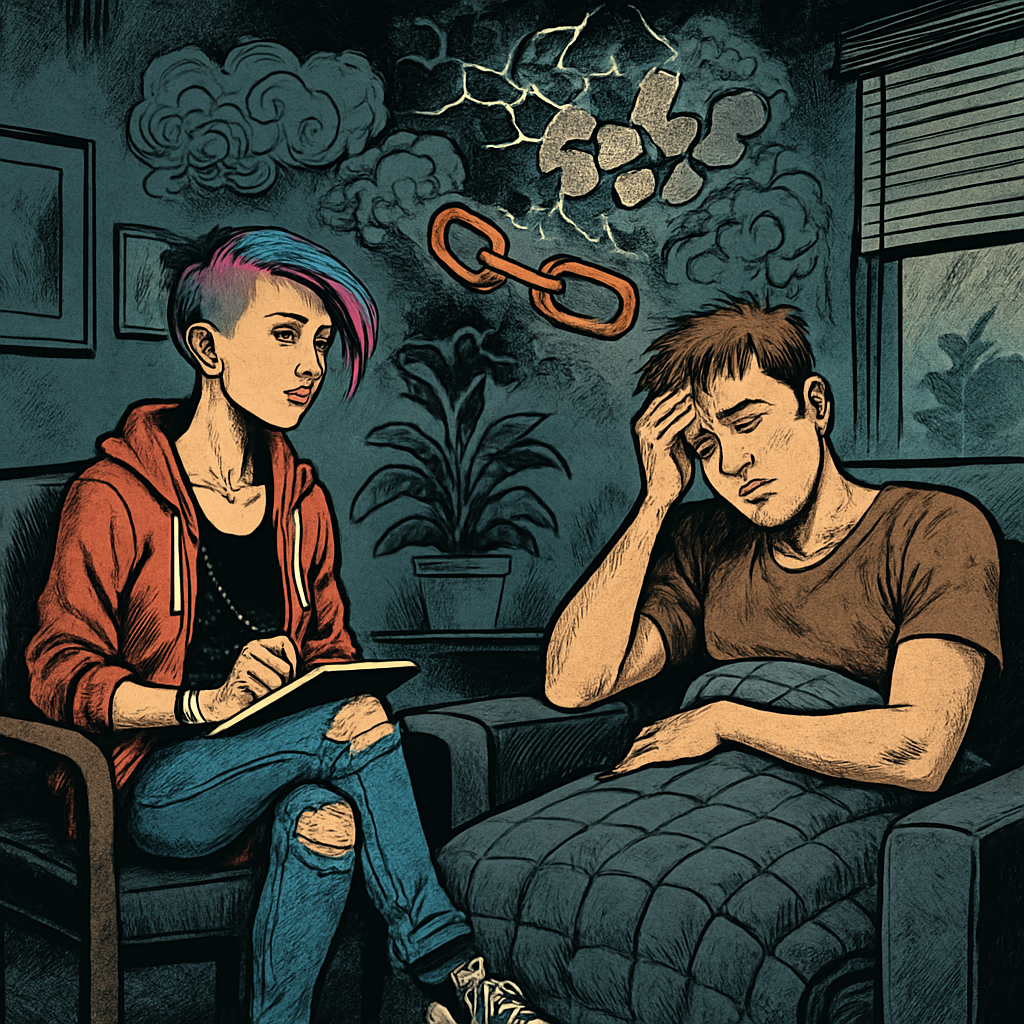
Tristan sat across from me with that particular brand of exhaustion that comes from loving someone who feels like a second job. He looked like someone who’d been cast as the lead in a romance but somehow ended up playing the therapist, the life coach, and the emergency contact all at once. His girlfriend—sweet, anxious, perpetually on the edge of some emotional precipice—had turned their relationship into a performance where he was both the safety net and the entire audience.
The worst part? He couldn’t tell if what he felt was love slowly dying or just the normal weight of commitment pressing down on his chest.
Here’s something that’ll live rent-free in your brain: 73% of people in relationships report feeling emotionally exhausted at some point, but only about half can identify when they’ve crossed from normal relationship work into full-blown caretaking mode.
Tristan had crossed that line so long ago he couldn’t even see it in the rearview mirror.
The thing about emotional labor imbalance is that it doesn’t announce itself with a dramatic entrance. It shows up wearing the costume of “being supportive” and “being there for your person.” It disguises itself as love until one day you wake up and realize you’ve been running a 24/7 emotional crisis hotline and you never even applied for the position.
The Attachment Trap Nobody’s Talking About 🚩
Let me put you onto something: Tristan’s girlfriend wasn’t clingy because she loved him too much. She was clingy because her emotional bytes—those fundamental units of sensation, charge, need, and narrative—had been programmed by a childhood that taught her love must be managed.
Her difficult family life had encoded a specific pattern into her system: closeness = danger, but also closeness = survival.
Studies show that anxious attachment doesn’t just make people needy—it fundamentally alters how they process emotional information. Her brain was running predictive models that said “he’ll leave unless I hold on tight,” which created exactly the suffocating dynamic that made Tristan want to leave.
Self-fulfilling prophecy, but make it devastating.
Meanwhile, Tristan’s own emotional bytes were screaming a different message: I’m drowning and nobody sees it because I’m too busy keeping someone else afloat.
The Three Signs You’re a Partner, Not a Caretaker ✨
1. Your emotional energy feels reciprocal
You’re not constantly managing their feelings while yours get shoved into a drawer labeled “deal with later” (spoiler: later never comes).
2. You can have needs without it becoming a crisis
When you express something you need, it doesn’t trigger their entire emotional defense system into red alert mode.
3. The relationship creates energy instead of just consuming it
You don’t feel like you need a vacation from your relationship. You feel like your relationship is the vacation from life’s chaos.
Tristan had none of these signs.
What he had instead was a girlfriend whose inner voice had been shaped by years of instability. Her emotional frames were locked on “threat detection” mode, scanning constantly for signs of abandonment. Every time Tristan needed space, her system interpreted it as the beginning of the end.
The Financial Anxiety Layer 🥲
As if the emotional labor wasn’t enough, Tristan was also carrying the weight of practical concerns that his friends kept dismissing as “materialistic” or “not what love is about.”
But here’s the truth they don’t put in romance movies: financial insecurity in a relationship isn’t shallow. It’s a legitimate need that sits right there in the psychological needs hierarchy—competence and autonomy require some level of stability.
His girlfriend’s inability to maintain steady employment wasn’t about laziness. It was another manifestation of her attachment patterns playing out in every domain of life. Anxious attachment doesn’t just wreck your romantic relationships—it infiltrates your relationship with work, with money, with your own sense of capability.
Tristan’s worry wasn’t “she doesn’t make enough money.” It was “I’m watching someone I care about struggle with basic functioning and I don’t know if I’m supposed to be a partner or a life raft.”
The Granular Truth of the Matter 🤌
Friendly reminder: Fading attraction in a relationship often isn’t about physical appearance or even compatibility. It’s about emotional granularity—or the lack of it.
When you’re stuck in caretaker mode, your emotional experience becomes this massive, overwhelming bubble of “exhausted-guilty-trapped-resentful-sad.” You can’t distinguish between individual feelings anymore because they’ve all merged into one suffocating blob.
Tristan’s fading attraction wasn’t shallow. It was his system trying to protect him by creating distance from a situation that was violating multiple core needs: his need for autonomy (constantly being needed), his need for emotional safety (never knowing when the next crisis would hit), his need for authenticity (performing stability he didn’t feel).
Research consistently shows that secure attachment predicts relationship satisfaction better than almost any other factor. But here’s what’s actually wild: it’s not just about whether you’re secure. It’s about whether the emotional scripts running between you and your partner create security or chaos.
Tristan and his girlfriend were running incompatible scripts. Hers: “Hold tight or lose everything.” His: “Create space or lose yourself.”
Both scripts made perfect sense given their histories. Both were trying to meet legitimate needs. And both were destroying the relationship.
The Cultural Pressure Plot Twist
Then there was Tristan’s family, hovering in the background like a Greek chorus of disapproval. Traditional expectations about relationships, probably some coded (or not-so-coded) opinions about his girlfriend’s background, the whole generational expectations package deal.
But here’s what became clear in our sessions: Tristan was using his family’s disapproval as a convenient external reason to avoid confronting his own internal truth.
It’s easier to say “my family doesn’t approve” than to say “I don’t think this person and I can build the life I want.”
The invisible structures of cultural expectation were real. They were applying pressure. But they were also providing cover for doubts that had nothing to do with tradition and everything to do with incompatibility.
The Work We Did Together
Our sessions became an exercise in emotional granularity—taking that massive bubble of confusion and breaking it down into manageable pieces.
We mapped his emotional bytes: What physical sensations came up when he thought about the relationship? (Tightness in chest, shallow breathing—anxiety, not excitement.) What needs were being met? (His need for purpose through helping, but at the cost of basically every other need.) What narratives was his inner voice running? (“Good partners stay.” “Her struggles aren’t her fault.” “Maybe I’m just being selfish.”)
We looked at her emotional frames—how her lens of “everyone leaves” was creating the very dynamic that made leaving feel inevitable for him.
We examined his own scripts—the ways he’d been taught that masculinity means being strong enough to handle anything, which made asking for reciprocity feel like failure.
I wasn’t there to tell Tristan whether to stay or go. That’s not how this works. I was there to help him see the systems creating his experience clearly enough that he could make an actual choice instead of just reacting to crisis and overwhelm.
The truth is, sometimes love isn’t enough. Not because love doesn’t matter, but because love without compatible emotional systems is like trying to run two different operating systems on the same device. Eventually, something crashes.
The Question He Finally Asked
Six sessions in, Tristan asked the question he’d been avoiding: “How do you know when you’re giving up too easily versus when you’re finally respecting your own needs?”
And I told him what I’m telling you: You’re not giving up too easily if you’ve been giving up pieces of yourself to keep someone else whole.
That’s not uncertainty. That’s clarity wearing the mask of guilt.
Research on attachment and relationship satisfaction is pretty clear: anxious-avoidant pairings can work, but only with massive amounts of intentional effort, therapeutic intervention, and genuine commitment from both people to transform their patterns.
The question wasn’t whether it was possible. The question was whether Tristan had anything left in his tank to do that work—and whether his girlfriend was even aware that work needed to be done.
Spoiler: she wasn’t. She thought the problem was that he wasn’t committed enough, not that their entire dynamic needed restructuring.
The Ending That Wasn’t an Ending
Tristan didn’t make a dramatic decision in my office. Real life isn’t like that.
But he left our last session with something more valuable than a decision: he left with the ability to see his emotional experience clearly. To distinguish between normal relationship doubt and the specific exhaustion that comes from incompatible attachment patterns playing out their predetermined scripts.
He stopped asking “am I being too picky?” and started asking “what are my legitimate needs?”
That shift—from self-doubt to self-awareness—is where transformation actually begins.
Not in the big dramatic moments. In the quiet recognition that you’ve been living inside someone else’s emotional frame for so long you forgot you were allowed to have your own.
Reminder: Your emotional exhaustion is data, not weakness. Your fading attraction is information, not shallowness. Your doubts are your system trying to tell you something—the question is whether you’re ready to listen.
— Melanie Doss
P.S. If you’re reading this and feeling attacked, that’s probably your emotional bytes trying to get your attention. The question isn’t whether you should feel guilty—it’s whether you’re going to keep ignoring the smoke alarm just because you’ve gotten used to the sound.
Love isn’t supposed to feel like labor. And if it does, that’s not a you problem or a them problem—it’s a system problem. And systems can be examined, understood, and sometimes, left behind. 💀✨
- [PDF] The Relationship between Attachment Styles and Relationship … – IJIP
- [PDF] Attachment style and relationship satisfaction among early adults
- Attachment Styles and Their Impact on Adult Relationships
- Exploring the Association between Adult Attachment Styles in …
- Exploring the Association between Attachment Style, Psychological …
- The Relationship Between Attachment Styles and Lifestyle With …
- How Attachment Styles Influence Romantic Relationships
- [PDF] Attachment Style and Romantic Satisfaction as Predictors of …
- Adult Attachment, Stress, and Romantic Relationships – PMC
- A systematic review on anxious attachment and relationship …
- A Brief Overview of Adult Attachment Theory and Research
- Associations of Attachment Style and Romantic Relationship …
- Attachment Theory, Bowlby’s Stages & Attachment Styles