
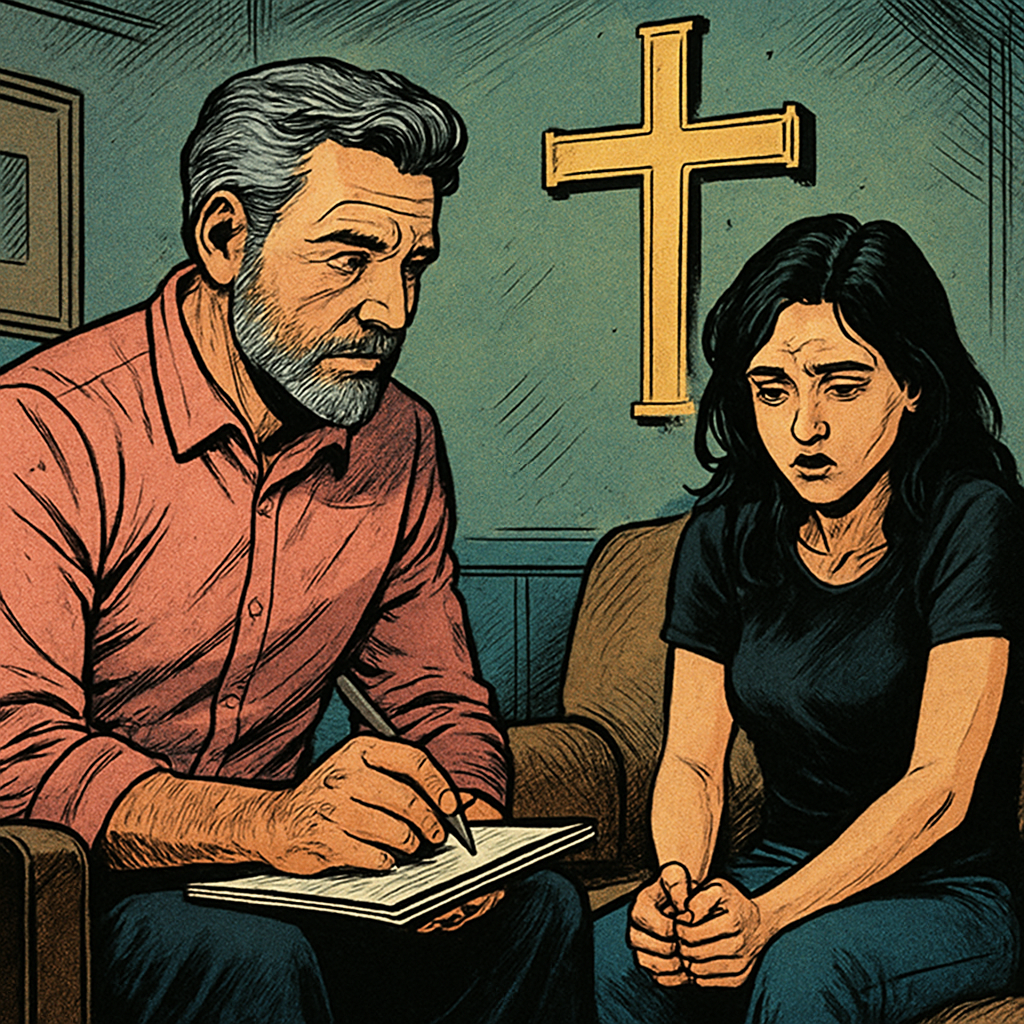
The Echo of Past Wounds 💔
The worst kind of darkness isn’t found in empty rooms or midnight skies, but in the shadowed corners of a soul where trauma has made its home. It’s there—in those hidden spaces—that the past continues to speak with a voice that drowns out the present.
Brooke sat across from me, hands fidgeting in her lap, eyes downcast. Twenty-eight years old with remarkable intelligence and a quiet strength that belied the storm raging within. She had come to therapy after what she described as a “panic attack at the gym”—something that left her confused and ashamed.
“I don’t understand what’s happening to me, Dr. Hartwell,” she began. “I’ve been going to this gym for months, and recently I met someone there. We started talking, and I felt… drawn to her. But when I found out she’s 27, something in me just shut down. I’ve been avoiding the gym during her usual times ever since.”
As our sessions progressed, Brooke’s story unfolded with painful clarity. At thirteen, she had been sexually abused by a female teacher who had groomed her with special attention and gradually violated sacred boundaries. The woman had been in her late twenties—not far from the age of the woman at the gym who had triggered such distress.
What Brooke was experiencing wasn’t simply anxiety; it was the activation of what I call “emotional bytes”—units of emotional information stored in our bodies and minds that contain physical sensations, emotional charges, unmet needs, and narrative meaning. For Brooke, the emotional byte connected to older women in positions of influence contained overwhelming sensations of danger, violation, and powerlessness.
“God sees the whole of your story, including the chapters you cannot yet read with clarity. Your reaction isn’t weakness—it’s your body remembering what your mind has tried to forget.”
Intuition vs. Trauma: Discerning the Voices 🤔
“How do I know if what I’m feeling is my intuition protecting me or just my trauma response?” Brooke asked in our third session. Her question cut to the heart of her struggle.
“That’s the sacred work of healing,” I responded. “Learning to distinguish between the voice of wisdom and the echo of wounds.”
In psychological terms, Brooke was experiencing what we might call a rigid emotional frame—an interpretive lens through which she automatically processed interactions with older women. This frame had been shaped by trauma and was now distorting her perception of a potentially healthy connection.
Biblical Reflection: David’s Hypervigilance ✨
I shared with Brooke how David, who had been hunted by Saul, later struggled to discern genuine threats from perceived ones. In Psalm 55:4-5, he writes, “My heart is in anguish within me; the terrors of death have fallen on me. Fear and trembling have beset me; horror has overwhelmed me.”
Like David, Brooke was experiencing the hypervigilance that comes after betrayal by someone in authority. And like David, her path forward would require bringing these fears into the light of God’s presence.
“The Psalms give us permission to name our distress before God,” I explained. “David doesn’t pretend to be unafraid. He acknowledges his fear while seeking God’s perspective on his situation.”
The Confusion of Social Cues 😕
As our work continued, it became clear that Brooke’s inexperience with relationships compounded her difficulty. Having never been in a romantic relationship—partly due to her trauma, partly due to growing up in a conservative Muslim community where same-sex attraction was taboo—she lacked the emotional scripts necessary for navigating adult connections.
“I don’t know how to tell if she’s being friendly or flirtatious,” Brooke confessed. “And I don’t know if my interest in her is healthy or if it’s somehow connected to my abuse.”
This confusion reflected the damage that boundary violations cause to our emotional processing systems. When a trusted authority figure crosses sacred lines, it distorts our ability to interpret social signals and establish healthy boundaries in future relationships.
“Brooke, your abuse didn’t create your attraction to women, but it has complicated your ability to trust that attraction. Your abuser exploited the natural vulnerability that exists in any mentoring relationship. That exploitation doesn’t define who you are or who you’re meant to love.”
Cultural Contexts and Hidden Truths 🕊️
In our sixth session, Brooke finally revealed what she had been holding back—her profound struggle with reconciling her faith background and her sexuality. Growing up in a devout Muslim family, she had never openly acknowledged her attraction to women, even to herself.
“I feel like I’m betraying everything and everyone,” she whispered.
This revelation illuminated the complex interplay between her trauma, her sexuality, and her cultural-religious identity. Brooke wasn’t just struggling with past abuse; she was navigating profound questions about who she was created to be.
“Beloved identity, broken experience. God’s heart toward your struggle isn’t condemnation but compassion. He sees the entirety of who you are—not just the parts you feel safe revealing to the world.”
Here, we encountered what the Emotional Bytes framework identifies as competing needs in the identity and relational hierarchies. Brooke’s need for authenticity conflicted with her need for belonging in her family and faith community. This conflict created a fractured self-concept that made discerning genuine attraction from trauma response even more difficult.
The Path of Grace-Anchored Growth 🌱
As our work progressed over months, Brooke began the delicate process of developing what psychologists call emotional granularity—the ability to make finer distinctions between emotional states rather than experiencing them as overwhelming, undifferentiated reactions.
We worked on recognizing the physical sensations that accompanied her emotional responses—the tightness in her chest when triggered by past trauma versus the butterfly sensation of genuine attraction. I invited her to practice naming these sensations aloud, connecting them to specific thoughts and memories.
“When I feel the tension in my shoulders and throat,” she might say, “I’m experiencing the emotional byte connected to my abuse. But when I feel the warmth in my chest and face, that’s something different—something present and new.”
This practice of emotional granularity became a spiritual discipline as well—a way of bringing her full, embodied experience before God rather than fragmenting herself into acceptable and unacceptable parts.
Sacred Boundaries 🙏
“Boundaries aren’t walls, Brooke,” I shared in one of our later sessions. “They’re sacred spaces that define where your responsibility ends and another’s begins. Your teacher violated those spaces, creating confusion about what healthy connection looks like.”
I explained how Jesus himself modeled perfect boundaries—being compassionate without being consumed, intimate without being enmeshed, loving without being manipulated. His relationships reflected what psychologists call secure attachment—a pattern characterized by autonomy within connection.
“The boundary violations you experienced weren’t just professional breaches,” I said. “They were spiritual violations—attempts to remake God’s image in you according to someone else’s broken design.”
This theological framing helped Brooke understand that her healing wasn’t just psychological but spiritual—a reclaiming of her identity as made in the image of God, marked by the fall, yet moving toward redemption.
Prayer for the Journey 🕯️
In our last recorded session before writing this reflection, I offered Brooke this prayer, which she later told me she kept close during difficult moments:
Father of compassion and God of all comfort,
Walk with Brooke in the space between memory and hope,
Between what was broken and what is being restored.
Grant her discernment to recognize Your voice amid the clamor of fear,
Courage to embrace the fullness of who You’ve created her to be,
And grace to build bridges between her past and future
Without being consumed by either.
May she know that her story is held in Your hands—
Not as a tale of trauma, but as a testament to redemption.
In the name of Christ, who makes all things new,
Amen.
Hope in the Darkness ✨
Brooke’s journey continues, as all our journeys do. She has begun cautiously returning to the gym, practicing the tools we developed together, distinguishing between past shadows and present reality. Recently, she shared that she had a brief conversation with the woman who had triggered her initial panic. It was small but significant—a step toward reclaiming what trauma had stolen.
Made in His image, marked by the fall, moving toward redemption—this is the sacred arc of Brooke’s story. And in witnessing her courage, I am reminded again why this work of integration between faith and psychology matters so deeply.
For in these therapy rooms, I don’t just see broken hearts finding healing; I see the very heart of God, meeting His children in their places of greatest need. 💝
—Dr. Samuel Hartwell, believing that when we bring our darkest places into God’s light, we discover He has been waiting for us there all along
- Long-term Effects of Child Sexual Abuse | Helping Survivors
- Teacher-Student Boundaries Post-Grad – McGrath Training Solutions
- What are the Effects of Child Sexual Abuse? – Bravehearts
- Professor Goldilocks and the Three Boundaries – Faculty Focus
- Adult Manifestations of Childhood Sexual Abuse – ACOG
- Boundary Issues in Teacher-Student Relationships – AdvocateWeb
- RAINN’s National Sexual Assault Hotline
- Trauma and Teaching: Boundaries and Bridges – MiddleWeb
- A review of the long-term effects of child sexual abuse – PubMed
- LIMIT: A Model for Understanding Healthy Teacher-Student …
- The impacts of child sexual abuse | CSA Centre
- Establishing and maintaining boundaries in teacher-student …
- Long-term outcomes of childhood sexual abuse: an umbrella review
- [PDF] Boundary Training: Promoting Healthy Adult-Student Relationships
- Psychobiological Consequences of Childhood Sexual Abuse
- Building Authentic Relationships With Students – Edutopia
- 3.2 The effects of child sexual abuse | IICSA Independent Inquiry …