
Listen:
Why Your Love Might Secretly Be Fear
The ProblemGraham is seeking support as he navigates growing relational strain following his wife’s eight-month depressive episode, during which she has increasingly isolated herself to work on a novel. This shift has drastically reduced their physical intimacy and shared routines, turning his attempts at connection into predictable cycles of defensiveness and withdrawal. He feels deeply isolated and anxious within his own home, constantly questioning whether his need for closeness is being overlooked while worrying about the long-term health of their marriage. Balancing this emotional uncertainty with an upcoming career transition, he hopes to find a way to bridge their current distance without losing the strong partnership they’ve built together.
The ResearchSustained depression is an automatic downregulation of emotional bandwidththat drives individuals toward compensatory, solitary hyperfocus as a regulatory scaffold against depletion. This provokes a pursuit-withdrawal cycle in which the attuned partner, developing heightened perceptual sensitivity, misreads tonal flattening and neutral cues as coldness or rejection, triggering attachment-driven bids for connection that the depleted partner experiences as overwhelming demands. Confrontation typically backfires, as the withdrawing partner’s overloaded system responds with genuine unawareness, defensive denial, and reactive irritability, producing a perceptual-affective mismatch in which both partners hold valid yet divergent emotional realities. Clinicians therefore emphasize re-psychoeducation. This reframes withdrawal as conservation rather than rejection, and structured, low-demand, paced interactions plus meta-communication about interaction patterns—rather than content-level blame—to restore dyadic equilibrium without overloading either partner’s regulatory capacity.
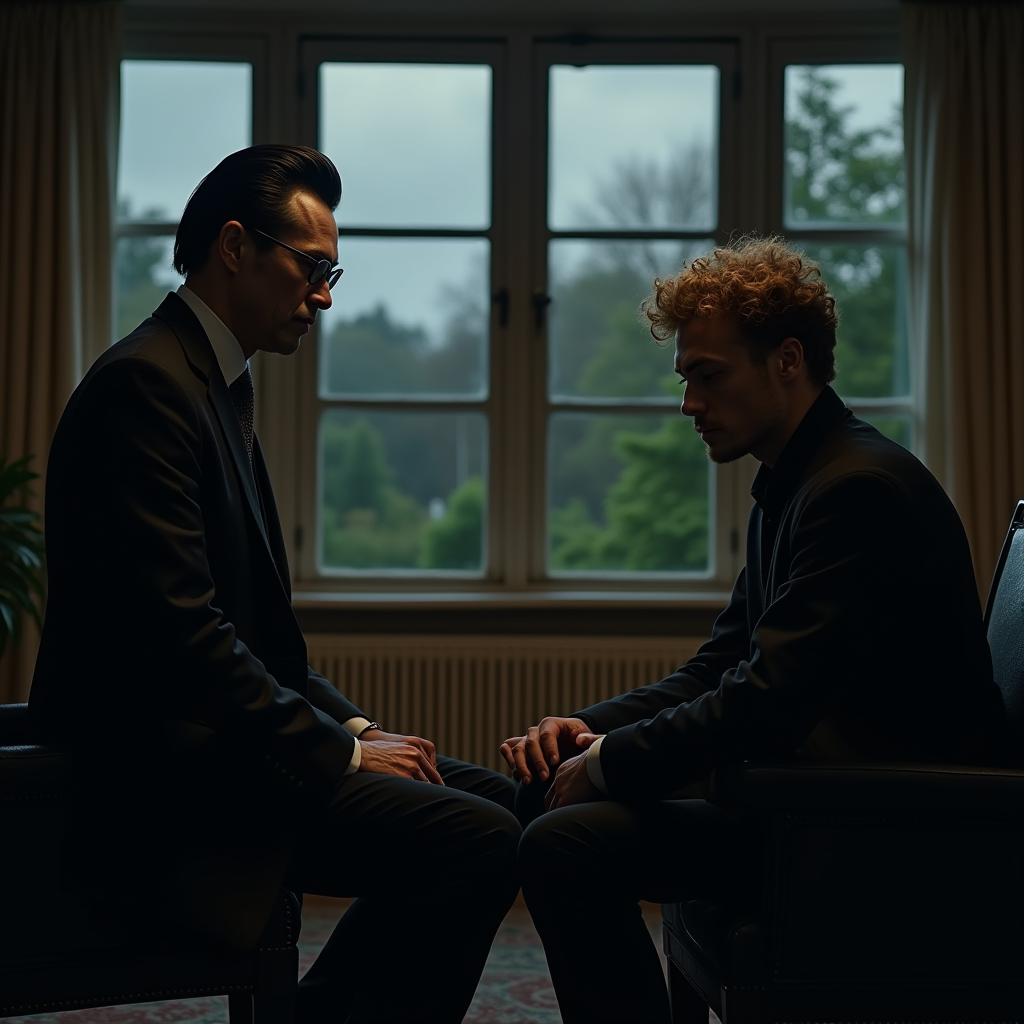
The SessionGraham Ellery sat across from me on our first session, his shoulders squared against a tremor he couldn’t quite hide in his hands. He clutched a coffee cup like it was the only thing holding them still, and he looked like a man who’d memorized the script for “Everything Is Fine” but forgotten where the exits were.
I want to name what I was looking at, because it matters. Those rigid shoulders, that tremor in the fingers, the way he gripped the cup — that was an Emotional Byte: a physical sensation, an emotional charge, a need, and a meaning, all landing in the same body at the same time. He was saying “I’m fine” with his whole face, and his hands were telling a completely different story. And the script itself — the one where he held it together and never once asked for help — is the kind of thing we run without ever choosing. A performance we’ve rehearsed so many times it stops feeling like a choice and starts feeling like who we are. The problem with a script is you stop noticing you’re performing it. This one had an exit he’d clearly never read.
Five years of marriage, and suddenly he was adrift in his own home. His wife, who once met him at the door with a kiss and a story, now met him with silence and the glow of her laptop screen.
“I just don’t understand,” he said, the words heavy with exhaustion. “She’s still here, but she’s not.”
The story Graham kept telling himself was one of bafflement and betrayal. His wife wasn’t sick, not in a way that would warrant hospital visits or concerned phone calls. She wasn’t cheating. She wasn’t leaving. But she was writing a novel, working late into the night, and when he tried to talk to her about the distance between them, she’d shut down or snap at him. The more he reached for her, the more she pulled away.
He was seeing it all through an Emotional Frame — a lens built from so many little moments of fear and longing that it stops feeling like a story and starts feeling like plain truth. In that frame, every silence became evidence, every late night a small betrayal, every step back confirmation that she was already gone. He wasn’t misreading the marriage. He was reading it through a lens fear had polished smooth, and you can’t tell the difference between a lens and reality while you’re still looking through it.
But the frame was lying to him, and the thing it was lying about was the simplest and hardest truth of all: Linda wasn’t pulling away. She was depressed.
Depression doesn’t announce itself with a megaphone. It whispers, then it steals. It takes the warmth out of a touch, the light out of a laugh. For years, Graham and Linda’s relationship had felt like a space station with two separate orbits, and now one of them had gone dark. He was left standing on a hill, trying to make sense of the wind, convinced that his failure to hold her close was why she’d drifted. He wasn’t wrong for feeling abandoned. He was misreading the map.
There was a belief that if he could just get her to understand how much this hurt him — that she’d wake up and come back — that was the coherence drive at work. It’s that deep, stubborn pull to make our experience make sense, even when the story we’re telling ourselves is the very thing keeping us stuck. He was holding to a bargain: love her hard enough, explain it well enough, and the picture will line up. And underneath that bargain sat the oldest myth of all — the one that says love is a switch. If love is a switch, then there’s a switch he can flip. If he can just find the right words, the right moment, then he has some control over a situation that otherwise feels utterly out of his hands. But love isn’t a switch. It’s a system. And that myth was going to cost him a great deal.
He believed that if she loved him enough, she’d choose him over her depression. And that belief wasn’t just wishfulness — it was his mind trying to make the unbearable make sense. So he threw rocks at a sinking ship. There’s an old emotional script running here: the one that says when the person you love is hurting, you push, you fix, you demand they get better for your sake. It fires automatically. It feels like love. But it’s actually fear wearing love’s clothes.
The truth, though, was more complicated than any villain story. He wasn’t just fighting for her attention. He was fighting a war with a ghost. The version of his wife he was trying to reach no longer existed in the form he remembered. And there’s something lonely about fighting a war with a ghost: you’re mourning someone who’s still sitting right there in the room. He was holding onto a prediction of a person that was gone, and holding on to what is gone is the most tiring kind of work.
The irony? He was right. She wasn’t the same person she’d been eight months ago. But neither was he.
The turning point came in an argument. He’d come home from a day of his own professional stress to find her still at her desk, her face bathed in the blue light of her screen. He’d asked, gently at first, if they could talk. She’d said no. He’d pressed. She’d snapped.
If you’ve ever been in a relationship, you know that sequence — the pursue-and-withdraw, locked in and automatic. He reaches, she withdraws, he presses, she pulls further, and the two of them end up in exactly the same place they’ve always been, each convinced the other is the one who needs to move. And then, in a moment of raw frustration, she’d turned to him and said, “I can’t give you what I don’t have.”
“I can’t give you what I don’t have.”
That was the sentence that had cracked him open. Because it wasn’t an insult. It wasn’t a rejection. It was the truth. Cracking open is what growth looks like before it has a name — that moment when the story you’ve been holding onto finally stops supporting your weight. Two people both trying to be seen, both drowning a little, each mistaking the other’s survival strategy for an attack. He wasn’t chasing her conversation. He was chasing the feeling that his world was still holding up. And she, in her own way, was asking for the same thing — room to breathe, to create, to wrestle with whatever her novel was dragging out of her. Both were reaching for the same thing, really: to be seen, to matter, to be allowed to be who they were. But they were reaching through different needs — him for relatedness, for the closeness he’d come to lean on; her for autonomy, for the space to become someone again.
And here’s the thing about needs: they don’t announce themselves. They hide under the frustration, under the “I just don’t understand,” under the silence.
But the deepest wound in all of this was one Graham couldn’t yet see. For years he’d been the anchor, the steady partner who held the center, whose worth was proven by being needed. His identity had been so thoroughly woven into that role that there was little left of an independent core to fall back on. When she retreated into her writing — into what psychologists call affective conservation, her brain conserving energy just to keep afloat — that frame cracked. He was left adrift, and worse, he began to realize he didn’t know how to exist without her.
Jung spoke of the shadow as the repressed, disowned aspect of the self. In Graham’s case, the shadow was his independence — his ability to stand alone without being swallowed by the need for connection. But I’d frame it a little differently. Over the years, Graham’s internal committee had quietly demoted the parts that didn’t serve the marriage. The pieces of him that wanted adventure, solitude, a life of his own — those had been shelved, then silenced, until the only voice that remained loud was the devoted partner. Reclaiming the shadow meant letting those exiled parts speak again.
I asked him to sit back and describe not only the wife he missed, but the man he’d become in their relationship — the routines, the emotional labor, the shared dreams. Once he had, I asked him to name the version of him that had been abandoned in the service of harmony. “What do you want?” I prompted. “What have you been starving for all these years?”
At first he hesitated. But what had been an overwhelming, shapeless ache — a fog of grief and guilt he couldn’t quite name — began to take form as he spoke. Longing for adventure. A hunger for solitude. The freedom to pursue his own passions without guilt or apology. And beneath it all, the resentment that had been building, the quiet fury at being taken for granted. Each word he gave a name was a small, intentional act — laying down new emotional bytes that contradicted the old model of himself as nothing more than his wife’s support system. And then, for the first time, he smiled. A bittersweet, liberating smile.
He had to learn to tolerate the discomfort of not being needed, to recognize that his worth wasn’t contingent on her emotional availability. There’s a quiet grief in realizing the person you’re holding up can’t always hold you back. And learning to name his own needs — for safety, for closeness, for a little certainty — that’s the needs hierarchy at work. Meeting them himself instead of demanding she fill a cup she had nothing left to pour was where his own strength grew.
The work, when it came, was the opposite of everything his panic had taught him. He had to learn emotional pacing — to sync his rhythm with hers, not drag her into his. Every time he felt the old urge to demand, to fix, to be reassured, he had to create a brand-new response instead: a smaller, quieter byte. That’s intentional experience in action — not one big revelation, but a hundred tiny, deliberate moments that quietly update what his nervous system expected from her. Short, low-pressure check-ins. A cup of coffee in silence. A note left on her desk. He had to learn her new language — the withdrawing wasn’t a betrayal, it was the language her brain was speaking right now, and he had to respect it even when he couldn’t understand it. He had to create a new rhythm, letting a quiet morning, a dinner cooked beside her while she wrote, a walk on his own that was respiration rather than abandonment, quietly rewrite the old story.
He had to ask for what he needed — and then ask again, and again, until she heard him. Not to blame, but to be seen. Behind every ask was a real need: the simple proof that someone was still there, still listening. We’re taught that asking makes us needy, but needs are just the map to what we’re actually alive for.
And he had to let her fail. And let himself fail, too. This isn’t a test. There are no grades here. You’re allowed to stumble, to fall, to not have all the answers. You can’t fix this for her, but you can fix it with her. The only thing you’re not allowed to do is give up.
He had to learn to sit in the dissonance, to tolerate the discomfort of not having all the answers. And that discomfort — that raw, unsettled tension — was the very thing that would crack him open. Growth almost always arrives disguised as a kind of small death: the old way of being a husband, a lover, a partner falling apart before something truer can form. He had to let his idea of being the man who fixes things die, before he could become the man who simply stays.
The most devastating losses are not the ones we suffer at the hands of others, but the ones we inflict upon ourselves by rejecting the truth of who we are. Graham’s journey wasn’t about saving his marriage — it was about learning to see himself. About learning that love is a commitment. To stay. To fight. To endure.
He left his office that day with a plan, not a promise. Because relationships aren’t about promises. They’re about showing up, even when it’s hard, even when it hurts, even when it feels like the other person has forgotten how to love you back. So he went home. And he tried. And sometimes, he failed. But he showed up. And in the end, that’s what love really is.
The ghost you mourn is the self you abandoned.