
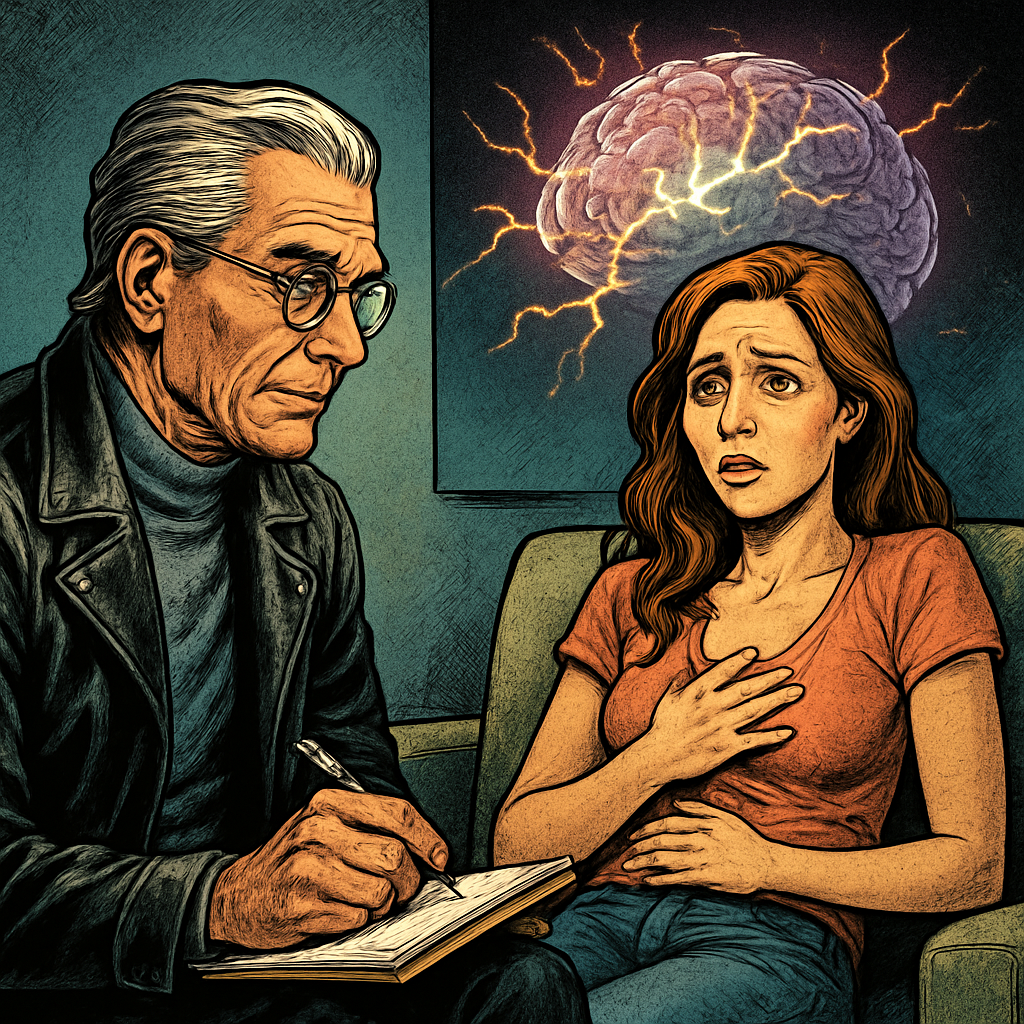
🧠 THE SETUP: THE STORY SHE TOLD HERSELF
Julianne walked into my office on a Tuesday morning looking like she’d been carrying a boulder. Tall, articulate, composed on the surface, but Julia was convinced that she’d destroyed her own mind.
“I used to be smart,” she said, and those five words told me everything.
She’d spent her teenage years in what she called “the fog”—depression and social withdrawal that kept her mostly isolated. Now, in her mid-thirties, she was convinced those years had permanently rewired her brain. Synaptic pruning, she called it, with the precision of someone who’d googled herself into terror. The brain eliminates unused connections. She hadn’t used her brain. Therefore, she’d lost the neural pathways that made her gifted.
But what she was really telling me was something different. She was describing an emotional cluster that had calcified over twenty years. A tangle of shame, loss, and identity confusion that her mind had wrapped in the language of neurobiology to make it sound irrefutable.
The real story was about loss. Missed opportunities. The unspoken terror: what if I’m still not good enough?
📊 WHAT THE SCIENCE ACTUALLY SAYS (AND DOESN’T)
Here’s where I had to level with her: depression in adolescence messes with your brain. But depression creates temporary disruption, not permanent destruction. When mood stabilizes and neurochemistry gets back into balance, cognitive function typically rebounds. Memory improves. Concentration returns.
The brain’s ability to rewire itself doesn’t disappear at twenty-five. It diminishes slightly with age, sure, but it’s still there, still functional, still working. The issue wasn’t that her brain had been permanently pruned. The issue was that her emotional frame had locked onto a narrative of permanent damage and was using selective neuroscience to reinforce it.
Her mind was trying to explain away the pain of lost time by converting it into medical certainty. You can’t feel guilty about opportunities you couldn’t have taken if your brain was literally broken, right? Broken brains are just broken.
She’d become an expert in everything science doesn’t know yet, and she’d used that ignorance as proof of her own permanent decline.
“So basically,” I said, “you’ve built a case for despair using gaps in scientific knowledge.”
Something shifted.
🎭 YOUR BRAIN IS A CONTAINER OF COMPETING STORIES
Your mind isn’t a unitary thing with one true story. It’s a Container—an organizational system running multiple processes simultaneously. Most of them aren’t conscious. Your job is recognizing which part of you is actually talking.
In Julianne’s case, three internal voices were competing for control:
The Achiever: The part that believed intelligence and productivity determined worth. Locked in overdrive since childhood. Terrified of decline because decline meant worthlessness.
The Critic: The internalized judgment voice that had converted those fog years into evidence of failure. Every gap in memory became proof of brain damage. This voice got louder the more successful she became.
The Protector: The part that had created depression as a shield in the first place. It had said, “Better to be broken than to fail at being whole.”
All three were using neuroscience language to protect her from a simpler, more terrifying truth: she had experienced genuine psychological pain, survived it, and now she was afraid that she wasn’t enough.
Here’s where most therapy gets it backwards: people don’t come to therapy because they have broken brains. They come because their internal system has created a rigid emotional script that keeps them locked in a self-fulfilling prophecy. She believed she was damaged. So every minor cognitive slip confirmed it. So she avoided challenges that might have proven her resilient. So her brain, through disuse, actually did lose some agility.
She’d built a trap and then blamed her neurons for springing it. 🪤
💥 THE CONVERSATION THAT CRACKED IT OPEN
About four sessions in, I asked her to stop thinking about her brain and start thinking about the feeling that showed up when she couldn’t remember something.
She described it as “fog.” Everything was fog. Incompetence. Stupidity. Broken.
“More specific,” I pushed.
“And the emotion. Name it more precisely than ‘I feel stupid.'”
She paused. “Shame. But also panic? Like I’m running out of time to prove something. Like if I don’t demonstrate my intelligence, everyone’s going to find out I’m fraudulent.”
Now we were getting somewhere real.
She wasn’t describing cognitive decline. She was describing an emotional bundle: the sensation of panic and chest-tightness; the emotional charge of deep shame; the need for validation; and the mini-narrative: “I have to earn my right to exist through demonstrated intelligence, and I’m running out of time, and if I fail I’ll be exposed as worthless.”
That bundle was firing every day. Every minor cognitive slip triggered it. Every normal human forgetfulness became evidence of neural damage because the emotional script made the interpretation feel certain.
This is emotional granularity—breaking down an overwhelming “I’m damaged” bubble into specific, manageable components. Physical sensation. Emotional quality. The Need. The narrative being auto-generated.
Once she could distinguish between “I temporarily forgot a word” and “My brain is broken and I’m a fraud,” something loosened.
“So the shame and panic—they’re not telling me the truth about my intelligence?” she asked.
“They’re telling you the truth about what you need,” I said. “But you’ve been trying to fulfil that need your whole adult life, and it’s become a cage.”
⚡ THE HARD TRUTH
Here’s the part that made her uncomfortable: Julianne wasn’t actually worried about her brain. She was afraid of discovering that her brain was fine, because that meant she’d have to take responsibility for her life differently.
If her brain is permanently damaged, she has a reason for staying right where she is now. A scientifically sound excuse. A narrative that makes her limitations biology’s fault.
If her brain is actually intact? Then she’s back to the terrifying question: Why am I choosing not to do the things I’m capable of doing?
That’s harder to live with than a broken brain.
I told her directly: “You’ve been using neuroscience as a grief mask. And I get it. Grief is messier than biological certainty. But your mind is doing something brilliant and protective—it’s converting emotional pain into intellectual problem-solving, because that feels safer. Emotions are wilderness. Neuroscience is a map. Maps feel like control.”
She sat with that for a while. Then: “So what do I do?”
“You grieve,” I said. “Not your brain. The years. The opportunities actually lost. Not because your brain was broken, but because you were in genuine pain and your system did the best it could to protect you. That deserves real grief, not scientific deflection.”
🌉 THE BRIDGE
What shifted in Julianne wasn’t her neuroscience knowledge. It was her emotional frame—her interpretive lens.
She started distinguishing between three different things:
Real cognitive aftereffects from depression: Adolescent depression is real. The effects aren’t permanent, but they’re also not nothing.
It’s Normal: She was applying a standard to herself she’d never apply to anyone else. This isn’t evidence of anything except that she’s human.
Emotional scripts masquerading as truth: The panic-shame-urgency-fraudulence cluster that fired up whenever her intelligence felt on trial. This was the actual enemy. Not her brain. Outdated Emotional Bytes.
Once she could integrate these into separate categories, something changed. She started taking risks. Challenging herself. Returning to reading what she liked to read. Not to prove herself—that was the old script—but because she wanted to.
The brain’s capacity to learn and rebuild was still there. Waiting. Like muscle that atrophies when you don’t use it and comes back when you do. Totally ordinary neuroscience. She’d just been using extraordinary language to avoid engaging with it.
The last time I saw her, she’d started writing again. Not for achievement. Just because something in her wanted to.
“What changed?” I asked.
“I stopped waiting for my brain to feel fixed before I started living. Turns out the brain fixes itself when you use it. It’s not the other way around.” ✍️
🎯 WHAT THIS ACTUALLY MEANS
Julianne’s story isn’t unique. I see versions constantly: people who’ve turned emotional pain into medical certainty, who’ve used gaps in science to build bunkers of hopelessness, who’ve convinced themselves damage is permanent so they don’t have to face the vulnerability of trying.
The truth is harder: your brain is probably not broken. The research on adolescent depression recovery is genuinely incomplete, which means we can’t say with absolute certainty what the limits are. But what we know about neuroplasticity and cognitive resilience suggests recovery is possible.
The real work is learning the difference between legitimate loss and the emotional narratives you’ve built on top of it. It’s understanding that your mind is a Container running multiple competing stories, and one of those stories has been working very hard to keep you safe by convincing you that you’re damaged beyond repair.
That part isn’t lying. It’s protecting. But it’s probably using incomplete information.
Your job is to recognize it. Name it. And then decide if you want to keep running that script, or if you’re ready to find out what you’re actually capable of.
The brain that built the cage is the same brain that can dismantle it. 🔓
—Jas Mendola
knowing tthat the smallest act of courage—one risk, one challenge, one moment of showing up despite the fear—is worth more than all the certainty in the world
- Brain Training Games Enhance Cognitive Function in Healthy …
- Four Principles to Unleash Your Full Potential – Rhapsody Strategies
- Therapeutic approaches for improving cognitive function in …
- Unlocking Your Full Potential/ Personal Development Strategies for …
- Scientists Say This Simple Habit Boosts Brain Health in as …
- Eight Ways to Realize Your Full Potential | Psychology Today
- 7 Tips for Improving Cognitive Thinking | JCU Online
- 15 Keys to Reach Your Full Potential – All Pro Dad
- Train your brain
- Cognitive Health and Older Adults | National Institute on Aging
- Brain exercises to improve memory, cognition, and creativity
- Cognitive Enhancement