
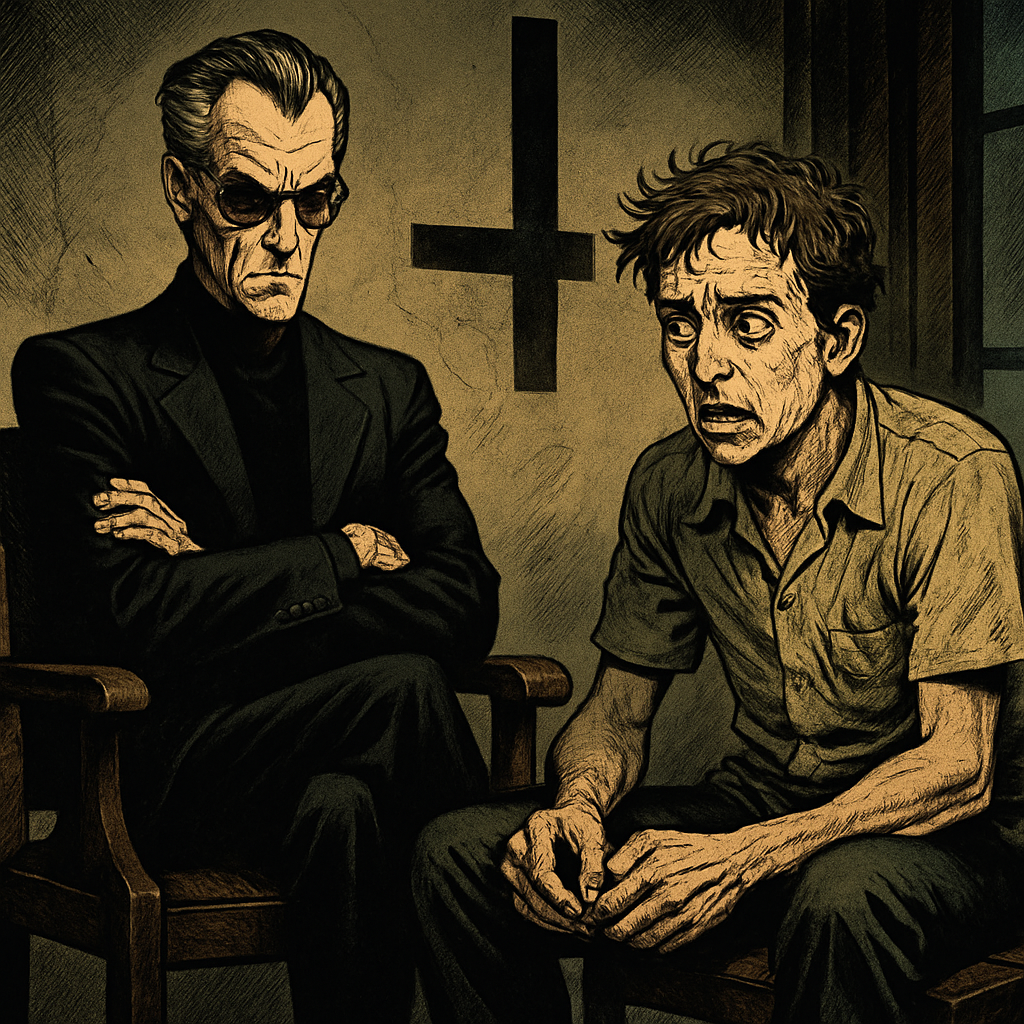
🪑 The Man Who Wanted to Disappear
Tristan sat across from me that first Tuesday in October, legs bouncing with nervous energy. His hands moved constantly— pulling at threads on his jeans, adjusting his thrift-store shirt. He hadn’t slept well in weeks.
“I’ve moved out of home. I’m living with a friend right now but I’m heading to Bozeman next month,” he said before I’d even started my opening questions. “I’ve got a friend who says I can crash for a few months while I figure myself out.”
Here’s what most therapists miss with young men like Tristan: they see the presenting problem and miss the organizational failure underneath. His internal system had fractured, with each part operating from different needs without awareness of the others.
Tristan’s Protector had become hypervigilant with narratives like “You’re a burden. You’re suffocating. You need to escape. You’re incompetent.”
His Achiever was desperately trying to restore feelings of competence by making a bold decision. Moving to Bozeman felt like control.
His Critic reinforced the narrative with relentless judgment: “You’ve failed. You’re dependent. You’re weak.”
And his Self—the observing, integrating capacity supposed to orchestrate everything? It was barely functioning. He could only feel the system’s outputs: dread, urgency, numbness.
When we applied emotional granularity—breaking down his massive panic into manageable pieces—we discovered something textured underneath: genuine shame, secondary guilt about the shame, grief for a maternal relationship that never existed, and terror of being discovered as incompetent.
✨ Intuition or Panic in Spiritual Clothing?
Tristan kept framing his decision spiritually. “I feel like I’m supposed to go. Like the universe is pushing me toward this.” For a young man open to spiritual interpretation, this was seductive. It reframed his desperate flight as destiny, as something which had already been decided for him.
I had to ask what no one else dared: “How do you know the difference between genuine intuition and a Protector that’s gotten so loud you can’t hear anything else?”
He didn’t have an answer. That was right.
The research on identity diffusion is clear: young adults in diffused states don’t engage in intentional future planning. They make reactive decisions to manage the dysregulation of the moment. Tristan’s move to Bozeman wasn’t about going toward something that he wanted. It was about going away from unbearable internal pressure of his own narratives (That had been installed by his upbringing). Running away from his family home was about distancing himself from his narratives. How successful do you think that was going to be?
But here’s the crucial part: real spiritual wisdom—whether Taoist wu wei (non-forcing action), Buddhist non-attachment, or heathen wyrd (fate woven through intentional action)—all point toward the same principle. Aligned action emerges from clarity, not confusion. Panic dressed in spiritual language is still panic.
Tristan’s crisis contained developmental potential. The emerging capacity to observe the system was where genuine growth could happen—but only if he stopped treating “falling apart’ as something to escape and started treating it as information.
💔 The Relational Container’s Silent Collapse
Tristan was living inside a damaged relational container. His difficulty relating to his mother had organized his entire emotional system around one principle: connection is dangerous; dependence is shame.
His relationship with his friend—where he was “crashing”—was becoming toxic. His hypervigilant Protector was interpreting every kind gesture as mercy, every offer of help as proof of inadequacy and he was now spiralling down a rabbit hole of fear and dependence.
Here’s what mattered: Tristan wasn’t actually burdening his friend. But he was living inside an emotional frame that made every interaction feel like a burden. The emotional signals he was collecting weren’t accurate data. They were data about his own internal system, mistaken for objective truth.
When I asked directly, “Has your friend ever said you’re a burden, or are you reading that from your own narrative?”—something shifted. He felt like a burden, so he interpreted kindness as pity. He interpreted pity as confirmation he was right. The frame became a self-fulfilling prophecy.
📊 Identity Diffusion and the Lost Moratorium
The research is brutal in its clarity. Tristan fit the “Diffused” identity profile perfectly: moderate coherence about who he was, but massive confusion about direction and purpose. This profile predicts anxiety, depression, and risky behaviors as the way towards identity coherence, but it’s actually associated with avoidance of future planning and present-focused risk-taking.
Neurologically, his prefrontal cortex—responsible for future-oriented thinking and impulse control—was being hijacked by his limbic system screaming danger, escape, now. He couldn’t plan because planning requires a stable sense of self extended into time.
Parental alienation is a primary driver of this diffusion. His mother’s behaviours had been interpreted as rejection, even though they were just her own system’s attempt to create emotional space. But for Tristan, it had cracked the foundation upon which identity synthesis is supposed to build.
A healthy response to identity crisis requires a period of exploration and experimentation supported by a stable relational container. Tristan needed permission to be uncertain, to try things. But his relational containers (hostile mother, increasingly strained friendships, absent extended family) couldn’t provide this.
So his system responded the only way it knew: it compressed the moratorium into a manic decision. Move to Bozeman. Escape. Reset.
The tragedy is that Tristan actually needed the crisis. The terror of identity diffusion should be treated as developmental information because that terror, when properly held and explored, is where synthesis happens. But he was trying to escape the very experience that could have led to his development and eventual freedom.
His plan to move to Bozeman wasn’t a break from his family system. It was a replication of it.
He felt like his mother had rejected him—pushed him away. Now Tristan was doing the same thing to himself. He was both the abandoner and the abandoned. His Protector had absorbed the mother’s push-away gesture and turned it inward, creating an automatic behavioral pattern where escape became the only viable response.
When I pointed this out, he sat in silence. “So I’m… doing what she did to me?”
“You’re running from what she made you feel about yourself,” I said. “By running, you maintain a fiction of control, but you’re still playing out her rejection. You’re just holding open your own exit door.”
This is meta-emotional intelligence in action: not managing emotions, but seeing the systems that generate emotions. His sense of clarity about moving was a kind of organizational momentum—the internal committee all pushing him to run away without any part actually doing the steering.
🏗️ Building Synthesis in the Wreckage
Over the next several months, our work wasn’t about preventing him from moving. It was about making the invisible visible and creating space for his Self to emerge.
We began with emotional granularity. I asked him to sit with the dread and describe what he actually felt in his body—not metaphorically. He discovered the urgency, the suffocation and the guilt emerged as information from his body, driven by predictions in his mind and narratives developed in his past. Once we could distinguish these sensations and the attached emotions, they became less overwhelming.
Then we examined his emotional frames. Hi was forbidden from creating narratives without evidence—real evidence. Every time we talked about “the evidence,” it turned out to be interpretation, not fact. His friend had never said he was a burden. The narrative wasn’t reality; it was his Protector’s reading. He learned to say “I feel like I’m a burden rather than a”I am a burden.” These are two completely different things.
Once we worked on identifying his underlying needs—autonomy, competence, and safety—we asked different questions: What would actually meet these needs? Not “What location?” but “What internal and relational conditions would create the experience of autonomy, competence, and safety?”
We began to build the capacity to hold multiple truths simultaneously. He could be somewhat dependent and somewhat competent. He could have a critical inner voice and be worthy of self-respect. He could need space and need connection. These weren’t contradictions; they were polarities to integrate.
His plan shifted.I didn’t convince him not to move, but his internal system began to generate more coherent and consistent narratives and this created feelings of stability, wholeness and balance. He started exploring his actual values. He had harder conversations with his friend about their relational container. He reconnected with a sibling he’d pushed away.
When he did actually move to Bozeman six months later, it was a different decision. He had saved money. He had a job lined up. Most importantly, he went with some level of a solid identity emerging. The internal committee was still navigating, but at least they were now talking to each other.
🌟 Authenticity vs. Escape
Tristan’s crisis was essentially a translation problem. His internal system was screaming for something real. The need for autonomy, for space, for a break from suffocating relational dynamics—those were authentic.
The problem was that his diffused identity couldn’t distinguish between an authentic calling and a protective impulse. What separates genuine intuition from panic is whether it emerges from an integrated narrative or from a fractured system.
That’s the real work is learning how to read the contradictions and learning how to hold onto both without giving in to one or the other. It’s learning to ask not “What should I do?” but “Who is actually deciding, and are they speaking from fear or from security?”
For Tristan, the answer was the willingness to hold both the real need and the protective panic without letting either one hijack the whole system—that’s when the real choice becomes what’s healthy and what’s not.
“HAIL” to your own becoming! To being your own sovereign choice.
- Identity in young adulthood: Links with mental health and risky …
- Young Adults & Identity Crisis: Signs, Causes, and How to Find Clarity
- Adolescent Identity Crisis: Insights from a Psychologist
- Exploring Identity in Young Adulthood – thewaveclinic.com
- Identity Crisis in Teens: The Role of Identity in Teens’ Mental Health
- [PDF] Identity Crisis among Young Adults – IJIP
- Adolescent Identity Development – ACT for Youth
- The Identity Crisis So Many of Us Face | Psychology Today