
The Weight of Everything Unsaid 💔
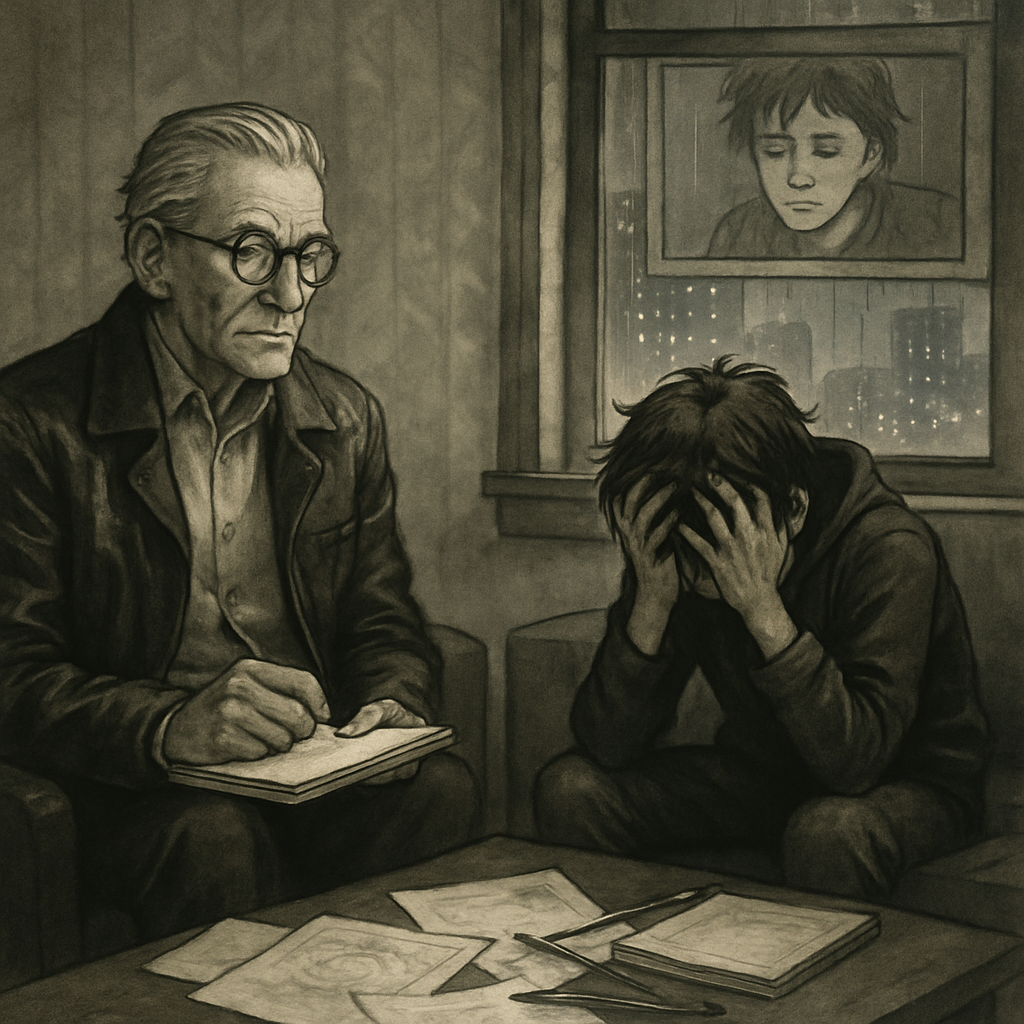
Austynn sat across from me, stirring coffee that had gone cold an hour ago, eyes fixed on the table. This was the third session. Outside, rain fell with indifference. Inside, a young person was slowly convincing themselves they were invisible—necessary perhaps, but nobody wanted them. Expendable. Gone tomorrow and the world keeps spinning.
“I remember Austynn because they taught me something crucial. They showed me how we don’t just suffer from our own thoughts—we suffer from the stories we’ve learned to tell ourselves about why those thoughts matter. How dangerous it is when you believe you’re a plot point instead of the protagonist.”
The Frame That’s Killing You 🎬
Here’s the hard truth: You’re not broken because you feel worthless. You’re stuck because you’ve internalized an emotional frame—an invisible lens filtering everything through “I’m insignificant.”
Your brain isn’t experiencing reality. It’s experiencing a curated interpretation built from emotional bytes—tiny units of sensation, feeling, need, and meaning that cluster into patterns.
Austynn had constructed these bytes from years of messages: comparison, invisibility, cultural narratives of expendable characters, silence when they shared something they cared about. Each unheard moment became data. Each “better” creator became confirmation. Their inner voice had packaged everything into one conclusion: “You don’t matter.”
That’s not a fact. That’s a script.
When a frame gets rigid enough, it becomes automatic. You don’t think your way into it anymore—you just live it. Austynn wasn’t choosing depression daily. They were running a program that had been running them.
The Loneliness Loop: Why Your Hobbies Are Lifelines, Not Escapes 🎨
Loneliness doesn’t just make you sad—it creates a specific need state. When relational and emotional needs go unfulfilled, your brain searches for any port in a storm. We use creative work and entertainment to satisfy unmet needs. That’s not pathological. That’s resourceful. That’s survival.
When I asked Austynn about their creative work, their posture shifted slightly—shoulders lifted just a centimeter. But then shame kicked in: “Nobody cares. It’s not good enough.”
I stopped them. “Who told you that caring had to be about audience size or skill?”
They didn’t have an answer because it wasn’t their original thought—it was cultural propaganda.
I told Austynn something that landed hard: “Your hobbies aren’t making you isolated. Isolation is making you develop hobbies alone. That’s not weakness—that’s you building internal resources because external ones failed you. But now you’re using those same hobbies to confirm how broken you are instead of recognizing them as evidence of how resilient you actually are.”
Media as Your Invisible Abuser 📺
This is where it gets dark: media culture has been building emotional frames inside your mind through repetition alone. Not conspiracy. Just steady exposure to stigmatizing depictions of mental illness. Narratives where depressed characters are villains, footnotes, or corpses.
Research on top-grossing films reveals the pattern: most mental health conditions aren’t shown at all. When they are, characters face mockery or violent endings. The cultural message sinks in: This is what happens to broken people. This is where your story goes.
Austynn had absorbed this unconsciously—through emotional bytes accumulating invisibly. Their inner voice had become fluent in the language of cultural stigma.
“You’re not seeing reality,” I told them. “You’re seeing a frame. And frames are chosen. They’re not inevitable.”
The Granularity Principle: Breaking the Unbearable Into Pieces 🧩
Here’s what saved Austynn: you don’t fix the whole collapse at once. You apply emotional granularity—you break “I’m worthless and should disappear” into smaller, manageable pieces.
That feeling isn’t one feeling. It’s a cluster:
- The physical byte: Chest heaviness. Fatigue. That’s depression—neurobiological reactions.
- The emotional charge: Shame. Loneliness. Hopelessness. Different states requiring different responses.
- The need hunger: Being heard. Mattering to someone. Validation that they weren’t worthless. These are relational needs screaming for attention.
- The narrative layer: “I’m a plot point. Disposable.”
When you lump all this into one blob called “worthlessness,” you’re paralyzed. But when you granulate it? The physical heaviness becomes addressable through improved movement and sleep. The loneliness becomes addressable through connection. The narrative becomes something to interrogate instead of accept.
I had Austynn track one simple thing: moments when they created something and felt genuine interest in the creative process itself, separate from judgment. Not “Did anyone like it?” Just “Did I engage with something?” Those moments are evidence (not of talent) of the capacity for meaning-making independent of who he was making it for (an audience).
The Comparison Trap 📊
Comparison to others isn’t about whose work is superior. It’s about your frame being rigid. A flexible frame would see different creators making different things for different reasons. It would understand that skill variation in certain areas is normal and often requires experiencing failure in order to improve. But it doesn’t create a hierarchy of human worth.
A rigid frame—built by years of unmet needs and cultural messages—turns comparison into a weapon against yourself.
Austynn’s frame was so tight that every other creator became evidence of inadequacy. But here’s what they weren’t seeing: those creators weren’t living better lives. They just had different emotional bytes, different needs being met, different frames interpreting their experience.
That’s the bastard demon logic of depression and shame—they take the things that would heal you and use them to hurt you.
The Stigma Structure 🔒
One session, Austynn said something that broke my heart: “I can’t tell anyone how bad my depression actually is because then they’ll think I’m crazy. And if they think I’m crazy, I’ll be alone.”
That’s not paranoia. That’s accurate calibration of how our culture treats mental illness. It’s why people die when they could have been saved—because stigma creates an invisible structure that prevents connection.
Therapy is depicted as something for broken people. Mental illness is shown as shameful or monstrous. The message: seeking help is admitting you’re fundamentally flawed.
I had to dismantle this directly with Austynn. “You think reaching out will confirm you’re broken. But the truth is the opposite: isolation is telling you you’re broken. Connection is what breaks that frame.”
Your Life Is Not a Draft to Delete ✨
This is what I kept returning to, session after session: the feeling that existing without exceptional contribution is pointless—that’s a frame. A vicious one, shaped by a media celebrating achievement and invisible-shaming everyone else. But it’s not truth.
Your value isn’t in your productivity or comparative skill. It’s in the simple fact that you exist in a way nobody else ever can. Your consciousness, your capacity for meaning, your specific angle on the world—that’s not a plot point. That’s a texture the story would genuinely lack without you.
What saved Austynn wasn’t me convincing them they were special or talented. What saved them was helping them see their emotional frames clearly enough to recognize they were choosing to interpret themselves through a distorted lens. Once you see that choice, you can make a different one.
Their suicidal ideation faded when we built emotional granularity. When we connected them to a small community of other creaters. When we deconstructed the media narratives they’d absorbed. When they started practicing intentional experiences—deliberately engaging with their hobbies without having to measure their results against others, building new emotional bytes of inherent interest and flow.
It wasn’t magic. It was systematic reframing. Strength isn’t about having no pain. It’s about seeing the structures causing the pain and deciding you’re not going to let them run your life anymore.
Jas Mendola – Knowing that your greatest enemy often wears your own face, speaking in your own inner voice, convinced it’s telling the truth when it’s just reading from a script someone else wrote.
- Popular Movies Misrepresent the Reality of Mental Health Conditions
- Loneliness, Escapism, and Identification With Media Characters
- Listening, Watching, and Reading: The Structure and Correlates of …
- [PDF] Media influences on self-stigma of seeking psychological services
- Is mental health still misconstrued on screen? Psychology goes to …
- The Psychology of News Influence and the Development of Media …