
The Setup 🍸
The bar was nearly empty when he walked in, rain still wet on his shoulders. He ordered a drink he didn’t want and sat where the light wouldn’t hit his face directly. That’s how I knew it was bad. Guys like Jordan—competent, trained in reading people’s dynamics for a living—don’t hide unless they’ve already lost the fight before throwing a punch. He’d been in a relationship five years. She had trauma. He had guilt. And somewhere between those two things, he’d become a hostage negotiator in his own life, except the hostage was him.
Why I Remember Jordan 🧠
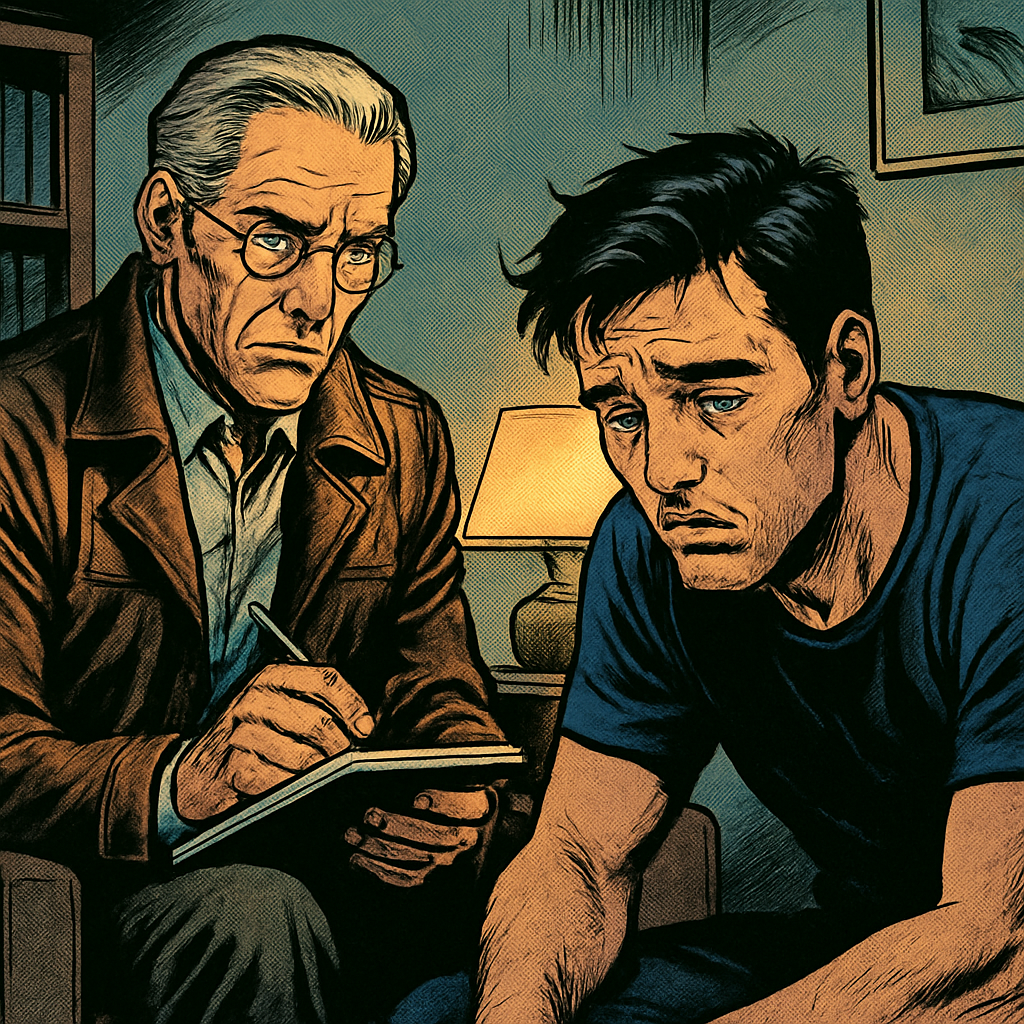
“I’m a therapist,” he said early in our first session, like it was an excuse. “I should know better. But knowing better and doing better are different animals, aren’t they?” I nodded.
This is the thing nobody talks about: the more you understand psychology, the more sophisticated your cage becomes. Jordan could name every dynamic happening in his relationship. He could probably write a dissertation on attachment theory as it applied to his girlfriend’s C-PTSD and social anxiety. But understanding the trap doesn’t automatically spring you free—sometimes it just makes you more comfortable sleeping in it.
The Caretaker’s Emotional Script 💔
Here’s what Jordan was really dealing with, and it took three sessions to get him to stop intellectualizing and start feeling it: He was operating from what I call the Caretaker’s Emotional Script.
This isn’t just about being nice or supportive. It’s an invisible structure where someone believes their job is to manage another person’s emotional safety at the cost of their own oxygen.
His girlfriend had abandonment fears rooted in real trauma. When she’d spiral at social events—shutting down, leaving early, accusing him of not protecting her—he’d automatically shift into what I call Narrative Override Mode. His inner voice would kick in: “She’s scared. You understand trauma. You can handle this. Be steady.”
What sounds reasonable is actually deadly. He was encoding a specific emotional byte into his system: My safety comes after hers. That byte gets stored. It gets reinforced. Soon it’s not a choice anymore—it’s an automatic response, a script he runs without thinking.
The problem? Those scripts become self-fulfilling prophecies. The more he managed her emotions, the more dependent the dynamic became. The more he prioritized her needs, the less she developed her own capacity to regulate.
The Hard Truth Nobody Wants to Hear ⚠️
You cannot therapy someone into health by staying in a sick dynamic with them.
His girlfriend wasn’t getting worse because he was thinking about leaving her. She was getting worse—or staying stuck—because the system they’d built together didn’t require her to get better. He was absorbing her emotional volatility, managing her triggers, and framing it all as “support.” What she actually needed was to feel the natural consequences of her own patterns and discover her own capacity to regulate.
When she accused him of manipulation, it stung. He’d heard it before. But here’s what I told him: “You’re not manipulating her. You’re enabling her. There’s a difference. Manipulation is conscious deception. Enabling is unconscious abandonment of your own boundaries dressed up as compassion.”
His attachment wounds had created what I call Invisible Guilt Structures—unspoken rules he’d internalized:
- If I’m strong, I’m responsible
- If I’m capable, I’m obligated
- If I understand, I must fix
Those aren’t noble principles. They’re landmines.
The Emotional Bytes Running Beneath the Surface 🖥️
By session four, we started breaking down what was happening in his nervous system. Each conflict followed the same pattern: she’d accuse him of something, he’d defend, she’d escalate, he’d retreat into compliance. With each cycle, he was encoding the same emotional byte:
Her anger = My failure. Her pain = My responsibility. My boundaries = Her abandonment.
That byte contained everything: the physical sensation of his chest tightening, the emotional charge of shame and helplessness, the unspoken need to feel like he wasn’t “bad,” and the narrative his inner voice had built around it all. It was running him like a dummies guide to self-abandonment.
But he wasn’t alone in this. His girlfriend had her own script running. Her C-PTSD and social anxiety had created emotional frames where the world felt fundamentally unsafe. When he’d try to set a boundary—even a small one—her nervous system would interpret it through the lens of Abandonment = Death. Her anxious-avoidant attachment style meant she’d both demand reassurance and reject it simultaneously.
Both of them were trapped in their own emotional architecture, completely unconscious of how those structures were reinforcing each other.
The Courage That Looks Like Betrayal 💪
Here’s what nobody wants to hear: Sometimes the most loving thing you can do is let someone face their own shit.
I didn’t tell Jordan to leave. That wasn’t my job. But I did help him see that staying was a choice—and choices have costs. Every time he smoothed over her outbursts, every time he apologized for her behavior, every time he absorbed her emotional volatility, he was inadvertently telling her: You’re not capable of managing this yourself.
That’s not love. That’s control dressed in compassion.
By our sixth session, Jordan had started to shift. We’d mapped the invisible structures running both their lives. His guilt wasn’t truth—it was an emotional byte from his childhood, from relationships where he’d learned that his value came from fixing other people’s pain.
We worked on what I call Boundary Architecture—not as walls, but as sacred spaces. A boundary isn’t where you stop caring. It’s where you start being honest about what you can actually carry. Jordan couldn’t carry her trauma. His assignment was to be present, to be honest, and to maintain his own integrity.
The real breakthrough came when he could finally feel the difference between abandoning someone and not rescuing them. Those are not the same thing. One is cruelty. The other is respect.
What Success Actually Looked Like ✨
Jordan didn’t leave the relationship in my office. Therapy isn’t about telling people what to do. It’s about giving them the perceptual shift to see their own situation clearly.
What changed was his internal architecture. He stopped running the Caretaker Script automatically. When she’d escalate, instead of feeling like her emotions were his responsibility, he could pause and ask: What is actually mine to carry here? What belongs to her?
That ability to separate his emotional bytes from hers changed everything. He could feel compassion without taking responsibility. He could be present without being consumed. He could love her without sacrificing himself.
And here’s the thing: Sometimes when you stop trying to fix someone, they either rise to meet you or they don’t. If they rise, you’ve got a shot at something real. If they don’t, you’ve got clarity about what this relationship actually is. Either way, you’re no longer operating blind.
Jordan didn’t need me to tell him whether to stay or leave. He needed to understand why he felt compelled to stay, what invisible structures were driving that compulsion, and whether those structures were actually serving him or destroying him. Once he had that clarity, he could make a real choice instead of running on autopilot.
That’s the only choice that actually matters.
The bravest thing most people ever do isn’t found in grand gestures, but in the quiet moment when they finally admit that loving someone isn’t the same as saving them—and that the person they might actually need to save is themselves.
— Jas Mendola
- How Relationship Attachment Styles Affect Conflict Resolution
- Repairing Hurt In Relationships: How Attachment Theory Can Help
- The Blame Game: Attachment Dynamics in Conflict – Kyle Benson
- Attachment Style and Marital Conflict – Forever Families – BYU
- [PDF] Attachment, Growth Fear and Conflict Resolution in Close …
- Attachment Styles in Adult Relationships – Complete Guide
- 7 Conflict Resolution Techniques That Can Save Your Relationships
- Here’s How Knowing Your Attachment Style Can Help You Manage …