
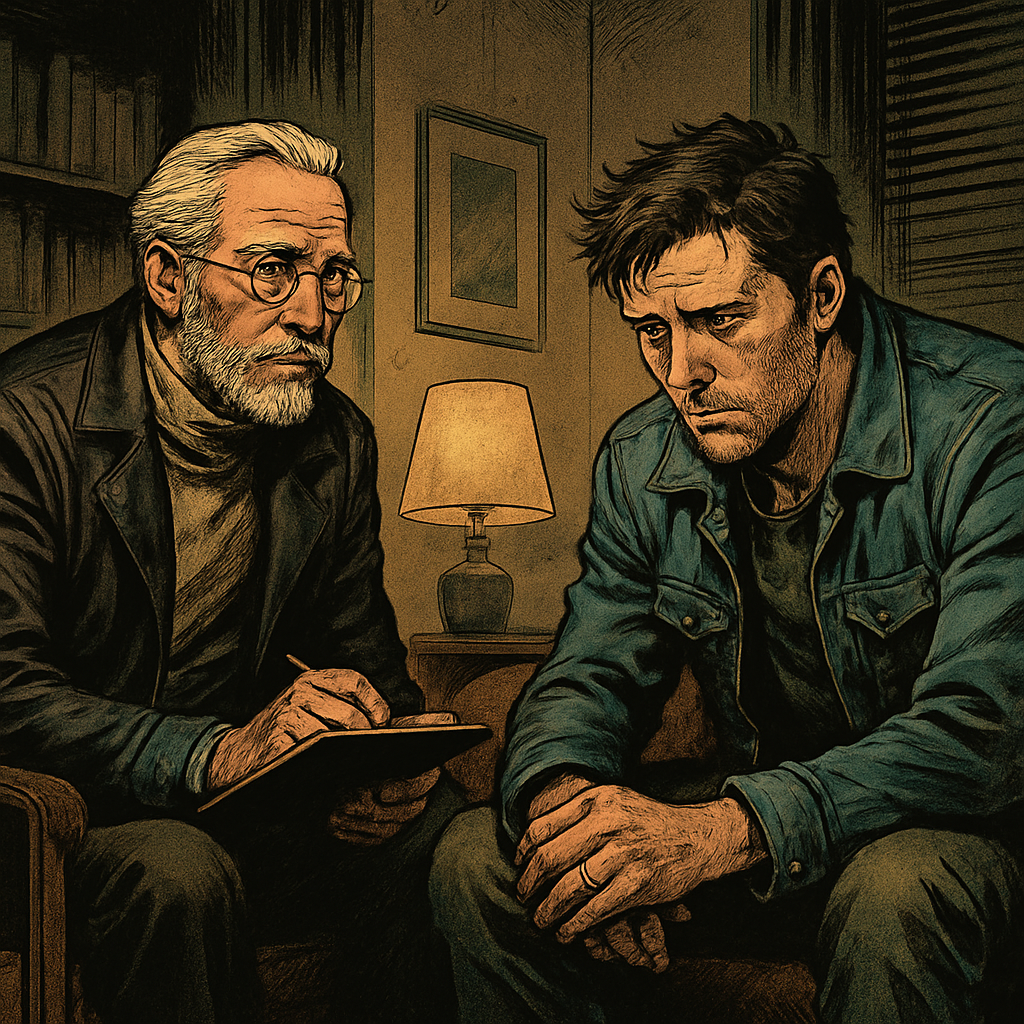
🪑Bryson sat down that first day. He was built solid, with hands that showed work and eyes that wouldn’t settle on any one spot in my office. His denim jacket had a patch from the local power plant. He twisted his wedding ring and spoke in short bursts, like a man accustomed to being interrupted.
At twenty-three, Bryson seemed young yet somehow ancient around the eyes. His situation appeared simple on the surface – he’d helped his drunk aunt home on her birthday – but beneath that basic story lurked a storm of confusion that had nearly capsized his marriage.
“I was just trying to do the right thing,” Bryson told me, his voice flat with exhaustion. “Her aunt Kelly was turning forty, having a rough night. Everyone else had left her at the bar, so I drove her home. But then…”
The story unfolded like a slow-motion accident. Kelly had been inappropriately affectionate, making suggestive comments, trying to get him to stay overnight. She’d touched his arm, his face, cried on his shoulder about her failed marriage. Nothing overtly sexual had happened, but the boundaries had blurred into a gray zone that left Bryson deeply uncomfortable.
“She texted me the next day apologizing, but then said I shouldn’t tell my wife because ‘young women get emotional about this kind of thing.’ Now I’m stuck wondering if keeping this secret is protecting my marriage or poisoning it.”
🧠 Truth Isn’t Just About Facts, It’s About Emotional Safety
“When you picture telling your wife what happened, what’s the worst-case scenario you imagine?” I asked during our second session.
“That she’ll think something happened between me and Kelly. That she won’t believe me. That it’ll create this permanent suspicion, or she’ll want to cut off her family,” his voice dropped. “Or maybe that she’ll believe me but still feel hurt, and I’ll be the cause.”
This is where most therapists mess up. They treat situations like this as simple moral equations about honesty versus dishonesty. But what I’d learned from working with hundreds of men like Bryson is that these dilemmas aren’t really about truth – they’re about psychological safety and threat detection.
Bryson wasn’t struggling with whether to tell the truth. He was caught in an emotional frame where all potential actions seemed threatening to something he valued. This created a scenario where avoidance felt like the only safe option.
“Her aunt did something manipulative here, Bryson,” I told him bluntly. “She put you in an uncomfortable situation, then tried to make you complicit by suggesting secrecy. That’s emotional manipulation, even if she didn’t intend it that way.”
His eyes widened slightly. Nobody had named it for what it was.
💔 The Real Cost of Emotional Deception
“When men hide experiences that made them uncomfortable, especially ones with any hint of inappropriate sexual tension, they don’t just hide facts. They hide parts of themselves. And that invisible wall becomes the real threat to intimacy.”
Research confirms this reality. Studies on disclosure show that what damages relationships isn’t just the revelation of uncomfortable truths – it’s the sustained pattern of emotional disconnection that secrecy creates over time.
“But what if telling her creates drama with her family?” Bryson asked.
“You’re being asked to choose between your wife’s right to know what’s happening in your life and her aunt’s comfort. But let me ask you this – if Kelly’s behavior was truly innocent, why would she be worried about your wife knowing?”
Bryson’s frame was shifting. He was beginning to understand that his discomfort wasn’t just about an awkward situation – it was his emotional warning system detecting a threat to his values and relationship integrity.
⚠️ The Hard Truth About Emotional Triangles
“Her aunt didn’t just cross a physical boundary. She tried to create what therapists call a ‘triangle’ – where two people share a secret that excludes a third. It’s a pattern that creates false intimacy between the secret-keepers while eroding trust with the excluded person.”
Most men struggle with situations like this because we’re taught to handle discomfort alone. We’re conditioned to believe that protecting others from uncomfortable truths is strength. It’s not. It’s fear disguised as consideration.
Secrecy doesn’t protect relationships – it protects comfort at the expense of connection. When you withhold information because someone “might get emotional,” you’re making a decision about what another adult is allowed to feel. That’s not protection – it’s control.
✨ The Breakthrough
“I told my wife everything. The whole uncomfortable situation, how it made me feel, Kelly’s text suggesting I keep it quiet. She was upset – not with me, but with the situation. And with Kelly,” Bryson reported in our final session.
“There was some drama. Kelly got defensive when my wife cooled toward her. But something unexpected happened too – my wife and I got closer. She said she was proud of me for being honest about something that was tough to talk about.”
That’s the field-tested truth most relationship experts won’t tell you: The short-term pain of honesty is almost always less damaging than the long-term erosion of secret-keeping. When you hide uncomfortable truths to “protect” someone, you’re actually protecting yourself from their authentic response – and robbing them of their right to reality.
The real strength isn’t in what men can endure alone – it’s in what we have the courage to bring into the light, even when every instinct tells us to bury it in the dark. 🌟
The hardest conversations are usually the ones most worth having.
- Investigating Disclosures of Infidelity to Primary Romantic Partners
- [PDF] DISCOVERY OF INFIDELITY A Phenomenological Study of …
- Sexual Infidelity Is Not Clearly Linked with Relationship Satisfaction …
- Once a Cheater, Always a Cheater? DU Study Examines Serial …
- Love and Infidelity: Causes and Consequences – PMC
- [PDF] Experiences Of Trust After Infidelity In A Previous Relationship
- Full article: Grappling with Infidelity: The Experiences of Therapists