
When Death Feels Like Freedom: A Journey with Tatiana ⚡
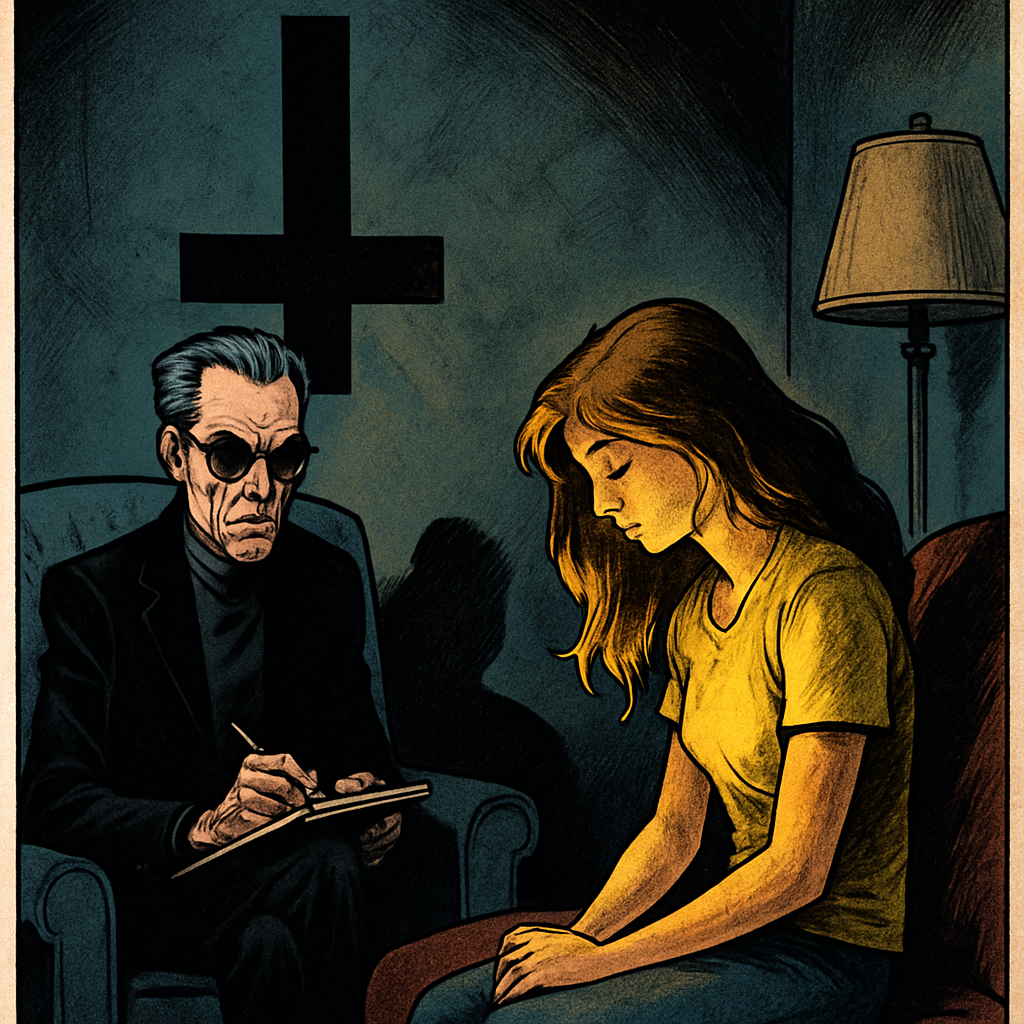
The consultation room was dimly lit that evening—just as she had requested. The young woman who entered moved like someone carrying an invisible weight, her eyes downcast, shoulders hunched forward as if to protect what little remained of her inner flame from being extinguished completely.
In my twenty-five years as both a clinical psychologist and ordained Satanic minister at the Autonomous Mind Institute, I’ve worked with countless individuals facing their personal demons. But there are cases that stand out—those that perfectly illustrate how society’s demands, internalized shame, and the loss of personal sovereignty can create the perfect storm for self-destruction. 💀
At 23, Tatiana came to my office not by choice, but at her boyfriend’s desperate urging. She had told him she “should have just killed herself” and instructed him to “let go before I get worse.” When she finally agreed to a single session, I knew we would be navigating treacherous waters together.
The Weight of Others’ Expectations 🎭
“My mother will kick me out if I don’t finish my degree,” Tatiana explained flatly, her hands trembling despite her controlled tone. “I’m so close, but I just…can’t. And honestly? Maybe that would be better. Maybe everyone would be better off.”
What struck me wasn’t just her suicidal ideation—which was deeply concerning—but the profound emotional frames through which she was interpreting her experience. These invisible interpretive lenses, constructed from clusters of painful emotional experiences, had fundamentally altered how she perceived her value and her very right to exist.
“She sacrificed everything for my education,” Tatiana replied when I asked about her mother’s ultimatum. “It’s not unreasonable. I’m the failure here.”
This response revealed the first crucial element of her suffering: Tatiana had internalized a narrative where her worth was conditional upon achievement. This emotional script had become so entrenched that academic failure had transformed into a failure of her right to exist. 📚💔
The Shadow of Conditional Worth 🌫️
“Your authentic will—your sovereign self—has been subjugated to others’ expectations,” I explained. “And when we live primarily through others’ expectations, we create a profound split in our psyche. The shadow self—the rejected aspects of our authentic nature—begins to communicate through increasingly desperate means.”
“Like wanting to die?” she asked with unexpected directness.
“Precisely. Suicidal thoughts often emerge not because you genuinely want to cease existing, but because part of you is desperately seeking liberation from an impossible situation.”
This reframing—positioning suicidal ideation as the psyche’s misguided attempt at freedom rather than a desire for oblivion—visibly shifted something in Tatiana’s posture. Her emotional understanding around death and escape was being recategorized, creating space for a more nuanced view of her own experience. ✨
The Sovereign Self in Chains ⛓️
As our session progressed, I learned that Tatiana had been pushing her boyfriend away—not because she didn’t care for him, but because she couldn’t bear to be seen in what she perceived as her failure.
“I don’t want him to watch me disintegrate,” she confessed, tears forming.
“What you’re describing is actually a form of positive disintegration—a necessary psychological tension that precedes transformation,” I reflected back. “The problem isn’t the disintegration itself; it’s the lack of support during that crucial process.”
Working from a foundation of Sovereign Self Psychology, I explained how this disintegration could be reframed not as something shameful to hide, but as the necessary dismantling of false structures that no longer served her authentic will. 🔥
Shadow Work: The Demon of Self-Destruction 👹
“In Satanic psychology, we understand that what society often labels ‘demonic’ is frequently the rejected aspects of our authentic nature,” I explained. “Your impulse toward self-destruction isn’t some external evil—it’s a part of you desperately seeking liberation from intolerable conditions.”
This perspective created space for what I call meta-emotional intelligence—the capacity to understand not just emotions themselves, but the systems creating those emotions.
“The demon of self-destruction is carrying crucial information about your needs,” I continued. “Not your desire to die, but your desperate need for autonomy, for unconditional worth, for the right to exist even when you don’t meet others’ expectations.”
As we unpacked this framework, Tatiana began identifying the emotional components underlying her experience—the physical sensations, emotional charges, need states, and narratives forming her responses. 🧠
Ritual Practice: Reclaiming Sovereignty 🕯️
After ensuring appropriate safety measures were in place, I offered a ritual framework for reclaiming her sovereign will—not as supernatural intervention, but as powerful psychodrama for emotional processing.
I outlined “The Dismantling of Chains” ritual:
1. Space preparation: Creating a private space with symbolic representations of external expectations (written on paper)
2. Statement of intent: Declaring her right to define her own worth beyond achievement
3. Symbolic action: Burning or tearing these papers while speaking words of self-sovereignty
4. Integration: Writing a declaration of will—affirming her right to exist unconditionally
“Ritual works as psychological technology,” I explained, “creating intentional experiences that update your emotional patterns. This isn’t about supernatural forces; it’s about reclaiming psychological territory through symbolic action.” ⚡
Ancient Wisdom: Personal Honor 🗡️
Drawing on pre-Christian traditions that valued personal sovereignty, I introduced Tatiana to the concept of wyrd—the understanding that while we don’t control all circumstances, we shape our destiny through our responses and choices.
“Your mother’s ultimatum exists,” I acknowledged. “But how you integrate that reality into your sense of self—that remains within your sovereignty. The ancient perspective wouldn’t ask you to simply obey or rebel, but to determine what oath you hold to yourself, what personal honor means to you.”
This helped Tatiana see beyond the false binary of compliance versus destruction, opening space for a third path—one where she could navigate these challenges while maintaining her authentic will. 🛡️
Direct Truth: Life Beyond Ultimatums 💎
As our session drew to a close, I offered this truth: “Your mother’s ultimatum reflects her own limitations and fears—not your worth. While suicidal thoughts feel like the only escape from impossible demands, they represent a fundamental misidentification.”
I continued: “The part of you seeking death isn’t your whole self—it’s the aspect that cannot see alternatives because your emotional perception has narrowed. The work isn’t to eliminate these thoughts through sheer will, but to integrate what they’re truly communicating: your need for unconditional worth, for sovereignty, for liberation from impossible standards.”
This perspective—focusing on integration rather than elimination—transformed her overwhelming emotional storm into manageable, distinct needs and feelings that could be addressed individually. 🌈
The Unfolding Work 🌱
Over subsequent sessions, Tatiana and I continued the delicate work of shadow integration, developing her capacity to identify and honor her own emotional needs rather than merely responding to others’ expectations.
Gradually, she began reclaiming her authentic will. She negotiated a reduced course load, had necessary conversations with her mother about conditional support, and—perhaps most importantly—allowed her boyfriend to remain present rather than pushing him away.
The suicidal thoughts didn’t vanish immediately—such integration work takes time. But they transformed from commands into information, from a perceived solution into recognized communications from aspects of self requiring acknowledgment. 🔄
“I am iron man” – and like that iconic declaration, Tatiana had to discover her own inner strength beneath the external pressures threatening to crush her spirit. 🤖
Declaration of Will 📜
In our sixth session, Tatiana shared the declaration she had written during her ritual work:
“I declare my inherent worth beyond achievement or failure. I claim the right to struggle, to falter, and to rise again—not as failings of character but as expressions of my humanity. My existence is not conditional upon performance. I am sovereign even in my darkest moments.”
This wasn’t magical thinking—it was the reclamation of psychological territory that had been colonized by others’ expectations and internalized shame. It was Tatiana’s authentic will asserting itself against the crushing weight of conditional worth. ⚔️
The Ongoing Journey 🛤️
In the ongoing work of shadow integration and psychological sovereignty, each of us must eventually confront the essential question: Will you live by your own hand and will, or by the dictates of others’ expectations?
Tatiana’s journey reminds us that even in our darkest moments, the authentic self remains—waiting for us to claim our sovereignty once more.
Hail yourself. Hail your becoming. 🔥
—Lucian Blackwood
The path to sovereignty often begins in the shadows where we’ve hidden our most authentic desires. It is there, in what others have deemed demonic, that we often find our truest liberation. 🗝️
- Positive adult relationships reduce adolescent suicide risk
- Relevant factors contributing to risk of suicide among adolescents
- Mental Health and Suicide Risk Among High School – CDC
- Adolescent suicide risk factors and the integration of social …
- Understanding suicidality in adolescents and young adults at clinical …