
Last Tuesday, I walked past a couple having coffee on my way to the office. From the outside: picture-perfect. Laughing, leaning in close, his hand on hers. Then I noticed her free hand under the table, furiously texting someone. As I passed, I caught a glimpse of her screen: “He’s being so fake right now. I can’t stand the way he chews.” 📱
There it was – the perfect metaphor for modern relationships. We smile, we pose, we perform intimacy in person, and then we text our real feelings elsewhere. Sound familiar?
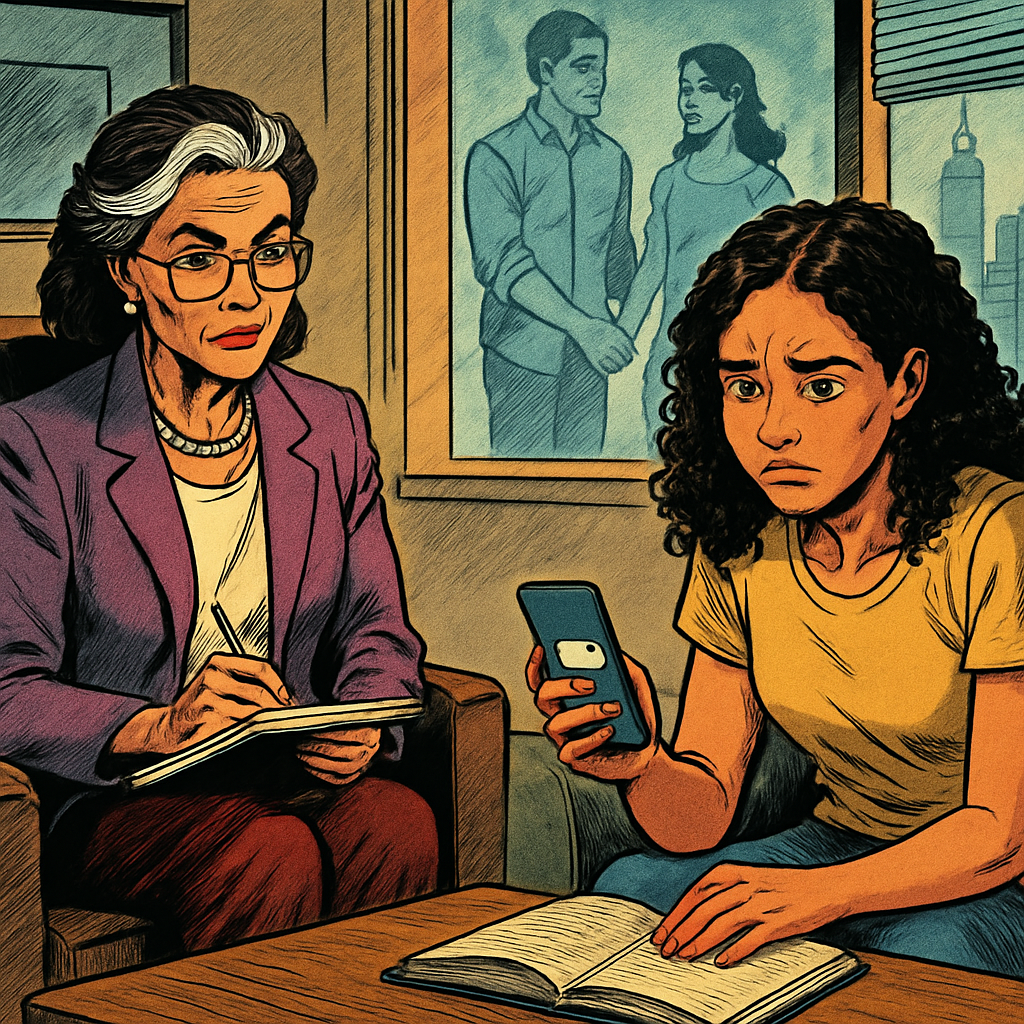
I remember Gabriella vividly. Twenty-one, bright-eyed with this mane of curly hair she’d twirl when nervous. She’d come in wearing her boyfriend’s oversized hoodies despite the summer heat, a habit she explained was “their thing.” She first arrived clutching her phone like a talisman, showing me text screenshots that made my stomach turn. 😔
Her boyfriend of two years had been rallying his friends to mock and belittle her, calling her “psycho,” “desperate,” and worse. What struck me wasn’t just the cruelty, but how it contrasted with their Instagram feed – all smiles, inside jokes, and #relationshipgoals.
The Digital Underground 📱
What fascinated me about Gabriella’s case wasn’t just the boyfriend’s betrayal – it was how his behavior revealed something we now know is common in young adult relationships: the creation of emotional bytes that carry completely contradictory information. To her face: love and commitment. In text threads: contempt and mockery.
During our third session, Gabriella revealed something that put this in perspective. “I found his journal,” she whispered, visibly uncomfortable. His journal detailed elaborate sexual fantasies about her best friend, alongside entries expressing feeling “trapped” and “suffocated” in their relationship. The journal functioned as yet another emotional outlet – different from his public face, different from his text persona.
Her boyfriend had developed completely separate emotional scripts for different contexts.
Trash-Talking as Emotional Regulation 🧠
Research shows that many young adults use digital back-channels not just for betrayal, but as primitive emotional regulation. Unable to express negative emotions directly (thanks to underdeveloped conflict skills), they create safety valves elsewhere.
“He doesn’t know how to be angry with me to my face,” Gabriella realized in our fifth session. “So he does it where I can’t see.”
This isn’t just about being two-faced. It’s about emotional fragmentation – different needs being expressed in different contexts because they can’t be integrated into a cohesive relationship narrative.
What many therapists miss is that trash-talking partners often genuinely believe they love the person they’re demeaning elsewhere. They’ve compartmentalized their emotional bytes so effectively that the contradiction doesn’t register as dissonance.
The Friends Who Enable 👥
What struck me as particularly significant was how his friends – most in “loving relationships” themselves – eagerly participated. They weren’t just bystanders; they were active collaborators in what I call “relationship undermining by committee.”
In one particularly revealing session, Gabriella admitted something she hadn’t told anyone. “Sometimes I create fake problems to tell him about, just to see if they show up in the group chat later.” Her intuition about the betrayal had led her to create a clever trap – feeding him specific stories that only he knew, then seeing which ones circulated back to her through mutual friends. 🕵️♀️
Her emotional intelligence was functioning at a sophisticated level, even as her heart was breaking.
The Real Secret 💡
Six months into our work together, Gabriella discovered something that changed everything. Her boyfriend’s mother had been secretly texting him daily critiques of Gabriella – from her appearance to her career choices. This family script of women being perpetually inadequate was being reinforced daily, creating an invisible structure neither of them had been conscious of.
“So it’s not just him,” she said, with the peculiar relief that comes from seeing a larger pattern. “It’s like he’s been programmed to see me this way.”
The irony wasn’t lost on me: the very mechanism that was destroying their relationship – secretive texting – had finally given her the clarity to understand it.
💎 Core Insight
The text messages we send reveal the relationships we actually have, not the ones we pretend to have.
Until next confession,
Sophia Rivera
(Still wondering why my clients’ partners never think I’ll eventually see their text messages) 😏
“`html
References
- Xia, M., Fosco, G. M., Lippold, M. A., & Feinberg, M. E. (2018). A Developmental Perspective on Young Adult Romantic Relationships: Examining Family and Individual Factors in Adolescence. Journal of Youth and Adolescence.
- [Anonymous] (2022). Relationship Dynamics and Abusive Interactions in a Nationally Representative Cohort of Youth and Young Adults. PubMed.
- Manning, W. D., Giordano, P. C., Longmore, M. A., & Flanigan, C. M. (2012). Young Adult Dating Relationships and The Management of Sexual Risk. Population Research and Policy Review.
- Dishion, T., Caruthers, A., & Chronister, K. (2012-2017). Relationship Dynamics and Young Adult Drug Use and Abuse. Arizona State University.
- [Anonymous] (2019). Youth and Young Adult Dating Relationship Dynamics and Subsequent Risk for Abuse. Journal of Adolescence, 72, 112-123.
- Add Health Team. (2020). Characteristics of Young Adult Relationships: Demographic Patterns and Quality. Add Health Research Brief.
Key Takeaways
- Family Influence on Relationship Quality: Positive family climate and competent parenting during adolescence lead to better problem-solving skills and healthier romantic relationships in young adulthood, emphasizing the importance of communication and conflict-resolution abilities.
- Abusive Relationship Patterns: Research identifies relationship profiles with intense or unhealthy dynamics that correlate with higher risks of partner abuse, psychological distress, and maladaptive communication patterns.
- Communication and Trust Impact: Emotional and communication qualities in young adult relationships significantly affect sexual risk management and mutual respect, highlighting how toxic interactions compromise healthy relational functioning.
- External Influences on Relationships: Substance use and social group dynamics can affect relationship formation and stability, contributing to relational strain and partner behavior issues.
- Relationship Dynamic Categories: Research categorizes relationships as healthy, unhealthy, intense, or disengaged, with intense relationships showing strong links to abuse and problematic communication patterns requiring comprehensive assessment.
- Demographic and Quality Variations: Intimate partner violence rates vary across relationship types (dating, cohabiting, married), with communication and relational quality serving as key protective or risk factors for relationship outcomes.
Clinical Applications
These sources provide empirical support for understanding developmental, relational, and contextual complexities underlying feelings of betrayal, toxic dynamics, communication breakdowns, and possible abuse in young adult intimate relationships. This research foundation supports interventions focusing on emotional processing, constructive communication, and safety assessment.
“`