
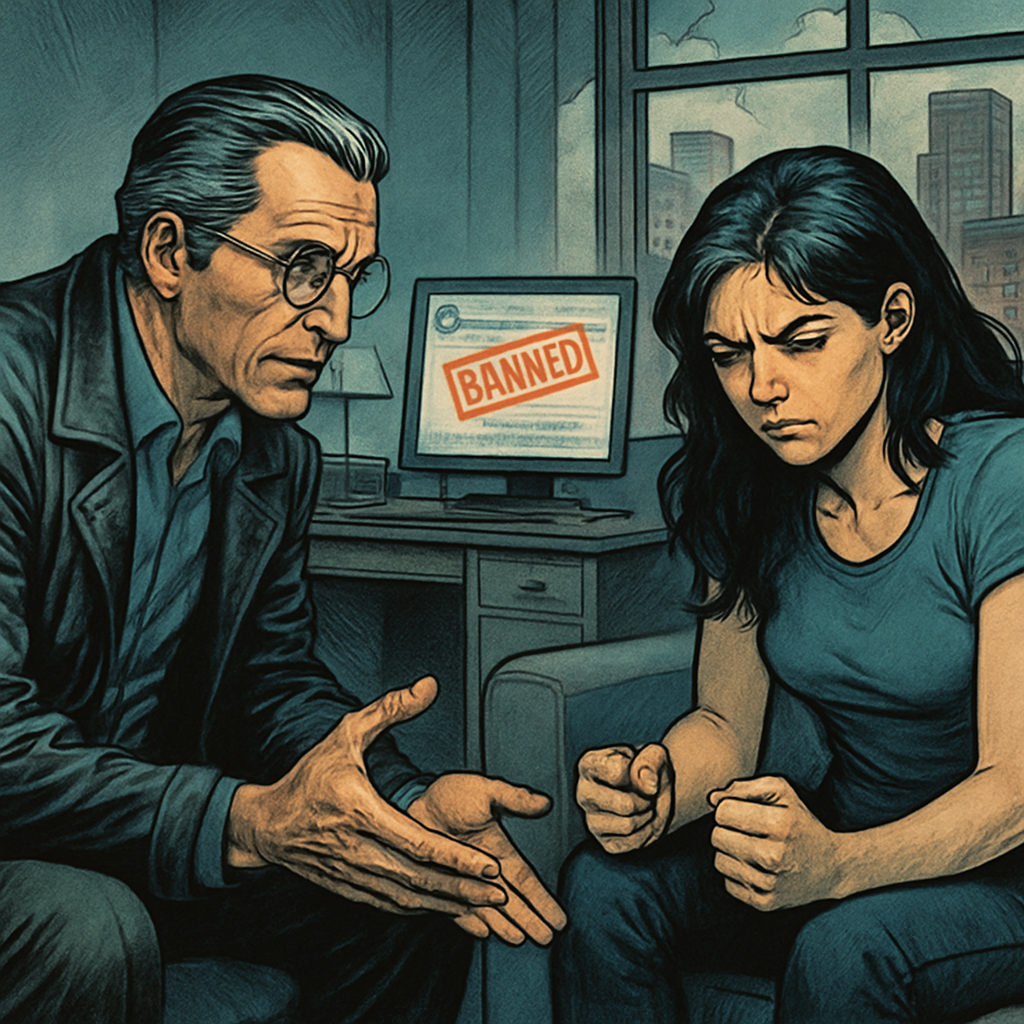
The weight of the words crashed down on her with unexpected force. She stared at the screen, her eyes narrowing as they traced the brutal dismissal from the moderator. “Shut the fuck up or I’ll ban you permanently.” The cursor blinked back at her indifferently. Her hands hovered above the keyboard, frozen between fury and resignation. 😔
She knew it was ridiculous to feel this hurt over something so small, yet the sting of injustice burned just the same.
I remember Zara J. vividly from among thousands of clients. Not because her problem was particularly unique, but because of the way she described the moment she received that moderator’s message – “like being slapped by someone who should have been a referee.” Zara had a gift for metaphors that cut straight to emotional truth. She was also the only client who ever brought homemade kombucha to sessions, insisting I try her latest experimental flavor (the ginger-turmeric remains undefeated). 🥤
💔 Digital Wounds Are Still Wounds
Let me tell you something that academics won’t admit in their peer-reviewed journals: online rejection activates the exact same pain pathways in your brain as physical injury. That’s not hyperbole or metaphor – that’s neuroscience.
When Zara came to me, she was embarrassed about being so affected by what happened in a role-playing subreddit. “It’s just the internet,” she kept saying, as if repeating it would make her feelings disappear.
“Look,” I told her, “I once spent three days in a funk because someone left a one-star review on an e-book I wrote. I drafted twelve different responses before my wife hid my laptop. We’re social creatures hardwired for fairness and inclusion. When either gets violated, we feel it.” 🧠
What was fascinating about Zara’s case wasn’t just the rejection, but how the emotional bytes associated with it clustered together. Each byte contained not just the unpleasant feeling but also physical sensations (tightness in her chest), need state information (recognition, fairness), and narratives (“I’m being singled out”).
⚡ Invisible Power Structures Shape Visible Pain
Every online community has invisible structures as real as load-bearing walls in your house. There are hierarchies, unwritten rules, and power dynamics that shape every interaction.
In Zara’s case, she’d unwittingly violated a rule that wasn’t actually enforced consistently. When she pointed this out (rationally, by her account), the head moderator responded with disproportionate aggression. This wasn’t just about a role-playing post – it was about power. 💪
“Moderation is a thankless job,” I told her. “These people deal with hundreds of rule-breakers daily, often with no training or support. They’re volunteers doing unpaid emotional labor. Does that excuse the ‘shut the fuck up’ response? Absolutely fucking not. But understanding the pressure cooker they operate in helps explain it.”
What’s happening beneath the surface is a clash of needs hierarchies. Zara’s identity needs (fairness, recognition) collided with the moderator’s psychological needs (autonomy, control). Neither was consciously aware of this collision, but both felt its impact.
⚖️ Disproportionate Response Reveals Hidden Truth
Here’s a field-tested truth most people miss: when someone responds with nuclear-level aggression to a minor challenge, they’re telling you more about themselves than about you.
“Think about it,” I said to Zara during our third session. “If you bump into someone accidentally at a grocery store, and they scream in your face, do you think ‘wow, I must have really bumped them hard’ or ‘that person is carrying something heavy I know nothing about’?” 🛒
People in positions of power – even small-pond power like subreddit moderation – often develop emotional scripts around maintaining authority. When these scripts are activated, they respond from a threat-based emotional frame rather than a rational assessment.
This isn’t about excusing poor behavior. It’s about understanding the emotional bytes driving the interaction so you can process what happened without taking it personally.
🔍 What Your Digital Heartbreak Really Means
Zara’s emotional response wasn’t just about a temporary ban. The rejection activated deeper emotional scripts around belonging and fair treatment that had roots far beyond Reddit.
“Let me ask you something,” I said during our final session. “If this is really just about a role-playing post, why does it still hurt two weeks later?”
Her eyes widened with recognition. “Because it reminded me of my old boss who fired me for speaking up about favoritism.” 💡
Our emotional bytes form patterns. When a new experience matches the pattern of an old wound, it’s not just current pain you’re feeling – it’s the accumulated weight of every similar experience you’ve ever had. This is what I call an emotional echo chamber – where present hurts amplify past wounds, creating a response that seems disproportionate to others but feels entirely appropriate to you.
On our last session, Zara brought me pineapple-basil kombucha (surprisingly good) and shared that she’d started a small Discord server for role-players who wanted clear, consistent moderation. “I can’t fix that subreddit,” she said, “but I can create something better.” ✨
That’s wisdom from someone who’s been there – taking the energy of perceived injustice and channeling it into creation rather than rumination.
—Jas Mendola, knowing that the battles that shape us most are rarely fought on fields of glory, but in the quiet moments when we decide what kind of story we’ll tell ourselves about what just happened 📖
🔗 Core Insight
Online rejection isn’t “just digital” – it’s neurologically real pain that often echoes deeper wounds. The key isn’t minimizing these experiences, but understanding their patterns so we can respond with wisdom rather than reactivity.
📚 References
https://arxiv.org/pdf/2206.05629
https://arxiv.org/html/2501.17430v1
https://openreview.net/forum?id=TcmYQkhBC1
https://thesis.eur.nl/pub/65065/stad_maarten_vander.pdf
https://pmc.ncbi.nlm.nih.gov/articles/PMC9933803/
https://pmc.ncbi.nlm.nih.gov/articles/PMC11366419/
https://mental.jmir.org/2025/1/e58891
https://papers.ssrn.com/sol3/Delivery.cfm/5243593.pdf?abstractid=5243593&mirid=1