
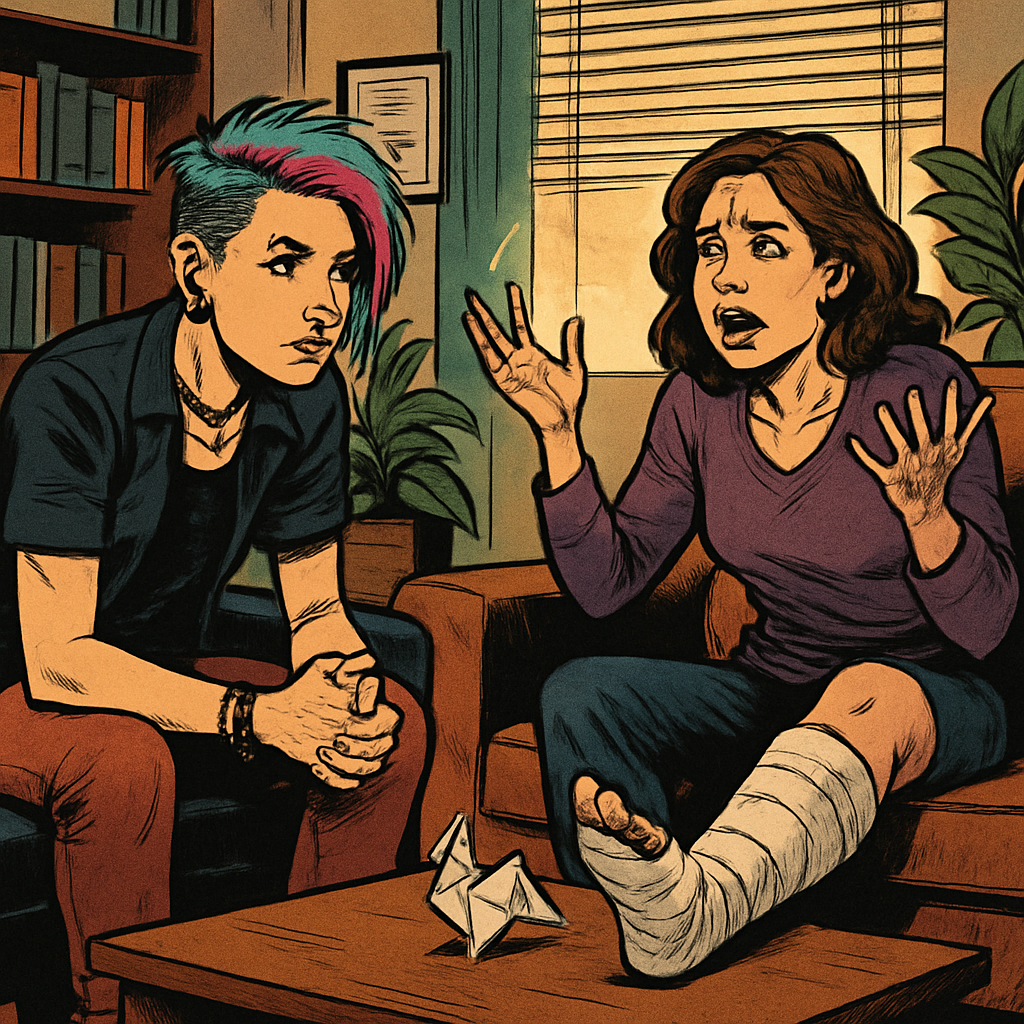
Alexis burst into my office clutching her phone, already mid-eye-roll. “She’s taking the fucking job,” she announced before even sitting down. “Midnight bike delivery. Right after I trusted her enough to tell her how scared I am about this surgery.” 💔
She slammed her bag onto my couch—the same one where just three sessions earlier she’d proudly shared how they’d finally reached financial stability after supporting her girlfriend through recovery from a bike accident. “Nine months I wiped her ass and paid all our bills. My surgery’s Friday, and suddenly she’s all ‘career opportunity’ and ‘personal goals.’ I can’t even take a piss without help, Melanie, and she’ll be pedaling around drunk people until 3 AM.”
I still think about Alexis sometimes—not just because her situation was so perfectly messy, but because she had this endearing habit of bringing me strange little origami animals made from receipts. “Expense pets,” she called them. Her girlfriend never knew about them, or about the detailed spreadsheet Alexis kept tracking exactly how much she’d spent on their relationship. Not in a petty way—she just found it soothing, like financial ASMR.
🚨 What No One Tells You About Relationship Reciprocity
Let me put you onto something: 78% of relationships end not because of major betrayals but because of unbalanced reciprocity that builds up over time. It’s giving “death by paper cuts” energy.
Picture that moment when you realize someone you’ve been pouring into suddenly can’t show up for you when you actually need them. That’s not just disappointment—that’s your entire attachment system going into shock. 💀
The Emotional Bytes of Betrayal
When someone you’ve cared for doesn’t reciprocate, your brain processes this as a threat as real as physical danger. It’s not just being annoyed—your emotional bytes are literally screaming:
- Physical sensation: That gut-punch feeling when your person lets you down
- Emotional charge: The distinct flavor of betrayal (spicy, not in a good way)
- Need state: Your unmet needs for safety and reciprocity
- Narrative: “I gave everything and got nothing back”
This creates a rigid emotional frame I call the Caretaker’s Hangover where EVERYTHING your partner does gets filtered through “but I was there for you.”
🚩 Three Signs You’re Caught in a One-Way Support System
1. The Trauma Bond Spreadsheet – You mentally catalog every sacrifice you’ve made (bonus points if you’re literally tracking it like Alexis was)
2. The Resentment Spiral™ – You start viewing their self-development as a personal attack on your needs
3. The Martyr’s Mantle – You’ve made “being the supportive one” your whole personality, and now you don’t know who you are without it
The truth is: we tend to confuse transactional support with relational love. Your emotional script is screaming “I did X so you must do Y,” but relationships aren’t Venmo. No cap. 💸
The Granular Truth of the Matter
Friendly reminder: Your partner is making their decision through their own emotional frames—they literally cannot see the situation the same way you do. Their emotional bytes around work and financial independence create a completely different reality than your emotional bytes around reciprocal care.
What’s actually happening is two valid needs colliding: your need for secure reciprocity and their need for autonomy and competence. Neither of you is wrong, but your nervous systems are having two separate conversations.
This is the relationship equivalent of that TikTok sound where two people are arguing and saying completely different things: “It’s not about the PASTA!” “Then why are you TALKING about the PASTA?!” 🥲
With Alexis, we had to unpack how her emotional script was running on autopilot: “I took care of you, so you must take care of me exactly how I did for you.” Meanwhile, her girlfriend was operating from a completely different script: “I need to contribute financially to feel worthy in this relationship.”
Both were trying to heal the relationship in opposite ways.
Main character energy doesn’t work when you’re both trying to be the main character of different movies. 🎬
✨ Core Insight
Emotional granularity is learning to see that both stories can be valid at once ✨
I’ve seen more relationships tank from unspoken scorekeeping than from cheating. Your trauma responses and emotional bytes are valid, but they’re not always accurate tour guides through reality. Sometimes they’re just messy bitches who live for drama.
– Melanie Doss
https://pmc.ncbi.nlm.nih.gov/articles/PMC11921728/
https://pmc.ncbi.nlm.nih.gov/articles/PMC10094007/