
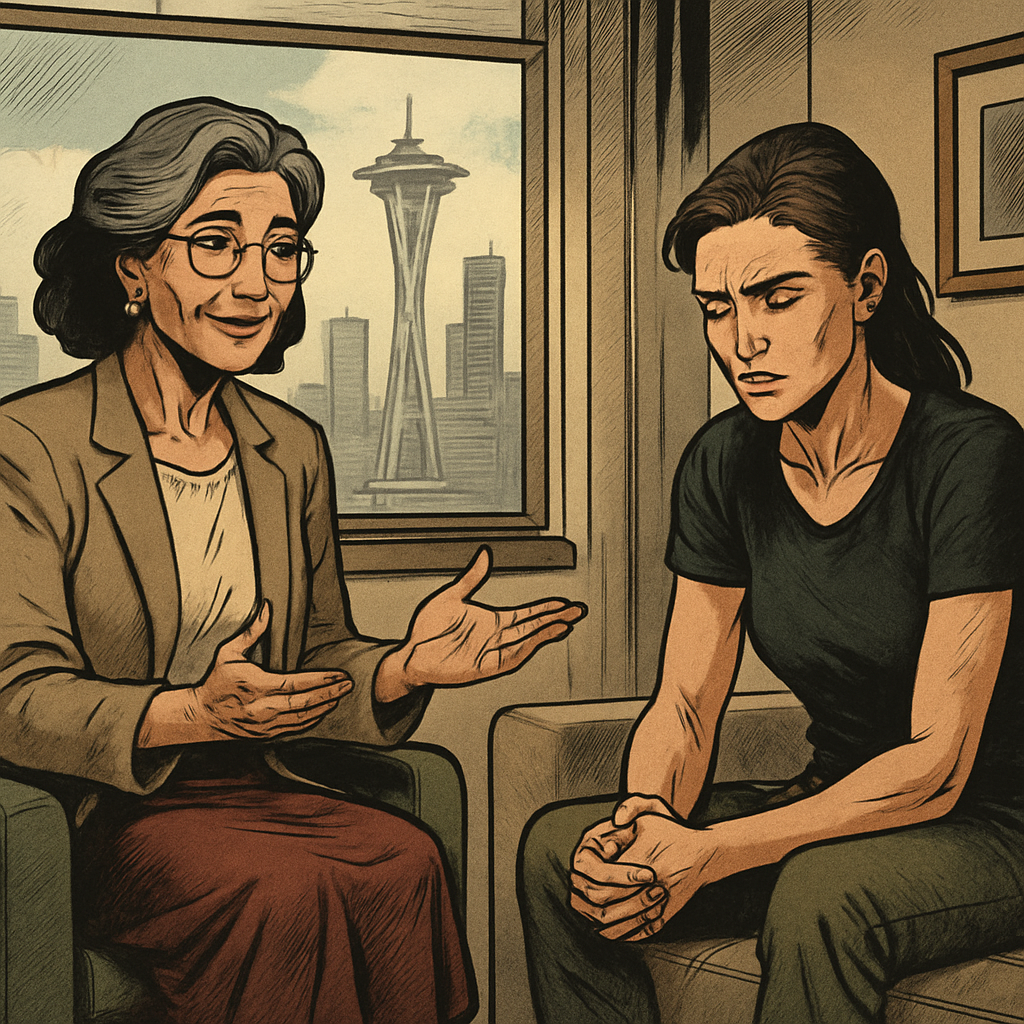
Last week, while arranging client folders, I stumbled upon Emilia’s file. It immediately transported me back to our first session three years ago. She walked in with perfect posture and immaculate makeup that couldn’t quite hide her exhaustion. “I’m supposed to be thriving in my newfound freedom,” she announced before even sitting down, “but instead I’m scrolling through dating apps at 2 AM while simultaneously reading self-help books about how I shouldn’t need anyone. Make it make sense.” 😮💨
💔 The Woman Who Wanted Permission to Want Love
Emilia K. came to me after leaving her alcoholic husband. A 32-year-old marketing executive with sharp wit and sharper boundaries (newly installed, she’d joke), she was caught in the peculiar purgatory that modern divorce creates. “Everyone keeps telling me to ‘focus on myself’ like I’m some kind of self-improvement project,” she told me. “But what if myself wants partnership? Am I allowed to admit that?”
What struck me about Emilia wasn’t her grief—that was expected. It was how she carried two competing emotional frames simultaneously: one that valued independence and healing, and another that honored her genuine desire for deep connection. These frames weren’t actually in conflict, but the narratives attached to them certainly were.
Her emotional bytes around intimacy carried complex information—the physical sensation of longing, the unpleasant charge of absence, the profound relationship need for connection, and narratives about what it meant to want love “too soon.” The result? A meta-emotional conflict where she felt bad about feeling bad about being alone. 🌀
🎭 The Grief Nobody Talks About
Research consistently shows something fascinating about divorce recovery that rarely makes it into popular advice: it’s not just about losing a person—it’s about losing an identity. “I miss being a wife,” Emilia admitted in our third session, whispering it like a confession. “I miss having a role, a place, even if it was in a broken system.”
This identity disruption creates a particular kind of emotional vacuum. The needs hierarchy gets scrambled—relational needs clash with identity needs, creating confusing emotional experiences. Emilia’s emotional scripts around self-sufficiency (developed in childhood watching her parents’ messy divorce) clashed with her authentic desire for partnership.
Here’s the kicker: the “focus on yourself” narrative often misses something crucial. Humans are relational creatures. The need for intimacy isn’t a character flaw to overcome—it’s hardwired. The question isn’t whether to want connection but how to pursue it while maintaining wholeness. ✨
🎫 The Permission Slip No One Issued
By our eighth session, we’d identified Emilia’s core struggle: she was waiting for permission to want love again. Her emotional granularity was improving—she could distinguish between desperate attachment and healthy longing, between escapist romance and authentic connection.
“I realized something,” she told me one day. “I don’t actually want to ‘get back out there.’ I want to create space for someone meaningful to enter my life, which is completely different. I want to be selective, intentional, but open.”
This realization marked a turning point. Rather than seeing herself as either “healing alone” or “seeking partnership,” she recognized these weren’t mutually exclusive states. Her emotional frames were becoming more flexible, allowing for nuance rather than black-and-white thinking. 🌈
We worked on intentional experiences to update her emotional bytes around intimacy. She practiced articulating needs clearly, explored what healthy vulnerability felt like in her body, and noticed when her inner voice became critical of her desires—responding with compassionate curiosity instead.
🎬 The Plot Twist
The most profound moment came when Emilia realized that wanting partnership wasn’t regression—it was progress. Her ability to articulate what she truly wanted in relationship rather than accepting scraps (as she had in her marriage) was evidence of growth, not weakness.
“The funny thing is,” she said in our final session, “now that I’ve given myself permission to want connection, I’m actually more discerning about it. I’m not rushing or settling. I’m building a life I love that has space for someone else to join, not a gaping hole I need someone to fill.” 💪
Studies consistently show that social support is among the strongest predictors of post-divorce adjustment and renewed self-esteem. But here’s what those studies often miss: there’s a world of difference between needing others to function and choosing to create space for meaningful connection from a place of wholeness.
💝 Core Insight
Sometimes the most radical act of self-love isn’t learning to be alone—it’s honoring your authentic desires without apology, even when they don’t fit neatly into healing narratives.
The heart doesn’t heal in isolation. It heals in the careful balance between solitude and connection, between honoring old wounds and creating space for new possibilities. 🌱
Until next confession,
Sophia Rivera (who still keeps Emilia’s thank you card pinned to my office corkboard as a reminder that sometimes the most helpful thing I can do is give people permission to want what they already want) 💌
https://pmc.ncbi.nlm.nih.gov/articles/PMC10508201/
https://scholarworks.iu.edu/journals/index.php/iusburj/article/download/19792/25869/43886
https://pmc.ncbi.nlm.nih.gov/articles/PMC6313686/
https://childandfamilyblog.com/children-of-divorce-self-esteem/