
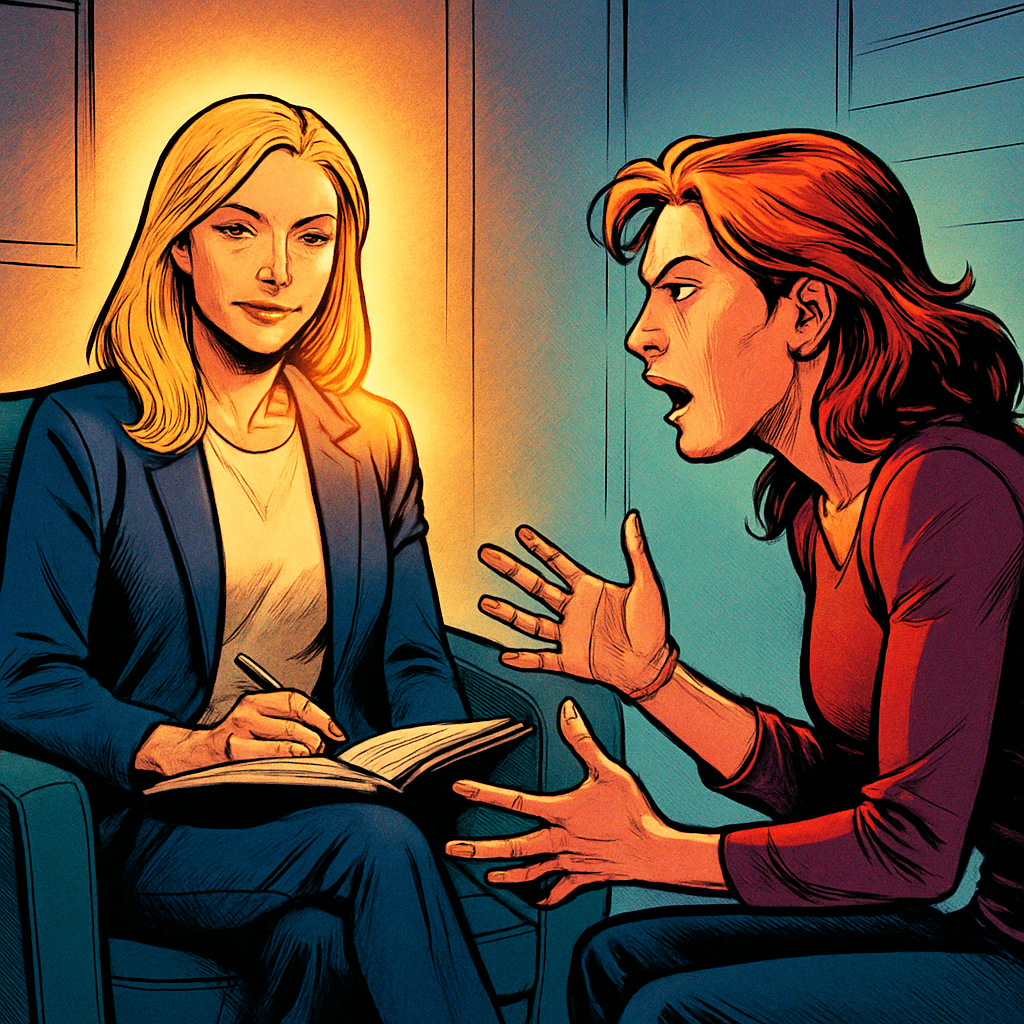
It was one of those autumn afternoons when Manhattan feels magical 🍂—just crisp enough for a light jacket, just sunny enough to sit outside at that little café on West 4th where I sometimes take sessions when the office feels too formal. Ava was thirty minutes into explaining why she absolutely, positively did not need to apologize to her husband. She was so convinced of her rightness that her cappuccino had gone cold, forgotten in the midst of her passionate defense.
“He completely misinterpreted what I said about the smell. It was about the room, not about him! Why should I apologize when he’s the one who jumped to conclusions?” She leaned forward, lawyer-trained and ready to present exhibit B in her case for innocence.
I’ve sat across from countless Avas over the years. Smart, accomplished people who can dismantle opposing counsel’s arguments with surgical precision but somehow can’t figure out why their marriages feel like emotional war zones. They come to me expecting validation that they’re right and their partner is wrong. Instead, they get me—with my weathered notebook and knowing half-smile that says, honey, this isn’t about who’s right.
🤝 The Invisible Dance We All Do
What fascinated me about Ava’s situation wasn’t the comment about the smell. It wasn’t even her husband’s insistence on an apology. It was how perfectly they were executing one of the oldest dances in the relationship playbook: the defensive spiral. One person feels hurt, the other feels misunderstood, and suddenly we’re arguing about who said what instead of why it mattered in the first place.
Behind every “you misinterpreted me” is a deeper story about what we need from each other. Ava’s husband wasn’t really fighting for an apology—he was fighting to feel respected and heard. And Ava wasn’t fighting against apologizing—she was fighting against feeling controlled and invalidated.
The words we exchange in these moments are just the visible tip of a much deeper emotional iceberg. Every accusation carries an unspoken plea: See me. Hear me. Value me. 💫
We think we’re arguing about facts (“I didn’t mean it that way!”), but we’re actually trading emotional frames—the invisible lenses through which we interpret everything. His frame said her comment was dismissive. Her frame said his reaction was oversensitive. Both frames felt absolutely real to their owners.
⚔️ The Power Struggle Nobody Wins
What makes Ava’s case stick with me is how clearly it illustrates our collective delusion about communication. We think good communication means expressing ourselves clearly. But that’s only half the equation.
The couples who actually make it aren’t necessarily better talkers—they’re better listeners. They’ve figured out that winning the argument means losing the connection. The goal isn’t proving your innocence; it’s preserving the bond.
Remember these tell-tale signs you’re stuck in the power struggle:
- 🕵️ You’re collecting evidence to prove your case
- 🎯 You’re more focused on being understood than understanding
- 🗣️ You’re rehearsing your next point while your partner is still speaking
- ⚡ You feel more like opponents than teammates
- 🔄 The same argument keeps resurfacing in different forms
When Ava asked if I thought she should apologize, I asked her a question instead: “Would you rather be right or connected?” The flash of recognition in her eyes told me everything. She knew. We all know, deep down.
💛 The Courage to Go First
Here’s what I eventually told Ava, after she finished building her airtight case: “The most powerful person in any relationship is the one who’s willing to be vulnerable first.”
Our defensive patterns are protective scripts designed to keep us safe from old wounds. Her husband’s quick assumption that she was criticizing him? That’s a script running from somewhere deeper. Her immediate resistance to apologizing? Another script, likely formed around experiences where apologizing felt like surrendering power.
These emotional scripts run silently in the background, dictating responses that feel completely natural and justified. The problem is, they’re often operating on outdated information from completely different relationships.
What heals relationships isn’t perfect communication—it’s the willingness to recognize when your defensive patterns have been triggered, and choosing connection over protection. It’s creating enough safety that apologizing doesn’t feel like losing, and hearing criticism doesn’t feel like being attacked.
💡 Core Insight
The most transformative moment in any relationship conflict isn’t when you prove you’re right—it’s when you choose to care more about your partner’s feelings than your own ego.
Two weeks later, Ava texted me: “I apologized. Not because I was wrong about what I meant, but because his feelings mattered more than being right. He apologized too, for jumping to conclusions. We both won.” 🏆
Perhaps the greatest act of love isn’t grand gestures or perfect understanding, but simply choosing the relationship over your own defenses, again and again.
— Lola Adams, noting that most couples spend years fighting about who started the fire while their house burns down around them 🔥
https://pmc.ncbi.nlm.nih.gov/articles/PMC4852543/
https://wjarr.com/sites/default/files/WJARR-2024-0634.pdf
https://pmc.ncbi.nlm.nih.gov/articles/PMC8915221/
https://digitalcommons.pepperdine.edu/cgi/viewcontent.cgi?article=1302&context=etd
https://journals.sagepub.com/doi/abs/10.1177/02654075231153668