
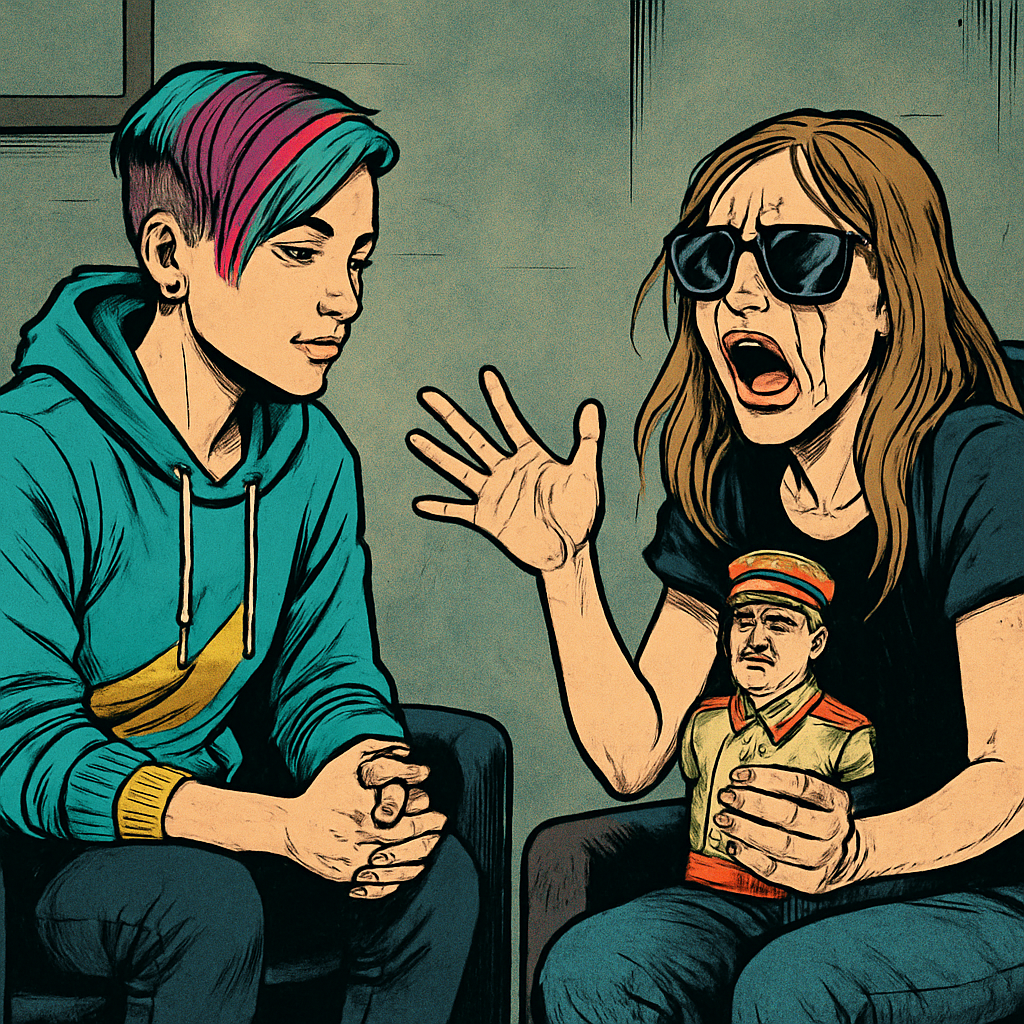
Friday afternoon, 4:37 PM. Alexis K. slammed into my office with the force of a meteorite, all mascara tracks and fury. “He lied again,” she announced, collapsing into my chair. She didn’t remove her sunglasses, which was fine—I’d already seen what lay beneath during our previous seventeen sessions.
“I can’t keep doing this,” she continued, but we both knew she would. Four years of promises, betrayals, cold silences, and passionate reconciliations had created a rhythm as predictable as the tide. 🌊
I remember Alexis fondly for her obsessive collection of vintage salt and pepper shakers shaped like famous dictators. “They remind me that even monsters have to season their food,” she once explained. It was oddly comforting, this weird little window into how she processed power dynamics.
✨ 3 BRUTAL TRUTHS ABOUT THE BREAKUP-MAKEUP LOOP ✨
Let’s get uncomfortably real: 67% of couples caught in the breakup-makeup cycle are actually addicted to their own emotional bytes—those powerful units of sensation, charge, and narrative that get activated during conflict.
When Alexis described becoming “cold with words” during arguments, she wasn’t just being mean—she was activating a defensive emotional script that felt as natural as breathing. Meanwhile, her boyfriend’s pattern of promising, hiding, and apologizing had become his own well-worn script.
🚩 THE ATTACHMENT WHIPLASH
Picture that moment when someone you love becomes a threat. That’s what I call attachment whiplash, and it’s leaving y’all in a constant state of emotional hangover.
Alexis and her boyfriend were caught in a loop where their emotional frames—those invisible interpretive lenses formed from clusters of emotional bytes—were fundamentally misaligned. Every time they fought, her frame shifted to “I knew he would hurt me,” while his likely shifted to “She’ll never forgive me.”
This is how you end up living in a trauma-response TikTok come to life:
- You start seeing “tests” everywhere (when really you’re just scanning for threats) 💀
- The words “we need to talk” send your nervous system into the multiverse 🥲
- You’ve perfected the art of the emotional Irish goodbye (three months of silence is giving avoidant attachment bingo) 🤌
- Your body keeps the receipts even when your mouth says “I forgive you” ✨
🔮 THE PROXIMITY TRAP
No cap, Alexis hit on something crucial when she mentioned living close to each other. Proximity creates the ILLUSION of connection when what you actually have is convenience.
Y’all are basically doing the relationship equivalent of that “moving background, standing still” TikTok trend—looking like you’re progressing when you’re actually just cycling through the same emotional territory.
Signs you’re in the proximity trap:
- You keep coming back because it’s E A S Y, not because it’s H E A L T H Y
- Your reconciliations are based on missing the feeling, not fixing the problem
- Your relationship only survives because breaking up requires more effort than staying together
THE GRANULAR TRUTH OF THE MATTER 🎯
Reminder: Trust isn’t just broken by big betrayals—it’s eroded by the tiny moment when your emotional byte saying “I’m scared” gets met with their emotional byte saying “I’m defensive.” The real relationship isn’t what happens during date night; it’s what happens during conflict.
With Alexis, we discovered something fascinating—her inability to trust wasn’t just about her boyfriend’s lies. It was about how her own emotional script of “withdraw and punish” had become a self-fulfilling prophecy, creating exactly the distance she feared most.
The truth is, her Stalin salt shaker collection wasn’t random at all. Her father, a history professor with his own trust issues, had given her the first set after their parents’ messy divorce. Every time she felt betrayed, she bought another dictator—a tiny, secret way of saying “I’ll control this narrative” when everything else felt chaotic.
💡 CORE INSIGHT
What makes the breakup-makeup loop so addictive isn’t love—it’s the intense relief of reconciliation after the suffering of separation. You’re not chasing each other; you’re chasing the neurochemical cocktail that comes from resolving emotional dissonance.
And sometimes, the bravest thing isn’t trying again—it’s finally letting the loop break.
When you realize you’re reheating the same emotional leftovers and calling it a fresh meal, that’s not dedication—that’s a microwave relationship. And honey, you deserve a whole damn feast. 🍽️
– Melanie Doss
https://ijip.in/wp-content/uploads/2024/05/18.01.202.20241202.pdf
https://pmc.ncbi.nlm.nih.gov/articles/PMC10047625/
https://pmc.ncbi.nlm.nih.gov/articles/PMC4845754/
https://courses.lumenlearning.com/suny-lifespandevelopment/chapter/attachment-in-young-adulthood/
https://www.columbiapsychiatry.org/news/how-attachment-styles-influence-romantic-relationships
https://papers.ssrn.com/sol3/papers.cfm?abstract_id=4885926
https://labs.psychology.illinois.edu/~rcfraley/attachment.htm