
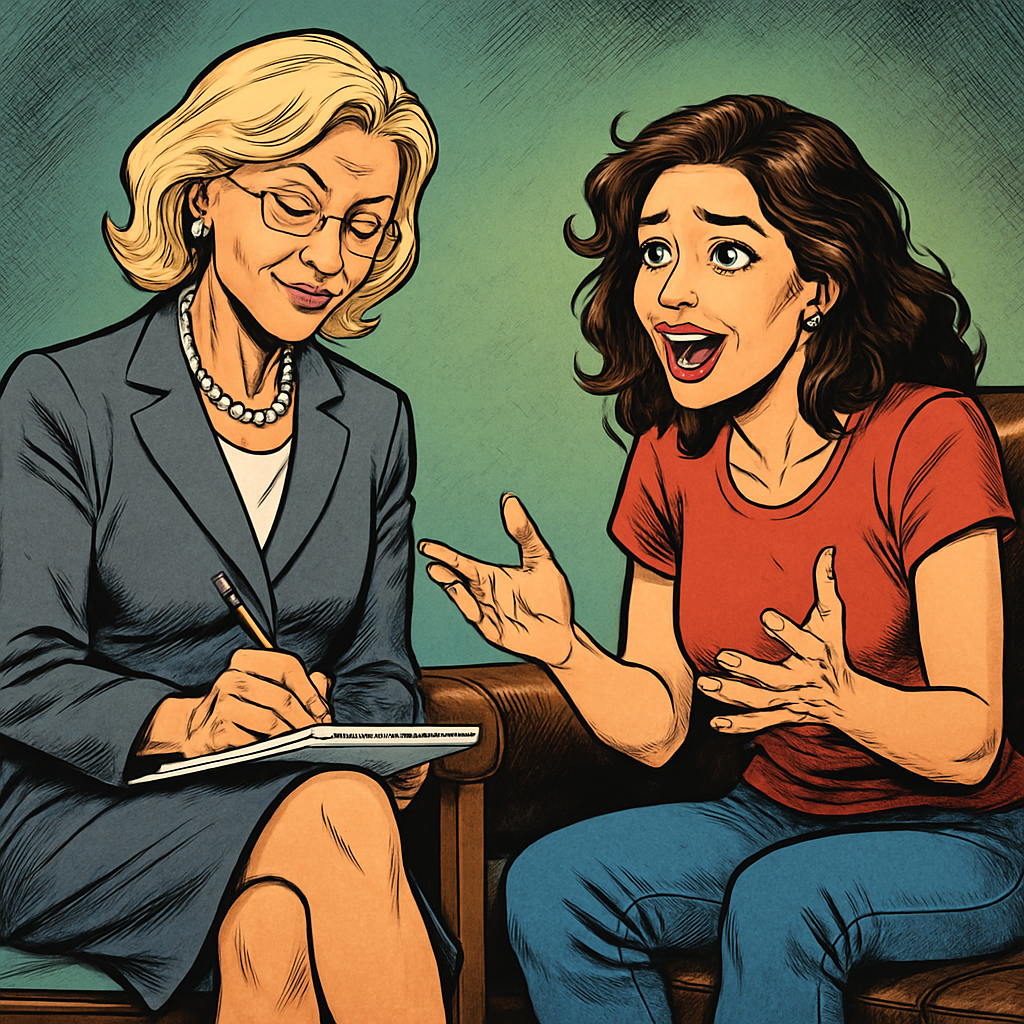
I remember Alexandra from the first moment she swanned into my office, all Tribeca elegance and barely contained nervous energy. She’d wandered into my favorite coffee shop near Washington Square Park, overheard me chatting with another client, and promptly scheduled an emergency session. When someone interrupts your perfect cappuccino to ask if you can fix their relationship, you know it’s going to be interesting. ☕
“He says I talk too much,” she announced, sinking into my leather couch. “Can you believe that? He actually suggested I—and I quote—’edit myself’ when I get excited about something.” Her eyes flashed with a mixture of hurt and indignation that I’ve seen countless times across my consultation room. “Am I really that unbearable?”
Ah, the classic “is this criticism or is this me being defensive” tango. I’ve watched this particular dance for 25 years, and I still find it fascinating. 💃
When Excitement Meets the Editor ✂️
Alexandra wasn’t dealing with a simple communication hiccup. She was experiencing that jarring moment when your authentic expression—your excitement, your passion, your unfiltered self—collides with someone else’s boundaries. It’s the emotional equivalent of running full-speed into a glass door you didn’t see coming.
When we share excitement, we’re not just exchanging information—we’re offering a piece of ourselves, raw and unedited. Each passionate ramble carries with it physical energy, emotional charge, and the unspoken need for validation. And when someone suggests we tone it down? That feedback gets encoded not just as “talk less,” but as “your authentic self is too much.”
“Every time I start getting really into something—a film, a book, whatever—I see him checking out,” Alexandra continued. “Then comes the suggestion to ‘get to the point.’ But my point is the journey, the details, the whole experience!”
The irony is that both people are actually trying to connect. One through elaborate sharing, the other through trying to shape the conversation into something they can better absorb. Two different frames, two different needs, crashing into each other like waves going opposite directions. 🌊
The Defensiveness Dance 🛡️
Defensiveness isn’t some character flaw—it’s a perfectly natural response when you feel your identity is under threat. When your partner suggests you talk less, they’re probably thinking about conversation flow. But what you hear is an attack on who you are.
Alexandra leaned forward. “I’ve always been the storyteller, the one who notices everything. It’s how I connect. If I have to filter that… then who am I supposed to be exactly?”
Here’s what I’ve observed in my years of listening to couples:
- What feels like criticism to you often wasn’t intended as such by them
- Your emotional reaction is usually about something deeper than the words said
- The more secure you feel in yourself, the less threatening feedback becomes
- People who can’t handle your fullness aren’t necessarily wrong—they just have different needs
- The degree of defensiveness usually matches the importance of what feels threatened
The problem wasn’t that Alexandra talked too much or that her partner requested more concision. The problem was that both interpreted the situation through entirely different emotional frames, creating a clash of invisible needs: her need for acceptance of her expressive nature versus his need for digestible communication.
The Rambling Path to Wisdom 🛤️
After several sessions, Alexandra started seeing her situation with more clarity. “I realized something,” she told me during our fifth session. “I get defensive not because I think he’s wrong about me talking a lot—I know I’m verbose. I get defensive because I’m afraid if I change how I communicate, I’ll lose the connection I’m trying to create.”
Precisely. 🎯
We often mistake identity for behavior. Changing how you express doesn’t change who you are—it just creates more pathways for connection. Alexandra’s breakthrough wasn’t about talking less; it was about recognizing that her rambling contained valuable emotional data about her needs for connection, validation, and being truly seen.
What she ultimately discovered was that defensiveness was her warning system—not telling her the criticism was wrong, but alerting her to pay attention to what felt threatened.
“Now when he asks me to condense, I don’t hear ‘you’re too full on,'” she told me in our final session. “I hear ‘I want to connect with the essence of what excites you.’ And honestly? Sometimes I still ignore him and ramble anyway.” She laughed. “But it’s a choice now, not a reaction.”
She kept in touch. They’re still together, five years later. He still occasionally asks her to get to the point. She still occasionally tells him that her point is the journey. But now they both smile when it happens. 😊
💡 Core Insight
The criticism that wounds us most is the one that brushes against the truth we’re not quite ready to see.
— Lola Adams, who knows that what we call “defensiveness” is often just our hearts putting up police tape around our most cherished qualities 💜
Research on Defensiveness and Accountability in Relationships
Academic Sources
- Wright, Collin Joshua. Defensiveness and Accountability in Couple Relationships: A Constructivist Grounded Theory Analysis. Brigham Young University, 2020. Available here
- Wenzel, Michael, Lydia Woodyatt, and Ben McLean. The effects of moral/social identity threats and affirmations on psychological defensiveness following wrongdoing. British Journal of Social Psychology, 2020.
- Geraci, Amanda et al. Is Defensive Behavior a Subtype of Prosocial Behaviors? Frontiers in Psychology, 2021.
- Benson, Kyle. Defensiveness Doesn’t Protect a Romantic Relationship. 2021.
- Markman, Howard J., Scott M. Stanley, and Susan L. Blumberg. Fighting for Your Marriage: Positive Steps for Preventing Divorce and Preserving a Lasting Love. 2010.
- Neff, Kristin D., and Jennifer M. Beretvas. The Role of Self-Compassion in Romantic Relationships. Self and Identity, 2013.
Key Research Findings
Defensiveness and Accountability in Couples
The primary research explores defensiveness and accountability within couples, emphasizing how individual factors like physiological state, mental health, and relationship safety influence whether a person becomes defensive or takes responsibility during conflicts. It outlines a spiral model showing that defensiveness worsens relational problems, while appropriate accountability mitigates them. This helps explain why feeling criticized in communication could trigger protective defensiveness, and how partners’ tone and respect affect this balance.
Social and Moral Identity Threats
Research on defensiveness triggered by perceived social or moral threat shows that people become defensive when they feel excluded or stigmatized, undermining their need to belong. It also highlights that fostering a sense of inclusion or affirming one’s identity reduces defensive responses. This is relevant for understanding how perceived criticism during sharing excitement might feel threatening and ignite defensiveness.
Defensive Behavior as Prosocial Response
Contemporary analysis conceptualizes defensive behavior as part of prosocial motivation, proposing that defensiveness can be an automatic, emotional response aimed at protection—whether of self or others. From this angle, defending one’s communication style could be a natural protective impulse, especially when underlying emotional distress or threat is sensed.
Clinical Perspectives on Relationship Dynamics
Clinical guidance highlights how defensiveness in romantic relationships blocks empathy and connection, replacing collaborative “we-ness” with a focus on self (“me-ness”). It explains that defensiveness escalates conflict cycles and proposes ways to transform defensive responses into accountability and curiosity about the partner’s feelings, fostering healthier communication. This applied perspective directly addresses the cyclical patterns a person might experience when feeling criticized for communication style.
Conflict Resolution Strategies
Marital relationship research expands on effective conflict resolution strategies, emphasizing open communication, acceptance of differences, and constructive feedback rather than criticism. It situates defensiveness as a consequence of feeling attacked but encourages partners to develop self-awareness and growth mindsets to maintain respect and relationship satisfaction. This supports using feedback as a growth opportunity, relevant to reflection about personality changes versus communication improvement.
Self-Compassion and Relationship Quality
Research on self-compassion in romantic relationships shows that individuals higher in self-compassion tend to respond to criticism with less defensiveness and greater relational warmth. By cultivating self-compassion, individuals can better manage sensitivity to feedback, lowering the threat response when asked to modify behaviors like storytelling or rambling, thereby enhancing self-awareness and relationship dynamics.
Integrated Understanding
Together, these sources provide a comprehensive academic basis for understanding the interplay of perceived criticism, emotional defensiveness, individual psychological needs, and strategies to improve relational communication and personal growth in counseling contexts relevant to addressing defensive communication patterns.