
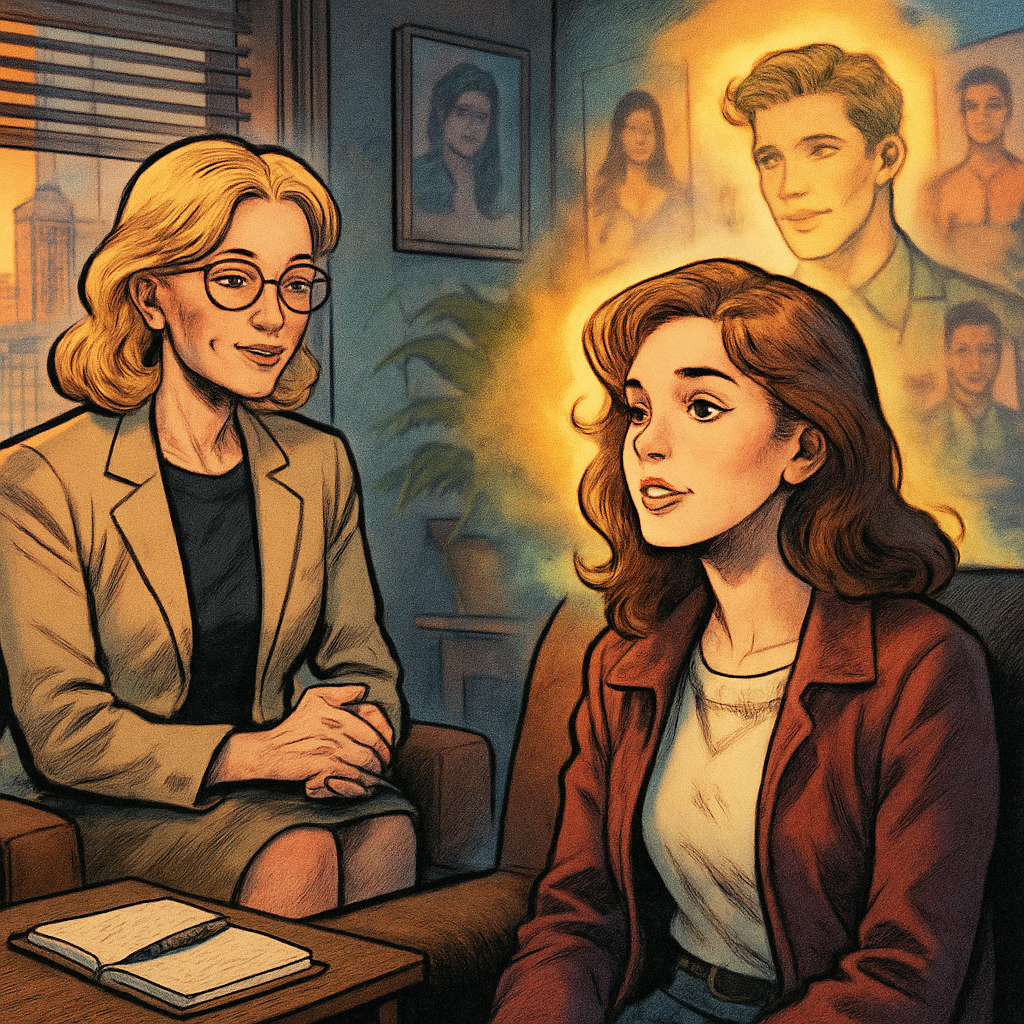
Emily stepped into my office on a Wednesday afternoon last October wearing a concerned expression that didn’t match her carefully curated outfit. She sat down, crossed her legs, and after a few pleasantries, asked the question that had been clearly bouncing around her mind for weeks.
“Is it weird that I think my boyfriend is the most attractive man in the world when, objectively speaking, he’s… you know… not?”
I smiled. In twenty-five years of practice, this particular flavor of relationship anxiety keeps returning like a seasonal cocktail special—reliable, familiar, and oddly comforting in its universality.
“Define ‘objectively,'” I replied, already knowing where this was headed.
“I mean, he’s handsome to me. Like, intensely attractive. But my friends don’t see it. They think he’s… cute. Just cute.” She frowned at the inadequacy of the word. “Before him, I dated guys who turned heads when we walked into restaurants. He doesn’t. But when I look at him, it’s like… everyone else fades away.”
Emily stayed in my memory because she articulated something most of us experience but rarely examine—the mysterious alchemy that transforms an ordinary face into the centerpiece of our emotional universe. ✨
The Great Attractiveness Illusion 🧠
Here’s what nobody tells you about attraction: your perception is gloriously, magnificently unreliable. When you fall in love with someone, your brain literally alters how you see them. It’s not delusional thinking—it’s your emotional system doing exactly what it’s designed to do.
The person you love becomes more beautiful to you because your emotional bytes—those packages of sensation, feeling, and meaning—reorganize around them. Their face becomes associated with safety, excitement, and intimacy. Their physical features get tangled up with how they make you feel, creating a perceptual frame unique to you.
This isn’t some romantic fairy tale. It’s your neurology and psychology working in concert to bond you to your chosen person. The same mechanisms that help you recognize patterns, avoid danger, and seek pleasure are busy creating a perception that serves your attachment needs.
And yet we question it. We worry. We wonder if we’re seeing things that aren’t there.
The Comparison Trap 📱
Emily confessed that she’d stopped noticing other attractive men. “Is that normal? Sometimes I wonder if I’ve lost my ability to see clearly.”
The modern relationship exists in a comparison economy. Dating apps. Instagram. Celebrity culture. Hollywood. We’re swimming in a sea of curated beauty, where everyone else seems to be partnered with someone who could grace a magazine cover.
But here’s what I told Emily: When you’re genuinely connected to someone, your emotional attention naturally narrows. Your perceptual system literally prioritizes your partner above others. It’s not that you become blind—it’s that you’ve created a hierarchy where they sit at the top. 💕
Consider these signs your perception has been beautifully, meaningfully altered:
- You find specific features attractive in your partner that you never noticed or cared about before
- Their “flaws” seem endearing rather than off-putting
- You genuinely forget that others might not see them as remarkable
- Their face gives you a physiological reaction—warmth, safety, excitement
- You catch yourself staring at them when they’re not looking
None of this means you’ve lost your objectivity. It means your emotional bytes and frames have reorganized to support attachment and bonding. Your perception isn’t wrong—it’s specialized.
The Question Nobody Asks 🤔
After several sessions, Emily arrived at the real question beneath her original concern. “What happens if this wears off? What if one day I wake up and see him… differently?”
This is the fear that lurks beneath our surface anxieties about attraction. Not that our perception is skewed now, but that it might correct itself later. That the magic might wear off.
The truth? The nature of attraction does shift in long-term relationships. The intense, all-consuming attraction of early love transitions into something more complex and integrated. Your partner doesn’t become less attractive—they become attractive in a different way.
Their face becomes mapped with shared experiences. Their body becomes a landscape of mutual history. Their features become shortcuts to emotional memories. This evolved attraction isn’t less powerful—it’s more sophisticated. 🌱
When Emily worried about losing her unique perception, she was actually sensing the inevitable evolution of attachment. The perceptual magic doesn’t disappear—it matures alongside the relationship, creating new forms of beauty that weren’t possible in the beginning.
Core Insight ✨
The most honest measure of love might be how beautiful someone becomes to you, not how beautiful they are to everyone else.
Months later, Emily sent me an email with a photo attached—her and her boyfriend on vacation, his arm around her, both smiling. “Still the most handsome man I’ve ever seen. Even if nobody else gets it.”
I saved that email. A small testament to the wisdom of our emotional systems when we stop questioning them. 💌
— Lola Adams, noticing that what we call “attraction” is actually the emotional universe’s way of marking someone as significant to our story
https://pmc.ncbi.nlm.nih.gov/articles/PMC9602849/
https://www.psypost.org/assortative-mating-confirmed-couples-align-in-physical-attractiveness/
https://pmc.ncbi.nlm.nih.gov/articles/PMC4011637/
https://crimsonpublishers.com/pprs/pdf/PPRS.000566.pdf
https://news.nd.edu/news/cupids-arrow-research-illuminates-laws-of-attraction/
https://trace.tennessee.edu/utk_graddiss/80/