
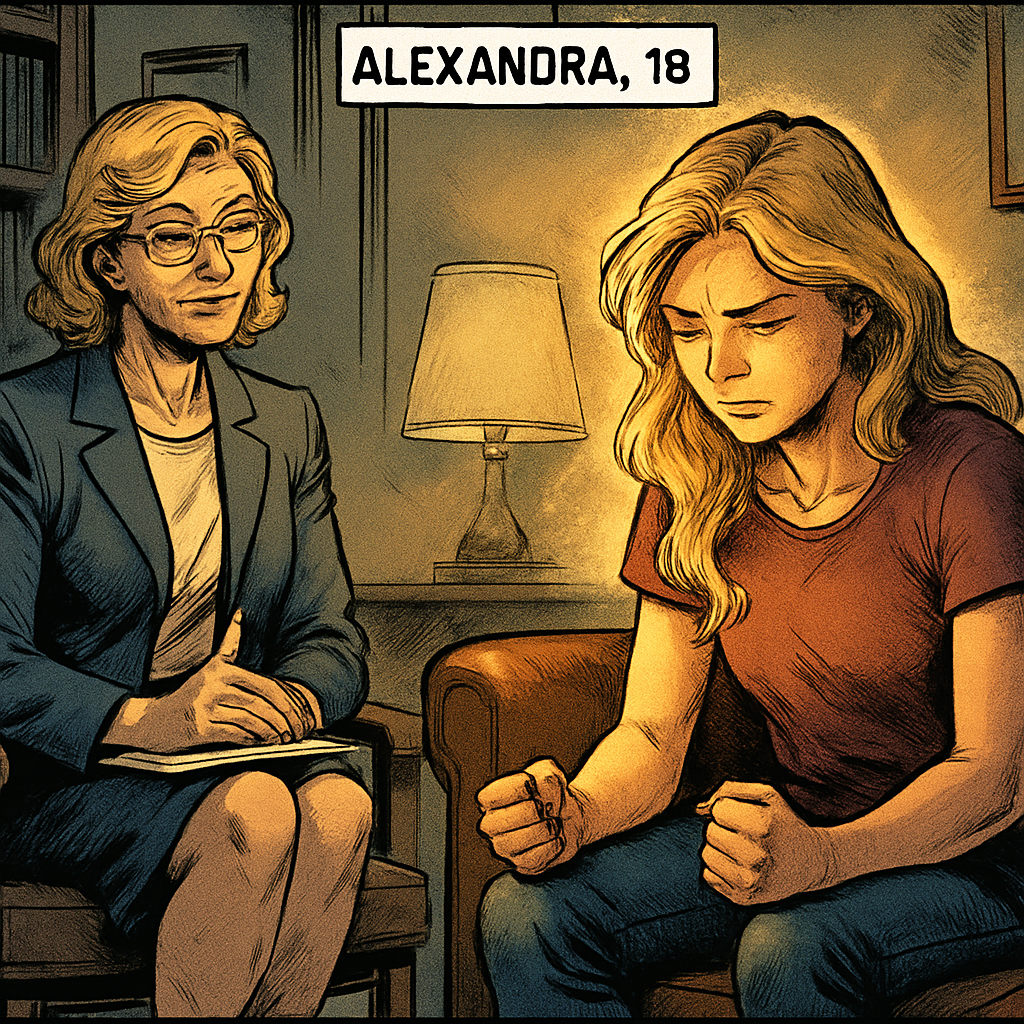
They say you will forget most of your clients—occupational necessity. But some stories stick with you, carving out permanent residence in your professional memory. Alexandra was one of those clients who walked into my Manhattan office on a rainy Tuesday, clutching her umbrella like it might shield her from more than just the weather.
She was 18, poised on the precipice between childhood and adulthood, dressed in the careful uniform of someone trying to be taken seriously. But it was her eyes that caught me—clear, unflinching, and carrying the unmistakable weight of someone who’d been forced to grow up too quickly.
“My sister told me I should be raped to teach me respect,” she said without preamble, settling into my leather couch. No tears, just a flat statement of fact.
And there it was—the kind of opening line that makes you set down your coffee and realize you won’t be checking your watch for the next fifty minutes. ⏰
We’ve created this cultural mythology that blood is thicker than water, that family bonds are somehow sacred and unbreakable. Alexandra’s story was a stark reminder of how dangerous that narrative can be.
Her older sister had married a man who saw Alexandra’s youth as both threat and invitation. When he made inappropriate comments about her body and verbally threatened her with sexual violence at a family gathering, Alexandra’s sister didn’t just fail to protect her—she actively sided with her husband.
Family estrangement isn’t the failure we make it out to be. Sometimes it’s the healthiest response to a toxic situation. Sometimes it’s survival. 🛡️
💔 The Grief Nobody Talks About
When a family member dies, casseroles appear at your door. When you cut off contact with a family member, people awkwardly change the subject.
Alexandra was mourning her sister—not the person who stood silently while her husband threatened violence, but the childhood playmate who once braided her hair and taught her to ride a bike. She was grieving the future relationship she’d always imagined they’d have.
This grief comes in waves:
- The shock of realizing the relationship isn’t what you thought 😲
- The anger at betrayal by someone who should have protected you 😡
- The bargaining (“If I just explained it better, maybe they’d understand”) 🤝
- The emotional numbness that serves as temporary shelter 🧊
- The acceptance that some relationships can’t—and shouldn’t—be saved ✅
I watched Alexandra move through these stages in our sessions, sometimes cycling through several in a single hour. The most painful part? Her mother’s insistence that she “be there” for her sister after a miscarriage, as though Alexandra’s boundaries were simply inconvenient obstacles to family harmony.
🦁 The Courage to Disappoint
One of the hardest emotional bytes to process is the disapproval of people we love. It creates a storm of conflicting needs—our need for safety battling our need for belonging, our identity needs colliding with relational ones.
Alexandra’s breakthrough came during our sixth session. Her mother had called, again pressuring her to reconnect with her sister. Alexandra had sent condolences for the miscarriage but refused further contact.
“I felt guilty for about ten minutes,” she told me. “Then I realized—I’m not responsible for fixing a relationship my sister broke. Her loss is tragic, but it doesn’t erase what happened.”
I’ve seen countless clients perform emotional contortions to avoid disappointing family members. Sometimes we allow ourselves to believe a narrative that says “I’m responsible for your feelings.” That’s allowing yourself to be a scapegoat. Alexandra was learning that healthy boundaries aren’t just wooden fences—they’re the invisible architecture of self-respect.
💡 Core Insight
Here’s what I’ve noticed after decades of watching people torture themselves over toxic family relationships: we confuse forgiveness with access. You can forgive someone from a safe distance, but reconciliation is a separate conversation entirely.
What made her story stay with me was watching her reclaim her power without hardening her heart. She maintained compassion for her sister, who was clearly in an abusive relationship herself, while refusing to make herself vulnerable to further harm.
She chose to send condolences from a distance—acknowledging humanity without compromising safety. That’s not coldness; it’s emotional intelligence of the highest order. 🧠💚
The greatest gift we can give ourselves is permission to outgrow relationships that diminish us, even when those relationships share our DNA.
— Lola Adams, who knows that sometimes the bravest form of love is the boundary that says “no more” 🚧
Additional Resources:
PMC Research on Family Relationships and Mental Health
Healing Your Heart After Sibling Estrangement
The Living Loss: Family Estrangement Stages of Grief
Family Estrangement Support Groups
Mayo Clinic: Estrangement Grief Discussion