
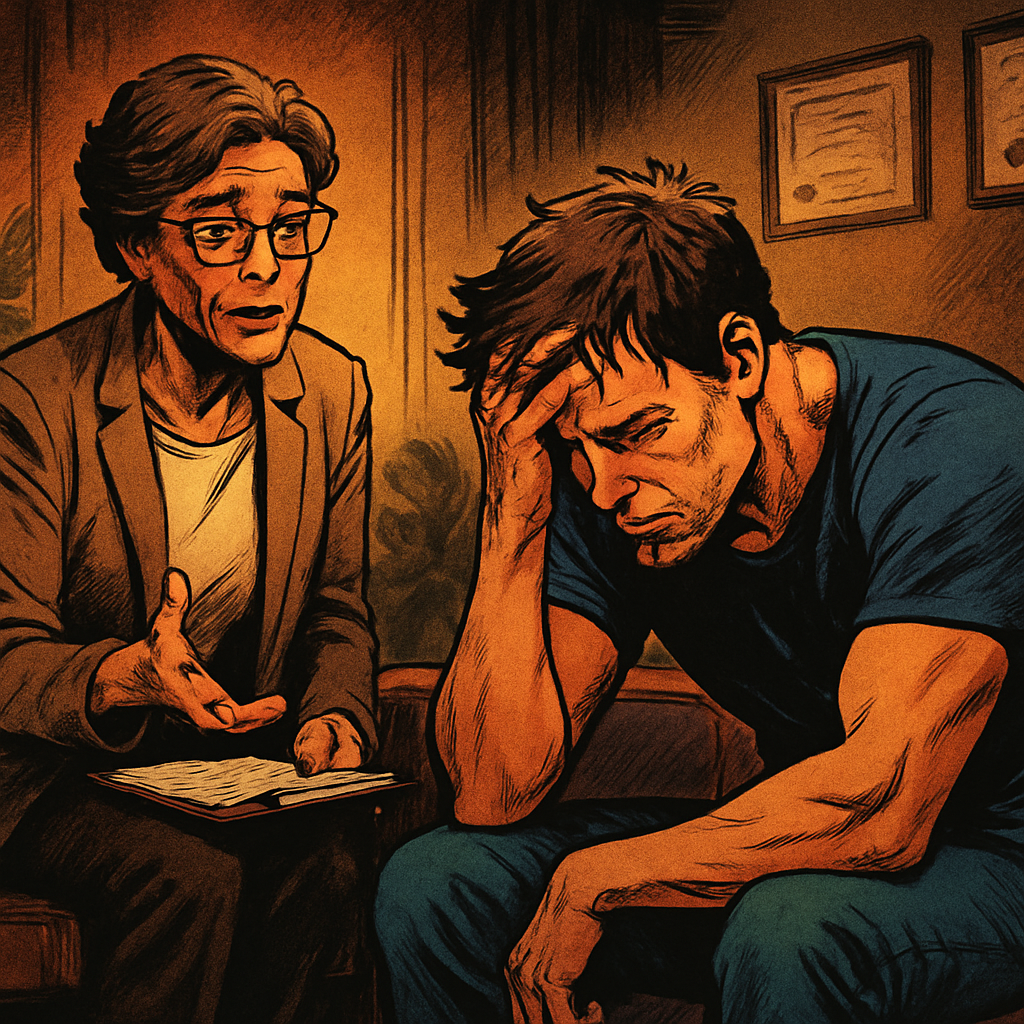
The first time Ethan K. walked into my office, he carried himself with the confident stride of someone who had everything figured out. Designer watch, perfect haircut, shoes that cost more than my couch. 💼 But beneath that meticulously crafted exterior was a man who couldn’t climax with his girlfriend of seven months.
“I think I broke my penis,” he whispered, collapsing into the chair opposite mine. 😔
This wasn’t a medical issue—it was what happens when your sexual response system has been wired to one very specific type of stimulation for over a decade. His admission came after several sessions: he’d been masturbating to increasingly specific pornography daily—sometimes twice daily—for fifteen years. His current girlfriend was the first real-life partner he’d had in years.
🔄 The Lonely Loop Your Brain Can’t Escape
What fascinated me about Ethan’s case wasn’t just the sexual dysfunction. It was how his emotional bytes—those packages of physical sensation, emotional charge, and narrative meaning—had become so rigidly programmed. His body had learned one path to pleasure, and it stubbornly refused alternatives.
“I feel nothing when we’re together,” he admitted during our third session. “I mean, it feels good physically, but there’s this disconnect. Like my brain is floating above, watching and judging.” 🧠
Research shows this disconnect isn’t rare. Your brain creates predictive models based on repeated experiences. Do something the same way thousands of times, and your nervous system optimizes for that specific pathway.
Ethan had a secret ritual he’d never told anyone: he would edge himself for hours while organizing his porn collection into elaborate categories before finally allowing release. This meticulous control had become central to his arousal—the complete opposite of the vulnerability required for intimacy with a partner.
💔 When Your Partner Becomes Collateral Damage
The most painful part of Ethan’s situation wasn’t his own frustration—it was watching his girlfriend internalize his dysfunction as her failure.
“She cried last night,” he said, staring at the floor. “Asked what she was doing wrong. I tried explaining it’s not her, but how can she believe that? What woman wouldn’t take it personally?” 😢
This is where emotional frames trap both partners. She interpreted his lack of climax through a frame of personal inadequacy. He viewed it through a frame of shame and broken masculinity. Both frames were reinforcing emotional scripts that made honest communication nearly impossible.
Ethan later revealed something telling: “When I’m with her, I keep thinking about how I must look, sound, perform. With porn, I don’t exist—I’m just watching. There’s no me to fail.”
✨ The Pathway Back to Presence
What most therapy approaches miss in these cases is that the issue isn’t just about sex—it’s about presence. Ethan’s nervous system had been trained to respond to scenarios where he was an observer, not a participant. His ability to experience pleasure had become dependent on emotional distance.
The turning point came when Ethan recognized his pattern wasn’t about stimulus intensity but about the complete absence of vulnerability. His porn use wasn’t just a habit—it was an elaborate defense mechanism protecting him from the messiness of real intimacy. 🛡️
“I realized I’ve been having sex with my own imagination for fifteen years,” he said in our eighth session. “My girlfriend isn’t competing with porn actresses. She’s competing with the perfect scenario I’ve built in my head where I never have to be seen.”
Working with Ethan meant helping him identify the invisible structures that had shaped his sexuality—the unspoken rules and expectations he’d internalized about performance, pleasure, and masculinity. We had to increase his emotional granularity around intimacy, breaking down the overwhelming “I’m failing” bubble into manageable specifics about sensations, emotions, and needs.
The most powerful realization for Ethan wasn’t about techniques or exercises. It was recognizing that his sexual response system wasn’t broken—it was perfectly optimized for the wrong environment.
🎯 Core Insight
Your pleasure isn’t broken; it’s just been programmed for a world that doesn’t exist.
Still wondering about Ethan’s progress? Let’s just say his girlfriend eventually stopped crying after sex. For entirely different reasons. 😌
– Sophia Rivera, who believes the most interesting confessions happen after clients leave the room
📚 Additional Resources:
Psychology of Premature Ejaculation – Hims
Association of Anxiety Subtypes and Premature Ejaculation
Translational Andrology and Urology Research
PubMed Study on Sexual Dysfunction
Clinical Research on Ejaculatory Disorders
Journal of Sexual Medicine Research