
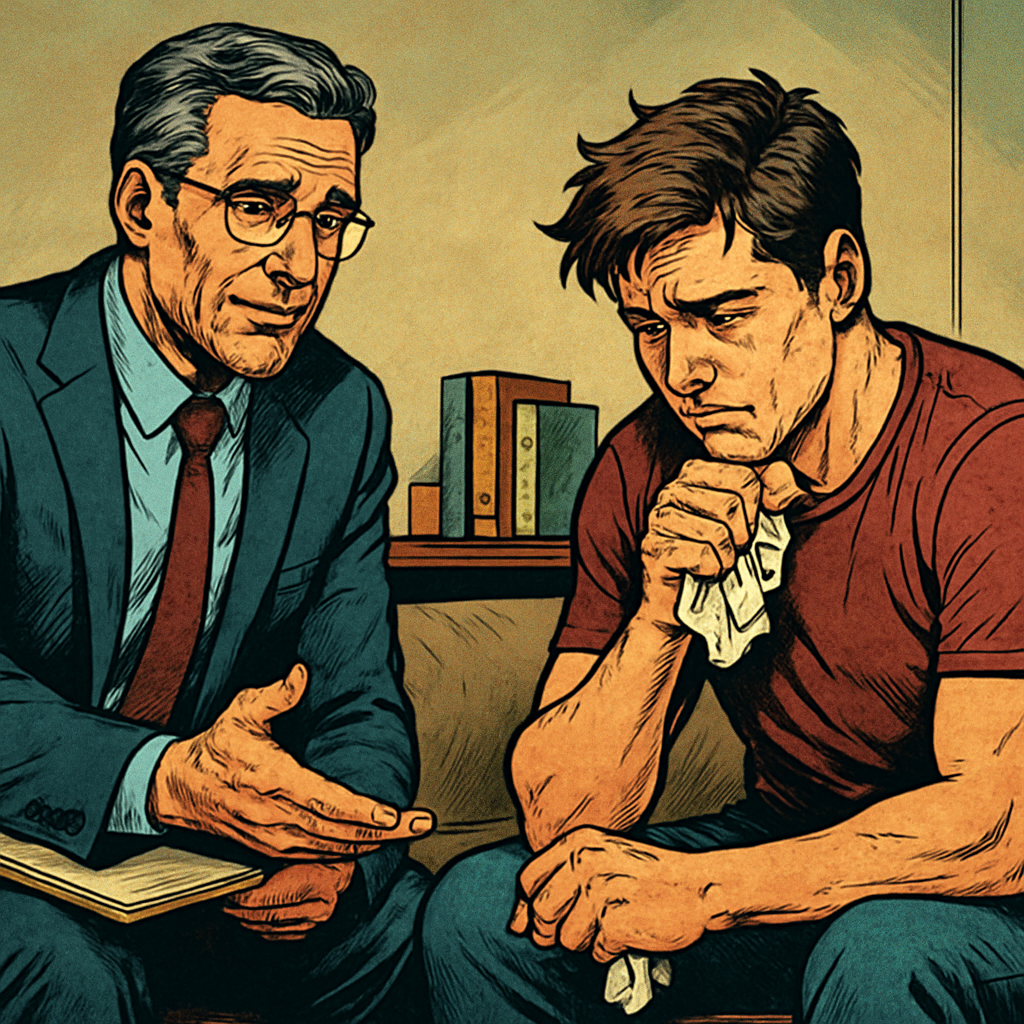
The hardest cases are always the ones where a client is trapped in someone else’s psychological prison. I remember sitting across from Austin, watching him absently fold a tissue into increasingly smaller triangles as he told me about his mother’s unexpected call. His father—the man who had beaten them both, threatened to kill Austin, and effectively held his mother hostage for decades—was finally dead. But somehow, the abuse wasn’t over.
“She’s defending him,” Austin said, looking up with bewilderment. “She’s threatening to cut me off if I don’t ‘respect’ the man who made our lives hell.” The tissue had disappeared into his clenched fist.
🛡️ The Protector Who Couldn’t Save Her
Austin had been kicked out at 18, homeless and traumatized. What stayed with me was his peculiar habit of taking a deep breath three times whenever we’d start a session, a habit from his traumatized childhood.
He had once confided that he still kept a box of his mother’s stolen belongings: a lipstick, a scarf, even strands of her hair he’d collected after his father had pulled it out during an attack. “I thought someday I could give them back to her,” he told me, “when she was free.” It was both heartbreaking and, I admit, somewhat unsettling.
🔗 The Invisible Prison of Trauma Bonding
What Austin was witnessing wasn’t unusual, though it feels incomprehensible from the outside. His mother wasn’t simply “brainwashed”—she was caught in a complex web of emotional patterns that had completely rewired her perception of reality. After decades of abuse, her inner voice had merged with her abuser’s. The cruel paradox is that the death of her husband likely triggered not relief but a profound identity crisis.
Who is she without him? What frame of reference does she have for understanding herself?
Research consistently shows that long-term abuse creates emotional scripts that become so deeply embedded they feel like natural law. Her defense of him isn’t Stockholm Syndrome—it’s her mind desperately trying to maintain coherence in a world that suddenly makes no sense.
💔 You Can’t Fix Someone Who Isn’t Broken (In Their Own Eyes)
The brutal truth I had to help Austin understand was this: his mother doesn’t see herself as someone who needs fixing. The narrative she’s constructed—that her husband was misunderstood, that his behavior was justified—serves a critical psychological function. It creates coherence. It prevents her from having to face the devastating reality that she spent decades with someone who systematically destroyed her sense of self.
When Austin pushed her to acknowledge the abuse, he wasn’t just challenging her view of her husband—he was inadvertently threatening her entire identity framework. Her emotional patterns around safety and stability are fundamentally linked to defending this man, even in death.
🔄 The Counterintuitive Path Forward
The advice I gave Austin surprised him, and it might surprise you too. I didn’t tell him to stage an intervention or bombard his mother with evidence of abuse. Instead, I suggested he temporarily stop trying to get her to acknowledge the truth.
“But if she doesn’t get help, she’ll never heal,” he protested.
“She’ll never heal if she feels attacked,” I countered. “Right now, your truth feels like an existential threat to her.”
The path forward wasn’t about confronting her defenses head-on but creating a space where those defenses weren’t necessary. This meant:
- Accepting her where she is, not where he wants her to be
- Creating safety through consistency, not confrontation
- Allowing her to develop new emotional scripts at her own pace
The hardest part for Austin was accepting that his mother might never fully acknowledge what happened. Some wounds are too deep, some stories too thoroughly embedded in our emotional operating system. And that’s okay.
💡 What Really Matters
Ultimately, Austin’s desire to help his mother get therapy wasn’t really about therapy at all—it was about validation. He needed her to confirm his reality, to acknowledge that what they both suffered was real and wrong. But sometimes, the most loving thing we can do is let go of our need for others to validate our experience.
Austin eventually stopped pushing her to see a therapist and instead focused on building a relationship on new terms. They never discussed his father again. Was this a perfect resolution? No. But it was real, and it allowed both of them to move forward.
Core Insight: Sometimes the bravest act of love is letting someone keep their defenses when they’re not ready to live without them. 🕊️
Signing off while wondering if we’re all just one conversation away from realizing we’ve been telling ourselves the wrong story this whole time,
Sophia Rivera
📚 Additional Resources:
Newport Institute – Parent Involvement in Treatment
Research on Family Trauma and Recovery
Understanding Complex Trauma Responses
How Parents Can Heal Rifts with Adult Children
Academic Research on Parent-Child Relationships