
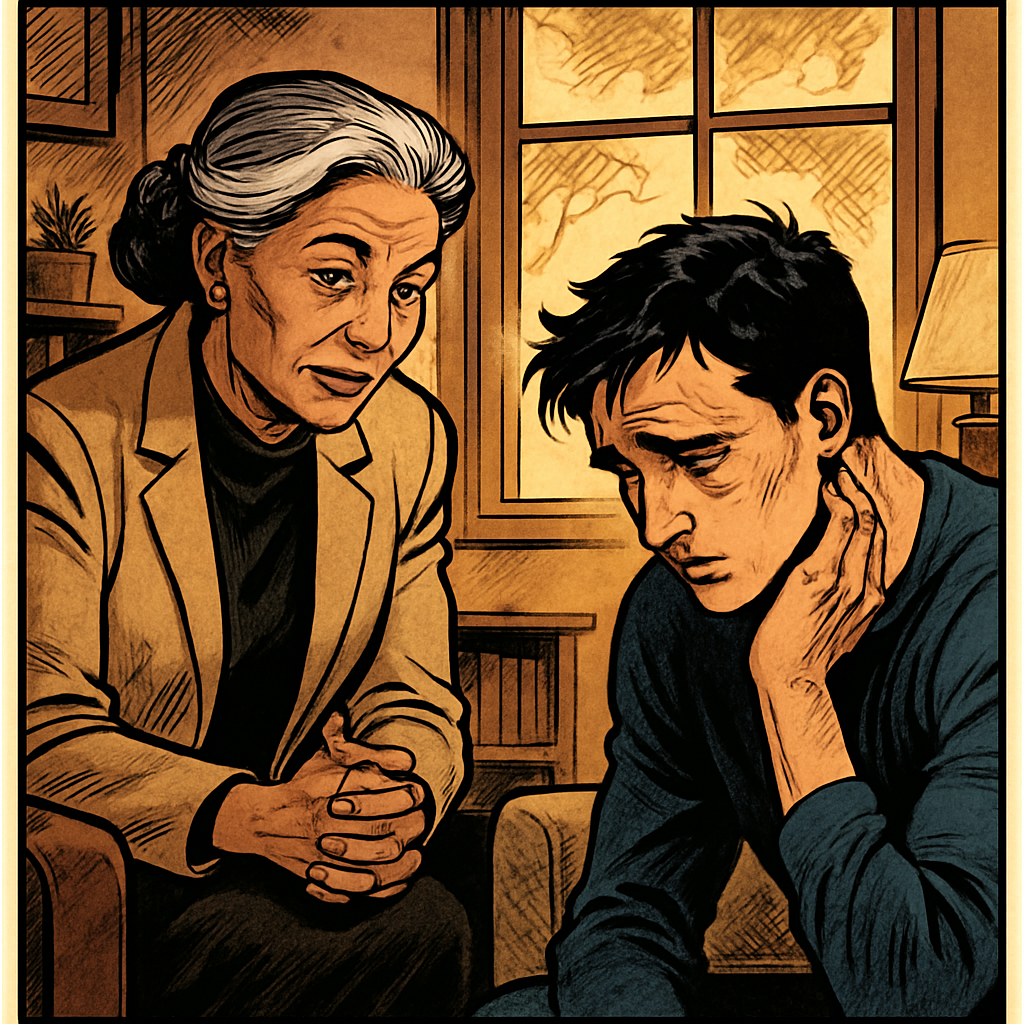
☕ I remember meeting Gabriel in a coffee shop, not my usual location for first sessions. The moment he sat down, he arranged his spoon, napkin, and coffee cup in perfect alignment – a subtle hint at the order he was desperately trying to bring to his chaotic emotional landscape.
“I need to talk about my best friend,” he said, eyes darting between my face and his meticulously arranged table setting. “But it’s… complicated.”
Gabriel had this habit of tugging at his earlobe whenever he approached an uncomfortable truth – a tell I noticed within minutes of our conversation. By our third session, I could practically time his revelations by watching his hand drift upward.
💔 When Friendship Gets Complicated
Gabriel was experiencing what I now recognize as a classic case of emotional frame collision. Here was this 21-year-old guy whose entire understanding of attraction and identity was suddenly being rewritten by his feelings for his trans female best friend. What struck me wasn’t his attraction – that was perfectly normal – but the elaborate architecture of confusion he’d built around it.
“I get physically sick when she talks about her dates,” he confessed during our fourth session. “Last week, I pretended I had food poisoning to get her to cancel a date. Who does that?”
During our sessions, I discovered Gabriel had a secret ritual whenever his friend texted him. He would immediately drop whatever he was doing, place his phone precisely 12 inches from his keyboard, and wait exactly three minutes before responding – regardless of how urgent or casual the message. “If I answer too quickly, she’ll know,” he explained, never finishing the sentence.
This meticulously crafted ritual was his way of maintaining the illusion of casual friendship while his emotional reality was anything but casual.
🧠 The Hidden Pattern of Trans-Attraction
What research makes abundantly clear – but rarely states outright – is that attraction to trans women isn’t some exotic deviation from the norm. It’s simply attraction, full stop. Gabriel’s struggle wasn’t about who he was attracted to, but about the stories he told himself about what that attraction meant.
Gabriel’s emotional scripts were running on outdated software. Every time he felt a flutter of attraction, his inner voice immediately labeled it as “confusion” or “just being supportive” – anything but the straightforward romantic and sexual attraction it actually was.
“I had this dream where we were just holding hands at a movie,” he admitted in session six, blushing furiously. “Nothing sexual. Just… together. I woke up crying.”
That dream revealed more than any analysis could – his emotional landscape contained not just attraction, but tenderness, companionship, and recognition.
🔍 The Real Problem Wasn’t the Attraction
The breakthrough came when Gabriel finally articulated his deepest fear: “What if I’m just another fetishizing asshole?”
He had read enough online discourse to know the valid concerns about cis men who reduce trans women to exotic experiences rather than full human beings. This fear had created an emotional frame that distorted all his genuine feelings.
Gabriel’s problem wasn’t transphobia – it was that he assumed any attraction he felt must be transphobic. The meta-emotional failure wasn’t in having the feelings, but in his interpretation of what those feelings meant about him.
In our final sessions, I watched Gabriel develop what I’d call emotional granularity – the ability to distinguish between fetishization (which centers on body parts and otherness) and genuine attraction (which encompasses the whole person).
✨ The Transformation
“Last night I told her I had feelings for her,” he reported in our final session, not a hand near his earlobe. “She said she needed time to think. But here’s the weird thing – I’m okay with that. Whatever happens, I’m not confused anymore.”
Whether Gabriel and his friend eventually dated isn’t really the point. The transformation was in his relationship with his own emotional landscape – from confusion to clarity, from shame to authenticity.
💡 Core Insight: Sometimes the love story that matters most is the one where you finally recognize yourself.
Until next time — and remember, your attraction isn’t weird, but your rituals might be 😉
— Sophia Rivera
“`html
References
- Ward, E., Bouman, W. P., et al. (2016). The Role of the Illusion in the Construction of Erotic Desire
- Jones, B. A., Tasker, F., et al. (2023). When Cisgender, Heterosexual Men Feel Attracted to Transgender Women: Effects on Gender Norms and Attitudes
- Surace, F. (2020). Attraction to Transgender People
- Robinson, B. A. (2023). Study Examines Straight Men and Their Sexual Attraction to Transgender Women (Men & Masculinities)
- Hsu, K., Rosenthal, L., Miller, S., & Bailey, J. M. (2019). Not Kink or Fetish, but a Legitimate Sexual Orientation
- Bouman, W. P., Gravestock, H., et al. (2022). Transamorous Misogyny: Masculinity, Heterosexuality, and Cis Men’s Desire for Trans Women
Key Takeaways
- The Role of the Illusion in the Construction of Erotic Desire explores the diversity of erotic attraction men have towards trans women, identifying patterns such as attraction to the individual rather than the group, interest motivated by challenge to traditional gender binaries, and erotic fascination with physical features. Key findings reveal men’s complex narratives about desire including emotional and social connections evolving from initial sexual interest. This is relevant in understanding the client’s confusion over feelings for a trans friend and deepening emotional attachment beyond physical attraction.
- When Cisgender, Heterosexual Men Feel Attracted to Transgender Women investigates how attraction to trans women can lead men to reinforce traditional masculine norms and sometimes bolster anti-gay attitudes to protect their heterosexual identity. It highlights internal conflict due to norm violations, explaining defensive behaviors like jealousy and confusion as seen with the client, who struggles with attraction and ideas of masculinity and heteronormativity.
- Attraction to Transgender People gives an overview of research on cisgender men’s attraction to trans women, noting that many identify as straight or bisexual but have distinct arousal and emotional patterns from typical heterosexual or homosexual attractions. Insights detail how sexual orientation frameworks inadequately capture these experiences, illuminating the client’s challenge in labeling his feelings and sexual identity toward his trans friend.
- Study Examines Straight Men and Their Sexual Attraction to Transgender Women finds that misogyny often underpins expressed desire for trans women, manifesting in beliefs about control and comparative gender diminishment. This study introduces “transamorous misogyny,” showing how men assert masculinity while desiring trans women, which connects to the client’s hesitation and fear about whether his attraction is compatible with his respect for and wish to maintain a healthy friendship.
- Not Kink or Fetish, but a Legitimate Sexual Orientation presents the concept of “trans-attraction” as a valid sexual orientation encompassing both physical and emotional dimensions. It critiques pathologizing views and fetishization, advocating for social acceptance and understanding of cisgender men’s attraction to trans women. The article’s content assists in normalizing and validating the client’s feelings beyond stigma or fetish, fostering self-acceptance and self-awareness.
- Transamorous Misogyny: Masculinity, Heterosexuality, and Cis Men’s Desire for Trans Women examines how men reconcile their attraction to trans women within hegemonic masculinity frameworks, often through dichotomous thinking about cis and trans women, yet finding emotional connection benefits in relationships with trans women. This dual experience of connection and societal pressure mirrors the client’s inner conflicts, jealousy, and valuation of friendship alongside emerging romantic feelings, offering pathways for identity negotiation and relational understanding.
“`